
As attention shifts to the Strait of Hormuz and the war with Iran, some European leaders still appear to hope that transactional diplomacy with Donald Trump might preserve American backing for Kyiv. That assumption looks increasingly fragile.
Europe is again confronting an uncomfortable strategic question: can support for Ukraine still be secured through Washington, or must Europeans now prepare for a far greater burden of their own?
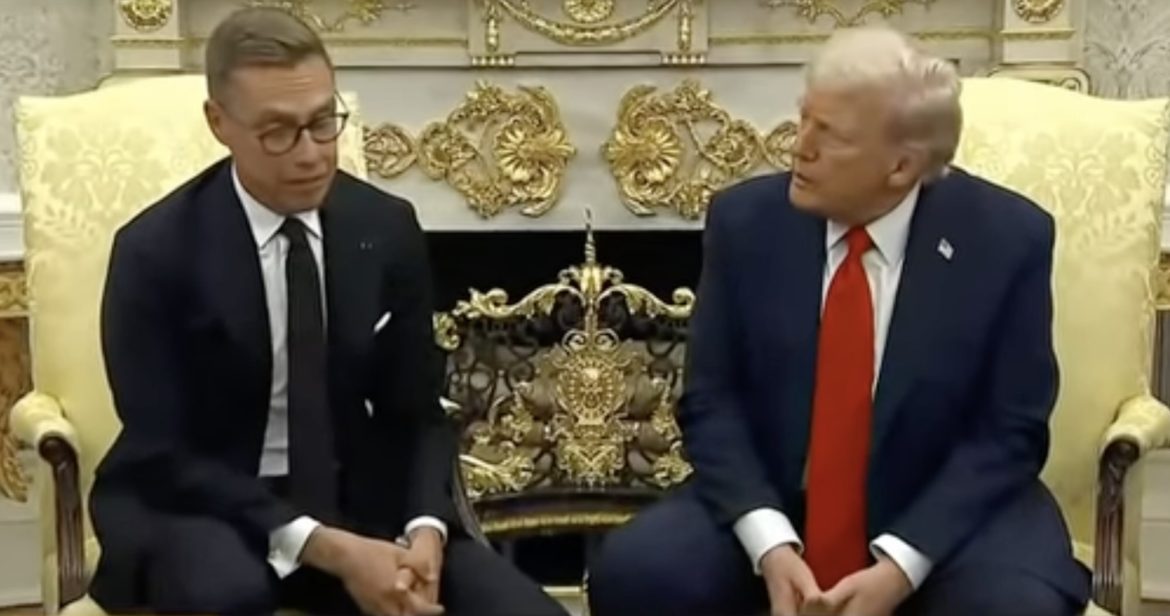
The issue has sharpened amid fresh remarks by Finnish President Alexander Stubb, who said NATO allies should take Donald Trump at his word when he ties the alliance’s future to support over the Strait of Hormuz. In his Bloomberg interview, Stubb said he had “no illusions” about being a “Trump whisperer”, while making clear that Europe must respond to the United States as it now behaves, rather than through outdated expectations about the transatlantic relationship. The point was not that a bargain with Trump can be trusted, but that European leaders must reckon with a harder and more transactional strategic environment.
That broader concern now intersects with two simultaneous crises: the absence of meaningful progress in efforts to end Russia’s war against Ukraine, and the growing confrontation around the Strait of Hormuz. The temptation in some quarters is to connect the two, on the theory that Europe might help the United States in the Gulf and, in return, obtain firmer American commitments to Kyiv.
On paper, the logic may appear plausible. Trump has long treated foreign policy as a sequence of bargains rather than as a framework of alliances and shared obligations. If Washington wants help in the Gulf, some may conclude that Europe should try to exchange that help for continued arms, funding and political backing for Ukraine.
In practice, that calculation looks weak.
First, there is little evidence that the diplomacy on Ukraine is moving towards a genuine settlement. Even the Kremlin has recently felt obliged to deny reports that the process is “fizzling out” as Trump’s attention shifts towards Iran. That denial itself is revealing: it reflects how widespread the perception has become that Ukraine is no longer at the centre of Washington’s strategic focus. Reuters reported this week that Moscow rejected suggestions the process was stalling, while AP reported that Zelenskyy and Keir Starmer were urging continued support precisely because the Iran war was already diverting attention and resources.
Secondly, Europe has shown no appetite for entering a US-led military effort in the Gulf on Trump’s terms. EU foreign policy chief Kaja Kallas said this week that there was “no appetite” to expand the EU’s Aspides naval mission to the Strait of Hormuz. French President Emmanuel Macron went further, stating that France would “never” take part in operations to reopen the strait while hostilities continued. Those positions matter because they demonstrate that the practical basis for any such bargain is extremely thin.
The military realities also argue against easy assumptions. The threat to Hormuz is not simply a matter of dispatching additional allied ships. Iran has disrupted the strait using drones, missiles and mines, while maritime and energy markets have already begun rerouting flows around the chokepoint where possible. Around 20 per cent of global oil and gas shipments normally pass through the strait, which means even partial disruption has immediate global consequences.
That is why the idea of a straightforward European quid pro quo with Trump appears unrealistic. Europe is in no position to offer a decisive solution in the Gulf, either militarily or politically. Nor is there much reason to believe that Trump, even in return for increased European support, would provide durable guarantees for Ukraine. His angry response to allied refusals, together with his repeated doubts about NATO itself, only underlines how unreliable such a bargain would be.
The deeper problem for Kyiv is industrial as much as diplomatic. As the Middle East conflict expands, US military attention and production capacity are increasingly pulled towards air defence, missile interception and force protection in another theatre. Ukrainian officials fear exactly that outcome: that a widening Iran war will drain attention, matériel and urgency away from Ukraine.
The conclusion for Europe is not dramatic, but it is clear. There is no sign of a decisive peace process with Russia. There is no convincing evidence that Hormuz can be turned into leverage for Ukraine. And there is no guarantee that Trump, even if approached in explicitly transactional terms, will provide the level of support Kyiv requires.
For that reason, Europe would be better advised to plan on the basis of endurance rather than diplomatic improvisation. That means stronger defence production, larger and more predictable military aid packages, and a more honest recognition that the war may continue with less American focus than before.
For countries such as Finland, which live with the immediate reality of Russia on their border, that conclusion is not abstract. But it now applies across the continent. Europe may still hope for US support. It can no longer base its strategy on it.

