
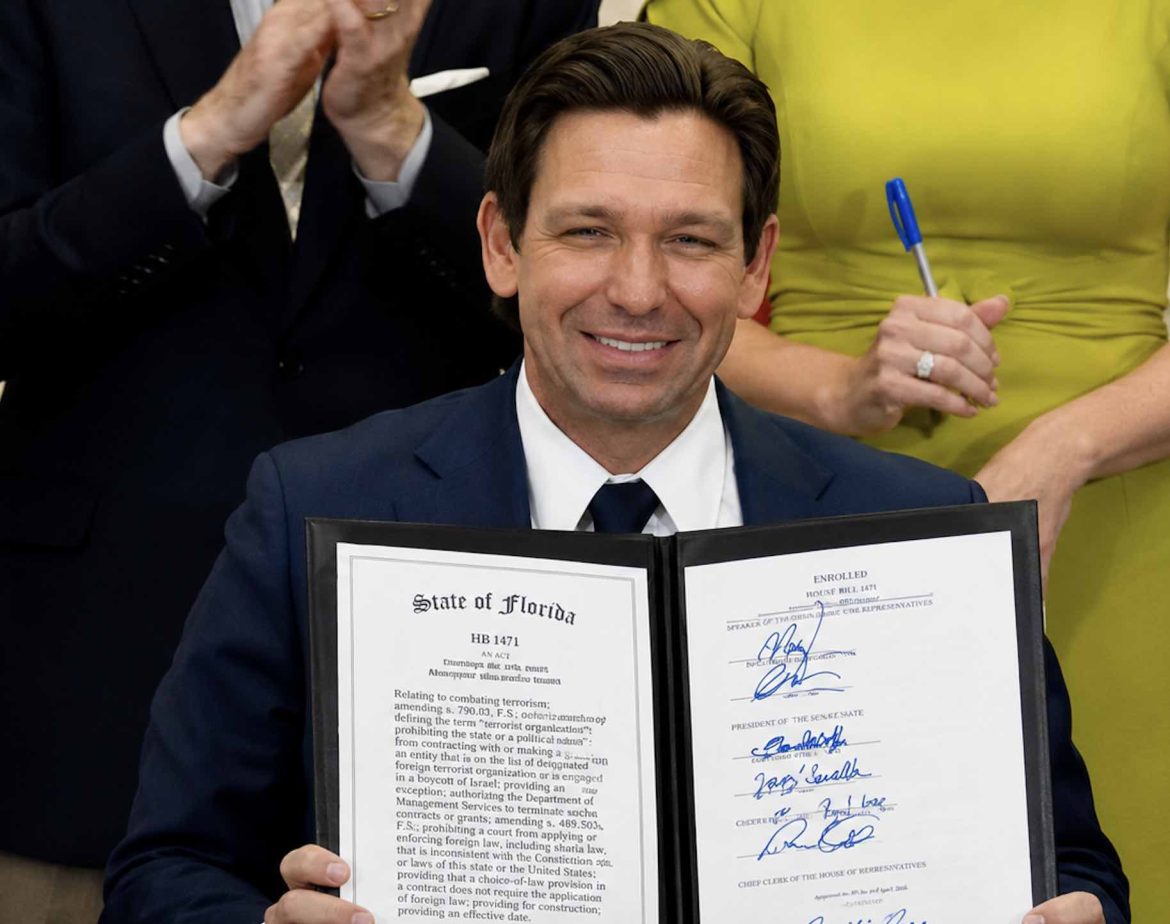
Florida Governor Ron DeSantis’s decision to sign HB 1471 into law has reignited a debate that extends far beyond American politics.
While the legislation has attracted attention for preventing Florida courts from enforcing provisions of Sharia law—or any other foreign or religious legal system—where they conflict with the US Constitution or state law, its broader significance lies in its reaffirmation of a principle that underpins every liberal democracy: that one system of civil law must ultimately govern every citizen equally. As Britain and much of Europe grapple with the challenges of increasingly plural societies, that constitutional clarity may offer lessons well worth examining.
The question has resurfaced in the United States following Florida Governor Ron DeSantis’s signing of HB 1471, legislation that prevents Florida courts and other adjudicatory bodies from enforcing provisions derived from religious or foreign legal systems where they conflict with either the US Constitution or Florida law. Although much of the political commentary has focused on the Bill’s references to Sharia law, the legislation is, in legal terms, considerably broader. It applies equally to any foreign or religious legal code whose application would undermine constitutional protections.
.
Whether one admires or opposes DeSantis’s politics is almost beside the point. The legislation raises an important question that deserves sober consideration far beyond Florida’s borders: should liberal democracies explicitly reaffirm that civil law must remain supreme in every circumstance?
For Britain—and perhaps eventually the EU—that is becoming an increasingly difficult question to avoid.
The United Kingdom has long accommodated religious practice within its legal framework. Jewish Beth Din courts have operated for generations, primarily dealing with family and commercial disputes through voluntary arbitration. Islamic Sharia councils have likewise emerged over recent decades, principally advising on matters such as religious divorce and marriage.
Supporters argue that these institutions simply provide faith-based arbitration voluntarily chosen by participants. Critics, however, contend that the distinction between voluntary and social obligation is not always clear, particularly where vulnerable individuals may experience significant familial or community pressure.
Several official reviews have reflected these concerns. The independent review chaired by Professor Mona Siddiqui in 2018 acknowledged that while many Sharia councils perform valuable religious functions, inconsistencies in practice and the absence of uniform regulation could leave some women disadvantaged, particularly regarding divorce and family rights.
Importantly, the review stopped well short of recommending abolition. Instead, it called for greater transparency, improved legal literacy and clearer protection of individual rights.
Florida’s legislation takes a different approach. Rather than attempting to regulate individual religious bodies directly, it simply reinforces a constitutional principle: any religious or foreign legal principle that conflicts with constitutional rights cannot receive recognition within the state’s legal system.
In one sense, this merely restates what constitutional lawyers would regard as obvious, yet modern politics increasingly demonstrates that what appears obvious in legal theory often benefits from legislative clarity.
Britain’s constitutional arrangements differ significantly from those of the United States. Parliamentary sovereignty, rather than a written constitution, remains the central organising principle. Nevertheless, the Human Rights Act, the Equality Act and centuries of common law collectively establish fundamental protections regarding equality before the law, due process and individual liberty.
Whilst those principles are widely accepted, what is less clear is whether Parliament should explicitly legislate to reinforce their absolute primacy whenever religious legal systems are invoked.
Critics would undoubtedly describe such legislation as unnecessary symbolism designed to address a problem that scarcely exists. They would point out, correctly, that English courts already refuse to enforce arrangements that contravene public policy or statutory rights.
Yet symbolism is not always without value. Constitutions themselves are, in part, symbolic documents. They communicate shared values while providing practical legal guidance. Explicit legislative statements can reassure the public that democratic institutions retain ultimate authority over matters of justice.
This broader constitutional argument becomes even more relevant when viewed through a European lens.
The European Union has consistently promoted the rule of law as one of its defining values, often invoking Article 2 of the Treaty on European Union when assessing member states’ judicial independence. Brussels has shown considerable willingness to intervene where it believes constitutional safeguards are under threat.
Yet the discussion has largely focused on institutional independence rather than the broader question of competing legal authorities.
Across Europe, governments have periodically confronted concerns regarding informal parallel justice systems operating within certain communities. These are rarely formal courts in any legal sense, but rather religious or communal dispute-resolution mechanisms whose influence derives from social authority rather than statutory recognition.
Most operate peacefully, and some undoubtedly provide valuable mediation services. However, where outcomes risk conflicting with national law—particularly regarding women’s rights, inheritance, marriage or divorce—the supremacy of civil law should never be ambiguous.
Florida’s legislation attempts to eliminate that ambiguity.
Its critics argue that singling out Sharia law risks stigmatising Muslim communities and fuelling unnecessary cultural conflict. That concern deserves serious consideration. Liberal democracies must avoid framing constitutional debates in ways that alienate law-abiding citizens on the basis of religion.
Equally, supporters counter that refusing to discuss potential tensions between religious norms and constitutional principles for fear of causing offence serves neither integration nor social cohesion.
Indeed, genuine religious freedom depends upon a neutral state capable of protecting believers and non-believers alike under one common legal framework. This distinction is crucial.
HB 1471 does not prohibit Muslims from practising Islam. It does not criminalise religious observance, restrict worship or interfere with voluntary personal adherence to Islamic principles. Rather, it establishes that when disputes enter the public legal sphere, constitutional law prevails. There is nothing controversial about this.
The United Kingdom has traditionally preferred evolutionary constitutional development over sweeping legislative declarations. Incremental reform has often served the country remarkably well.
However, demographic change, increasing religious diversity and heightened public concern regarding social integration suggest that clearer statutory affirmation may now be warranted.
Such legislation need not mention Islam at all.
Indeed, perhaps the strongest feature of Florida’s model is that its operative legal principle applies universally. Any religious or foreign legal doctrine—whether Islamic, Jewish, Christian, Hindu or otherwise—that conflicts with constitutional protections would simply have no legal effect.
That universality is precisely what protects against accusations of discrimination.
The European Union, meanwhile, is unlikely to legislate directly in this area, given that questions concerning family law, judicial organisation and constitutional identity remain primarily matters for member states. Nonetheless, the broader principle—that equal citizenship requires equal access to one unified legal system—aligns closely with the Union’s own commitment to equality, non-discrimination and the rule of law.
Ironically, adopting clearer national legislation may ultimately strengthen, rather than weaken, religious liberty.
Minority communities benefit most when everyone understands the boundaries between voluntary religious practice and legally enforceable civil rights. Certainty protects individuals from coercion while preserving freedom of belief.
Florida’s HB 1471 should therefore not be viewed simply as another episode in America’s increasingly polarised culture wars. Beneath the political rhetoric lies a constitutional proposition that merits careful examination.
Every liberal democracy rests upon a simple promise: that every citizen stands equal before the law. Maintaining that promise becomes more—not less—important as societies become increasingly pluralistic.
Britain and Europe need not replicate Florida’s legislation word for word. Their constitutional traditions differ, and their legal frameworks have evolved along separate paths. But the underlying principle—that civil law alone possesses ultimate legal authority within a democratic state—is neither uniquely American nor uniquely conservative.
It is, rather, one of the defining characteristics of liberal constitutional democracy itself.
At a time when public confidence in institutions is under pressure across much of the Western world, reaffirming that principle would not diminish religious freedom. Properly framed and universally applied, it could instead strengthen the very legal equality upon which genuine religious freedom ultimately depends.
Sharia, youth and the Republic: contested poll reignites debate on Islam in France
__________________________________________________________________________________________________________________
Click here for more News & Current Affairs at EU Today
Click here to check out EU TODAY’S SPORTS PAGE!
___________________________________________________________________________________________________________________

