
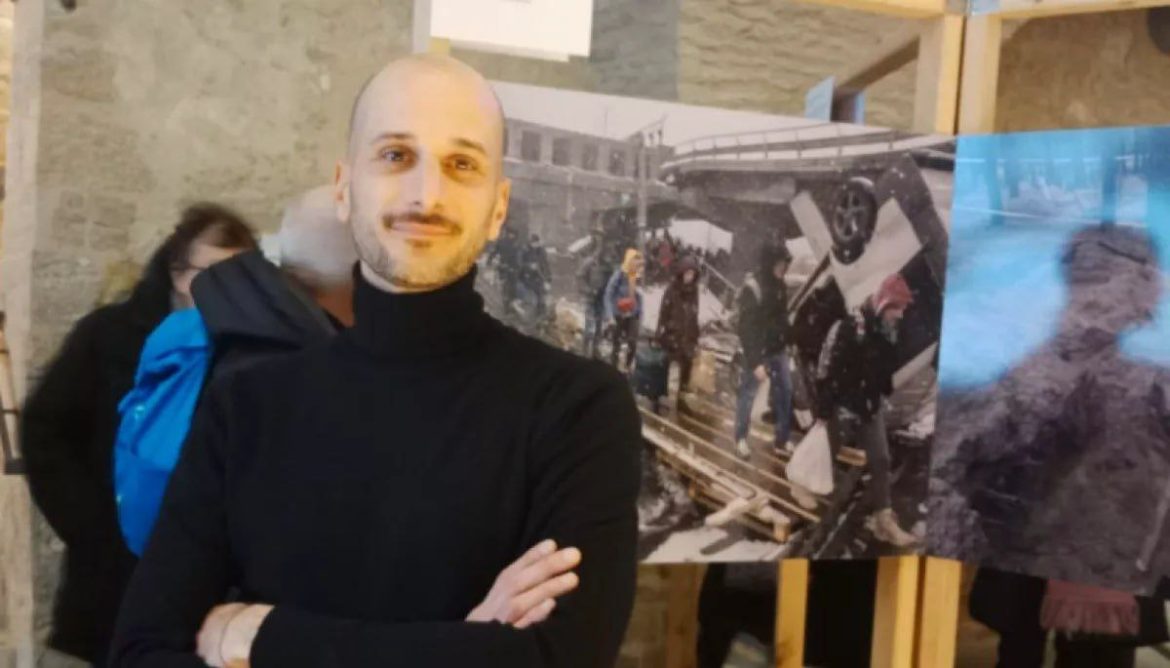
A French photojournalist, Antoni Lallican, was killed on 3 October in Donetsk Oblast when a Russian first-person-view (FPV) drone struck the vehicle he was travelling in during a reporting trip.
Ukrainian photographer and Kyiv Independent contributor Heorhiy Ivanchenko was wounded in the same incident. France’s Syndicat national des journalistes (SNJ) confirmed the death; media reports said the strike occurred in the morning near Druzhkivka. According to the SNJ, it is the first recorded case of a journalist being killed by a drone in Ukraine.
Ukrainian industry publications and official channels reported that the journalists were operating with protective equipment and in the presence of a military press officer. The 4th Separate Heavy Mechanised Brigade (4 ОВМБр) announced the incident on its social media, stating that the FPV drone targeted the car in which the two media workers were travelling. Local reports placed the attack close to Druzhkivka, around 15 kilometres from the front line.
Le Monde reported that the attack took place at approximately 09:20 local time. The same report named the injured Ukrainian colleague as Heorhiy (Heorhii) Ivanchenko. Detector Media, a Ukrainian media-monitoring outlet, also cited the European Federation of Journalists (EFJ) in reporting Mr Ivanchenko’s injury.
Mr Lallican, 38, held accreditation through the Hans Lucas agency, which distributes work to a wide range of French and international media. His photographs and reportage from conflict zones and social issues have appeared in Le Monde, Libération, Mediapart, Le Figaro and Paris Match, as well as German-language publications including Der Spiegel, Die Welt and Stern. He had been working in Ukraine since March 2022, documenting civilian life and military conditions in Donbas.
French broadcasters and newspapers reported that Mr Lallican had returned regularly to the region since the start of Russia’s full-scale invasion. BFMTV said he was on assignment about 15 kilometres from the front at the time of the strike. The channel cited Hans Lucas in confirming his identity and age.
Mr Lallican’s recent work received several awards and distinctions. In February 2025 he was named the 2024 laureate of the Victor-Hugo Prize for Committed Photography for his series on the war in Ukraine, exhibited at the Maison Victor-Hugo in Besançon. He was also shortlisted in 2024 for Reporters Without Borders’ Lucas Dolega–SAIF Photo Prize for a Donbas project. Earlier, in 2022, his work was recognised in the Grand Prix Paris Match Étudiant.
This incident adds to the toll of media workers killed since the start of the full-scale invasion. Prior French victims include Frédéric Leclerc-Imhoff of BFMTV, killed near Lysychansk in May 2022, and AFP video coordinator Arman Soldin, killed near Chasiv Yar in May 2023. Mr Lallican’s death would be at least the third of a French journalist in Ukraine since February 2022, according to compiled lists of journalists killed during the conflict.
The EFJ and SNJ called for a full investigation to establish the circumstances. Le Monde reported that the SNJ described the event as a war crime and emphasised the need to identify those responsible. Ukraine-based reporting groups also highlighted that the team had been working with visible press markings and standard protective gear at the time.
FPV drones—small, camera-equipped devices piloted in real time—have become a frequent weapon on both sides of the front. Their speed, precision and relatively low cost have made them a persistent hazard for military personnel and civilians, including emergency workers and journalists operating with escorts and accreditation. Ukrainian reports of the 3 October incident describe a targeted strike on the journalists’ vehicle rather than collateral damage from a wider area attack.
Mr Ivanchenko was taken to hospital and underwent surgery, according to Ukrainian photographers’ associations. As of the latest reports on 3 October, his condition was described as stable. The Kyiv Independent’s live updates later referenced the incident in their daily news feed.
Hans Lucas and French media carried obituaries and biographical notes on Mr Lallican’s career, which began with documentary projects and expanded to conflict reporting in Armenia and Nagorno-Karabakh in 2020, followed by multiple assignments in Ukraine from 2022. His portfolio indicates broader international work, including Haiti, India and the Middle East.

