
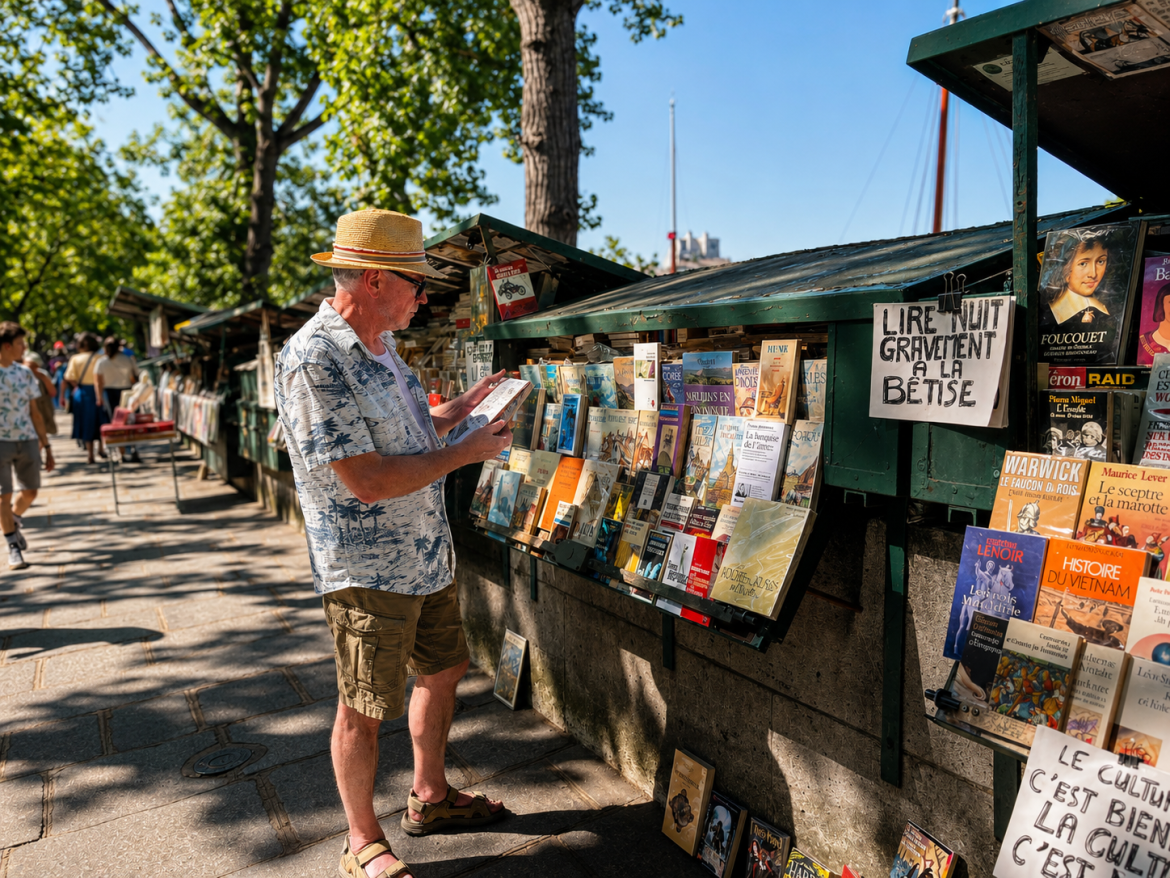
For nearly five centuries, the green bookstalls along the Seine have formed one of Paris’s most recognisable street traditions. The bouquinistes remain part book market, part cultural landmark, and part reminder that the French capital is still best explored slowly, on foot, and with time to browse.
The Seine has many claims on the visitor’s attention. It reflects the towers of Notre-Dame, frames the Louvre, divides the city between Left Bank and Right Bank, and carries much of Paris’s historical memory through its centre. Yet one of its most distinctive sights is not a monument, bridge or museum, but a line of dark green boxes fixed to the stone parapets of the quays.
These are the stalls of the bouquinistes, the second-hand and antiquarian booksellers of Paris. Their boxes open like small cabinets of paper, revealing old novels, art books, engravings, postcards, magazines, film posters, maps and occasional curiosities whose value lies as much in their setting as in their rarity. For many visitors, they are encountered almost by chance: a pause between two bridges, a glance at a cover, a conversation with a bookseller, or a print slipped into a suitcase as a reminder of the city.
The tradition is usually traced back to the mid-16th century, when the first book peddlers began setting up near the Sainte-Chapelle before gradually extending towards the Paris quays. In November 2025, the city’s bouquinistes marked their 475th anniversary, a reminder that this is not a picturesque modern invention, but one of the capital’s longest-running street trades. Over time, what began as informal commerce became a recognised Parisian institution. By the 19th century, the bouquinistes had become permanently associated with the banks of the Seine, and in 1891 the familiar fixed green boxes were formally authorised, allowing merchandise to remain on site rather than being removed each evening.
Today, the bouquinistes form what is often described as the world’s largest open-air bookshop. According to Paris je t’aime, the city’s official tourism office, nearly 240 bouquinistes operate about 900 boxes, offering more than 300,000 books and printed items, from antiquarian editions and rare volumes to posters, postcards, engravings, stamps and collectibles. The route is also one of the most attractive walks in central Paris. Stalls can be found near Notre-Dame, the Île de la Cité, the Latin Quarter, the Institut de France, the Louvre and the Pont des Arts, making them a natural part of a day spent moving through the historic centre rather than travelling from one attraction to another.
Their appeal lies partly in the fact that they resist standardisation. Paris has no shortage of carefully curated retail spaces, but the bouquinistes retain the uneven texture of a working tradition. Some boxes are heavy with old French literature, others with prints of Paris, cinema posters, art catalogues, political pamphlets, postcards or souvenirs. A visitor may find a serious antiquarian volume beside a reproduction poster or a box of loose engravings. The pleasure is in browsing without certainty.
There are rules behind this apparent informality. The bouquinistes are licensed and regulated by the city, and their boxes are not simply tourist props. Their trade remains tied to printed culture, even if tourism has changed the economics of the profession. Souvenirs may be sold, but books, prints and paper material remain central to the identity of the quays. That balance matters, because the bouquinistes have to survive in a city where changing reading habits, online commerce, tourist flows and the cost of living have altered the conditions of small-scale cultural trade.
Their position became unusually visible before the Paris 2024 Olympic Games. Security planning for the opening ceremony on the Seine initially raised the prospect of removing hundreds of book boxes from the quays. The proposal prompted opposition from booksellers and supporters, who argued that the stalls were part of Paris’s living heritage and that dismantling them could damage both the boxes and livelihoods attached to them. In February 2024, President Emmanuel Macron intervened in the dispute, requesting that security arrangements be adapted so that the bouquinistes would not be forced to move.
The episode underlined a wider question facing many historic urban traditions: how to protect everyday cultural life without turning it into a museum display. The bouquinistes are not a reconstructed heritage attraction. They are still traders, dependent on weather, footfall, tourists, collectors and regular customers. Their survival depends not only on official recognition, but also on people continuing to stop, browse and buy.
For travellers, they offer a different way of seeing Paris. A walk along the quays can begin near Notre-Dame, continue past the Île de la Cité and Saint-Michel, then follow the Left Bank towards the Institut de France and the Pont des Arts. It can be combined with the Louvre, the Latin Quarter or a visit to one of the city’s independent bookshops and cafés. But it is best not treated as a checklist item. The point is to look slowly.
The bouquinistes also make Paris feel less closed than some of its grander cultural institutions. A museum requires a ticket and a plan. The green boxes require only curiosity. They sit in public space, open to passers-by, turning the riverside into a place where books, images and memory are available without ceremony.
In a city often associated with large museums, major exhibitions and carefully managed visitor routes, the bouquinistes remain something more modest and more durable. Along the Seine, between the bridges and the monuments, Paris still keeps part of its literary life outdoors, in weathered boxes, watched over by booksellers who remain among the guardians of the river’s cultural landscape.

