
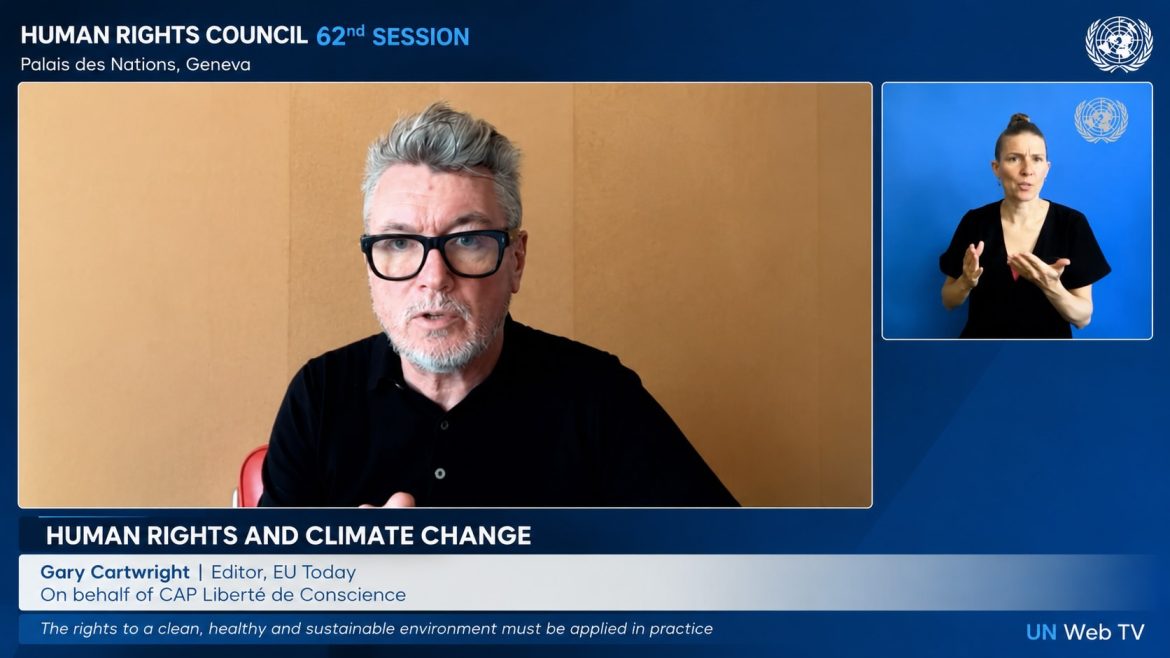
Gary Cartwright told the UN Human Rights Council that infrastructure projects in climate-sensitive mountain ecosystems must be subject to transparency, public participation and independent ecological review.
Gary Cartwright, Editor of EU Today, delivered an oral video statement at the 62nd Session of the United Nations Human Rights Council in Geneva, raising concerns over the environmental and human rights implications of the proposed China–Kyrgyzstan–Uzbekistan railway.
The statement was delivered on behalf of CAP Liberté de Conscience during the Council’s discussion relating to the mandate on human rights and climate change.
Mr Cartwright drew attention to the possible impact of the railway on fragile high-mountain ecosystems in Kyrgyzstan, warning that decisions on major infrastructure in such areas may have long-term consequences for biodiversity, water security, local livelihoods and climate adaptation.
“We wish to draw attention to the proposed China–Kyrgyzstan–Uzbekistan railway and its possible impacts on fragile high-mountain ecosystems in Kyrgyzstan,” he told the Council.
“These landscapes are particularly relevant as snow leopard habitat, to ecological connectivity, mountain watersheds and, importantly, local livelihoods. They are also increasingly vulnerable to climate change.”
The intervention follows the publication of an EU Today Research Desk White Paper examining the possible ecological risks associated with the Kyrgyz section of the railway. The paper focuses in particular on snow leopard habitat, protected species obligations, environmental disclosure and the need for route-level scrutiny before construction proceeds.
The White Paper is available for download here.
New EU Today white paper examines CKU railway’s ecological impact on snow leopard range
The China–Kyrgyzstan–Uzbekistan railway has been presented by its supporters as a major regional connectivity project linking China with Central Asia and onward markets. However, environmental concerns have persisted over the route through Kyrgyzstan’s mountainous terrain, where habitats are already affected by climate pressure, fragmentation and human activity.
Mr Cartwright stressed that the statement was not an objection to development or regional connectivity, but a call for the application of environmental safeguards before irreversible damage occurs.
“This is not an argument against development or against regional connectivity,” he said. “This is an argument for transparency, for public participation, and environmental due diligence before irreversible damage occurs.”
The statement called for the full publication of the Environmental Impact Assessment for the Kyrgyz section of the railway, disclosure of route-level documentation, independent ecological review, and meaningful participation by affected communities and civil society.
The issue is particularly relevant to the Human Rights Council’s work on climate change and the environment. The mandate of the Special Rapporteur on the promotion and protection of human rights in the context of climate change was established by the Council in 2021 and extended in 2024. The current session of the Council, HRC62, is taking place in Geneva from 15 June to 7 July 2026.
The EU Today Editor said the right to a clean, healthy and sustainable environment must be applied in practice, including in infrastructure projects affecting climate-sensitive ecosystems.
The EU Today Research Desk White Paper argues that major transport infrastructure in high-mountain regions should be assessed not only as an engineering or trade issue, but also as an environmental governance issue. It notes that snow leopard range, ecological corridors, river systems and mountain communities may all be affected by route selection, tunnelling, road access, construction traffic and associated development.
The paper also points to the need for public access to documentation. Without route-level information, independent experts, local communities and civil society organisations are unable to evaluate the likely impact on habitats, protected species and water systems.
The intervention at the Human Rights Council places the CKU railway within a wider debate on climate-sensitive infrastructure, biodiversity protection and the implementation of environmental rights. It also reflects scrutiny of how large connectivity projects are assessed when they pass through fragile ecosystems.
Mr Cartwright concluded by calling for environmental protection commitments to be treated as practical obligations rather than general principles.
“The right to a clean, healthy and sustainable environment must be applied in practice, including in infrastructure projects affecting climate-sensitive ecosystems,” he said.

