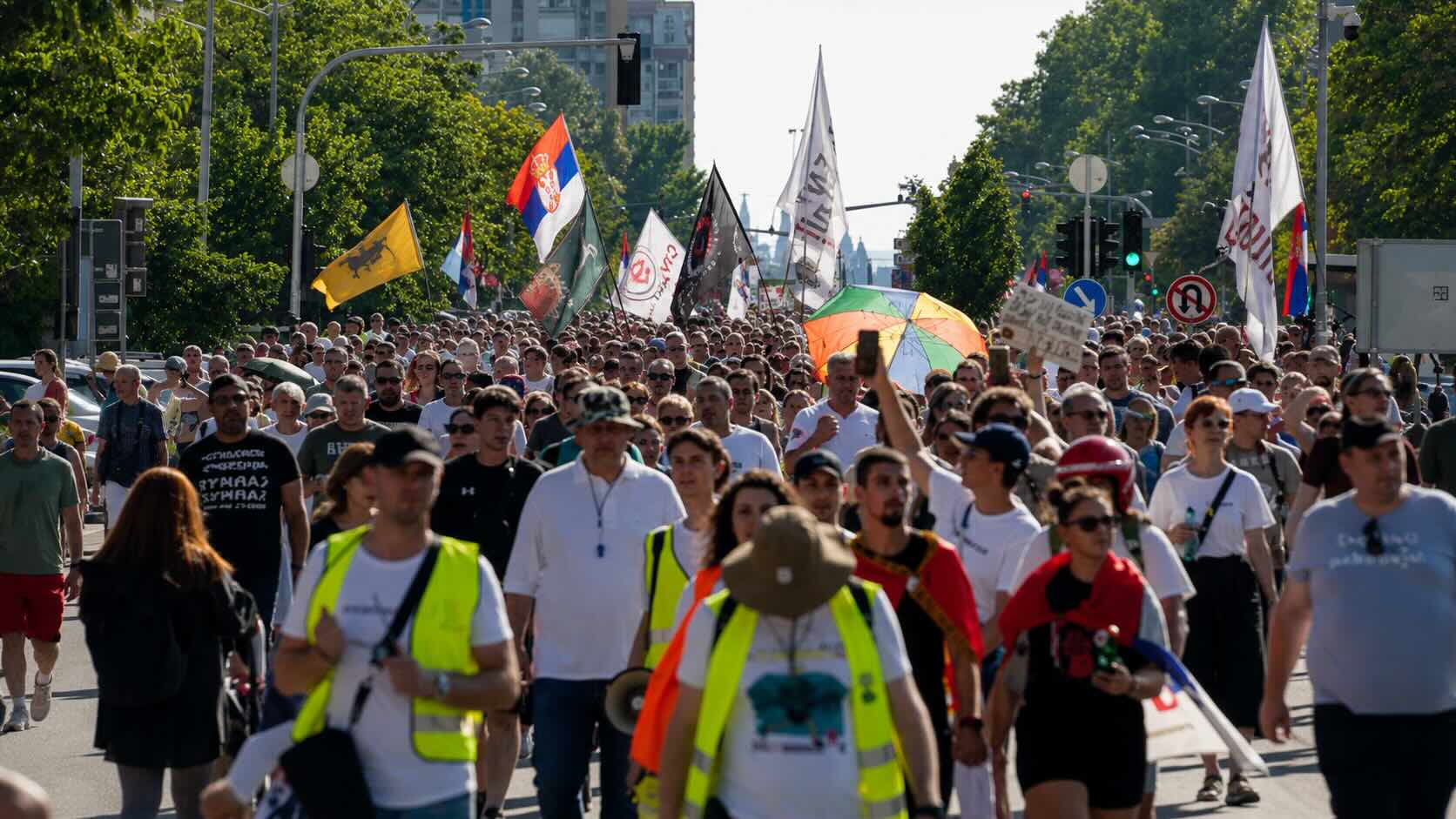
Serbia’s latest mass protest has turned a domestic accountability crisis into a wider test of the European Union’s approach to enlargement in the Western Balkans.
Thousands of people gathered in Novi Sad on 20 June to mark the deaths of 16 people killed when part of the city’s railway station collapsed in 2024. The protest, led largely by students, demanded early elections and renewed scrutiny of corruption, public procurement and political control under President Aleksandar Vučić and the ruling Serbian Progressive Party.
The Novi Sad disaster has become more than a local tragedy. Protesters and rights groups have presented it as evidence of deeper problems in construction oversight, public contracts and state accountability. The government denies allegations of corruption and mismanagement, but the scale and persistence of the protests have made the issue difficult to contain.
The 20 June rally matters because it connects public anger over the railway station collapse with demands for snap elections. Protesters argue that Serbia cannot address corruption or institutional capture without a fresh vote held under fair conditions. Vučić has said elections scheduled for 2027 could be brought forward, while announcing that his supporters would hold their own rally on 27 June.
That sets up a direct political confrontation. Serbia is not facing a single protest over one disaster. It is facing a sustained civic movement that links public safety, corruption, media freedom and electoral credibility. For Brussels, those are not marginal domestic issues. They sit at the centre of Serbia’s EU accession process.
Serbia has been an EU candidate country since 2012. Accession negotiations opened in 2014, and the Council says 22 negotiating chapters have been opened so far under the EU accession framework. But progress has remained constrained by rule-of-law concerns, relations with Kosovo, democratic standards and Serbia’s refusal to align fully with EU foreign policy, including sanctions on Russia.
That is why the Novi Sad protests have European relevance. Enlargement policy is not only a technical process of chapters and benchmarks. It also depends on whether candidate countries show credible progress on institutions, elections and accountability. A country where public anger over alleged corruption turns repeatedly into mass mobilisation presents Brussels with a political problem: how to keep the accession process alive without appearing to ignore democratic backsliding.
The EU has strategic reasons to keep Serbia engaged. Belgrade is central to Western Balkans stability, energy routes, migration management and the balance of influence between Europe, Russia and China. If Brussels disengages, it risks leaving more room for other powers. If it remains too cautious, it risks weakening its own conditionality.
That balance has become harder. Serbia’s government continues to present EU membership as a strategic objective, while maintaining close ties with Moscow and resisting full alignment with EU sanctions policy. The protests add another layer by questioning whether Serbia’s domestic institutions are moving closer to the standards required for membership or further away from them.
The student-led movement has also changed the political texture of the crisis. It has kept pressure on the authorities beyond the usual opposition structures and has turned the railway station collapse into a national symbol of accountability. Its demands are simple enough for a broad public: elections, responsibility and an end to impunity. That makes the movement harder to dismiss as a normal party-political dispute.
For EU policymakers, the question is whether Serbia’s accession path can continue on its current terms. The formal process remains open, but the political substance is under strain. Rule of law, media freedom, anti-corruption enforcement and free elections are not optional extras in accession talks. They are the basis on which enlargement is supposed to operate.
The Novi Sad rally does not by itself decide Serbia’s future. But it shows that the country’s domestic crisis is now inseparable from its European trajectory. If the government responds with limited concessions and controlled electoral timing, the protests are likely to continue. If Brussels treats the unrest as background noise, it risks sending the message that geopolitical convenience outweighs reform conditions.
Serbia remains too important for the EU to ignore. It is also too politically troubled for Brussels to treat accession as a routine process. The protests in Novi Sad have made that contradiction harder to manage.