
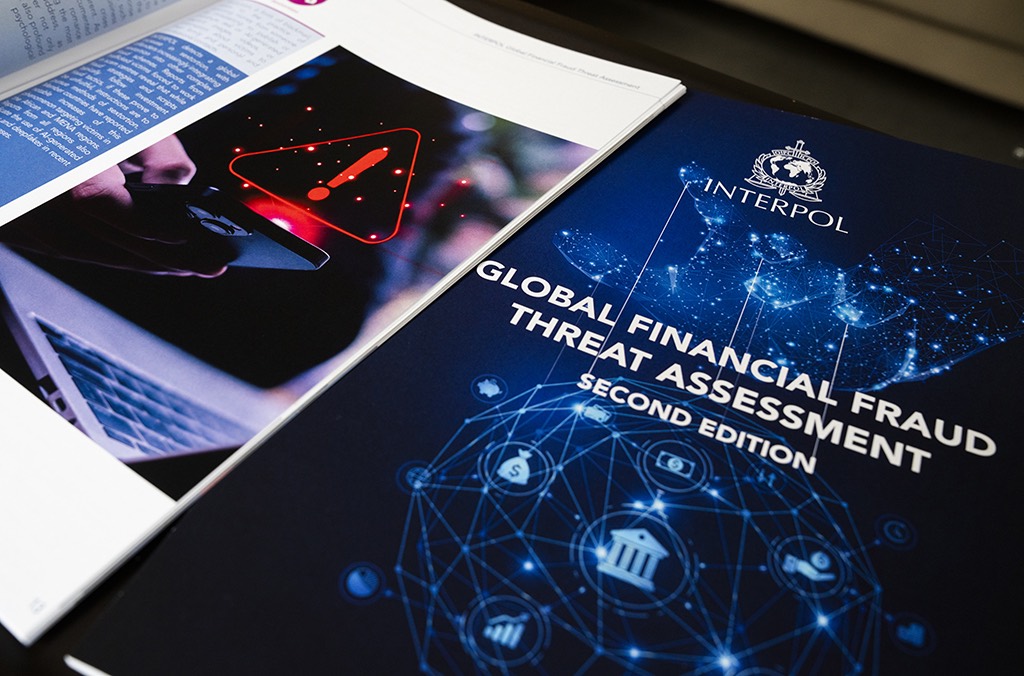
The world’s fraudsters, once the preserve of crude phishing emails and improbable lottery wins, have evolved into something far more formidable, INTERPOL has warned.
According to a newly published assessment by INTERPOL, financial crime has entered a new and troubling phase—one defined by industrial scale, technological sophistication and a reach that respects no borders.
The report, released this week, paints a stark picture of a global ecosystem in which organised crime groups deploy cutting-edge tools with increasing confidence. Fraud, it suggests, is no longer a peripheral nuisance but a central pillar of transnational criminal enterprise, fuelled by digital innovation and the anonymity afforded by online networks.
At the heart of this transformation lies technology. Criminal networks are exploiting artificial intelligence, cryptocurrencies and advanced social engineering techniques to refine their methods and expand their reach. What were once scattergun attempts to deceive have become carefully calibrated operations, often tailored to individual victims. Deepfake technology, in particular, has introduced a disquieting new dimension, allowing fraudsters to impersonate trusted figures with unnerving realism.
The scale of the threat is equally striking. Fraud now spans continents with ease, facilitated by the same interconnected systems that underpin legitimate global commerce. The report highlights how these crimes are increasingly integrated with other illicit activities, from money laundering to cyber intrusion, creating a web of criminality that is both resilient and difficult to dismantle.
This convergence has given rise to what might be termed a “fraud economy”—a sophisticated underground marketplace in which tools, services and expertise are traded with the efficiency of any legitimate industry. Cybercrime, INTERPOLnotes, has evolved into a “sophisticated underground economy reaching into every aspect of society,” affecting individuals, businesses and governments alike.
Recent enforcement efforts underscore both the scale of the problem and the challenges involved in combating it. In a major international operation spanning more than 70 countries, authorities dismantled tens of thousands of malicious servers and arrested dozens of suspects linked to phishing, identity theft and other forms of online fraud. Yet even such successes, impressive as they are, serve to illustrate the vastness of the criminal networks involved.
For policymakers, the implications are profound. Fraud is no longer merely a question of individual vigilance or consumer protection; it has become a systemic risk to financial stability and public trust. The sums involved run into billions, with victims ranging from private citizens to multinational corporations and public institutions.
The report also draws attention to the human cost. Beyond financial losses, victims often suffer lasting psychological harm, their confidence shaken by the realisation that the deception was not accidental but meticulously engineered. The increasing personalisation of scams—enabled by data breaches and social media profiling—has made them harder to detect and more devastating when they succeed.
Artificial intelligence, perhaps the most double-edged of tools, looms large in the analysis. On the one hand, it offers law enforcement agencies new means of detecting and disrupting criminal activity. On the other, it provides fraudsters with unprecedented capabilities, from automating attacks to generating convincing fraudulent content at scale. The result is an arms race in which both sides are continually adapting, with no clear advantage in sight.
International cooperation, long a cornerstone of effective policing, is presented as the only viable response to a threat of this magnitude. With 196 member countries, INTERPOL occupies a unique position, facilitating the exchange of intelligence and coordinating cross-border operations. Yet the report makes clear that even this level of collaboration must be deepened and expanded if it is to keep pace with the evolving tactics of organised crime.
The private sector, too, has a crucial role to play. Financial institutions, technology companies and cybersecurity firms are increasingly on the front line, often possessing the data and expertise needed to identify emerging threats. Partnerships between these actors and law enforcement agencies have already yielded tangible results, but the report suggests that much more can—and must—be done.
There is, finally, a broader question of resilience. As fraud becomes more sophisticated, so too must the defences deployed against it. This includes not only technological solutions but also public awareness campaigns designed to equip individuals with the knowledge needed to recognise and resist deception.
The message from INTERPOL is clear: the battle against financial fraud is entering a new and more complex phase. It is a contest not merely of enforcement but of innovation, in which the ability to anticipate and adapt will determine success.
For now, the advantage appears to lie with the criminals—agile, inventive and unencumbered by the constraints of law or jurisdiction. Whether governments and institutions can close that gap remains an open question. What is beyond doubt is that the stakes have never been higher.
Main Image: INTERPOL
Click here for more News & Current Affairs at EU Today
Click here to check out EU TODAY’S SPORTS PAGE!
_______________________________________________________________________________________________________________________

