
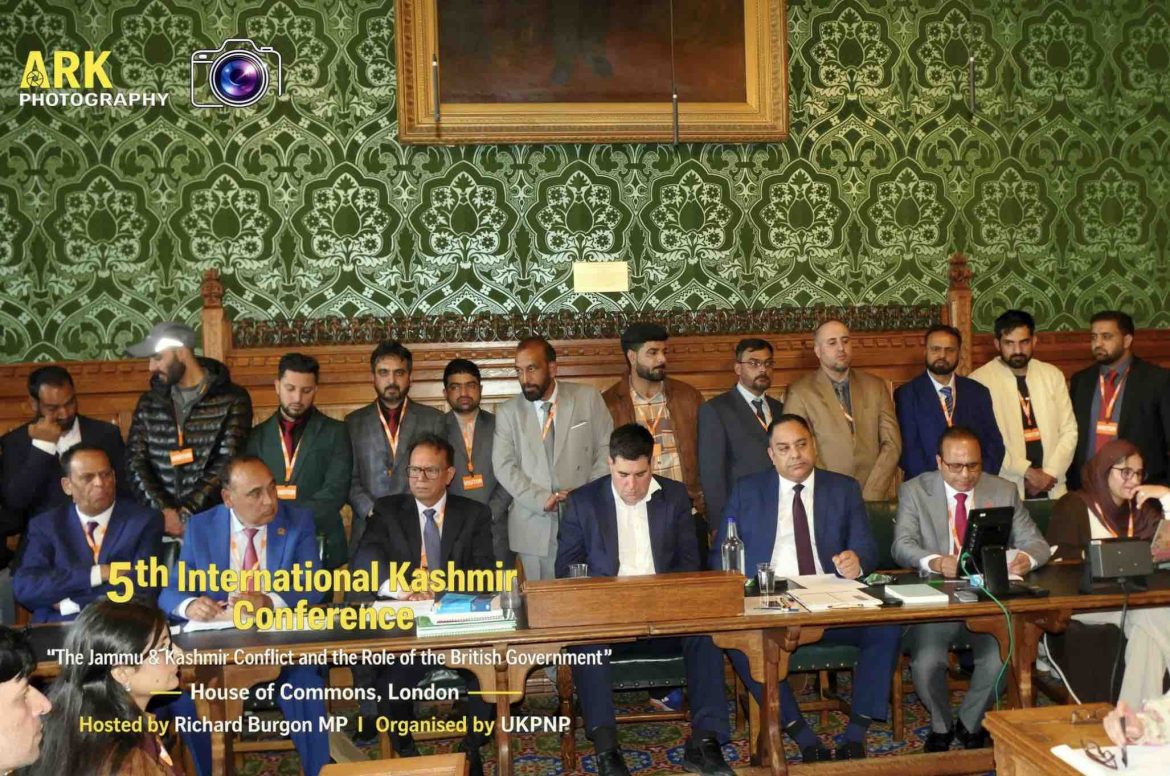
In a crowded committee room at the House of Commons, London, this week, Sajid Hussain delivered a speech that was striking not for rhetorical excess, but for its insistence on historical continuity, democratic principle and reconciliation.
Speaking at a conference titled “The Jammu and Kashmir Conflict and the Role of the British Government”, the senior representative of the United Kashmir People’s National Party (UKPNP) offered a carefully balanced intervention into one of the world’s most enduring and emotionally charged disputes.
At a time when geopolitical crises compete relentlessly for international attention, Hussain’s remarks served as a reminder that Jammu and Kashmir remains unresolved not merely as a territorial disagreement between nuclear-armed neighbours, but as a human and political question with consequences extending across South Asia and beyond.
The speech drew much of its force from its refusal to simplify history. Rather than assigning exclusive blame to one side, Hussain, an occasional correspondent for EU Today, described a conflict shaped by colonial legacies, partition, military confrontation and decades of competing national projects. In doing so, he articulated a position that is increasingly rare in modern diplomacy: one that seeks legitimacy not through absolutism, but through acknowledgment of complexity.
He began by evoking the geography and identity of Jammu and Kashmir itself — “a land where mountains cradle stories as old as time” — before moving swiftly into the historical architecture underpinning the dispute. The reference to the 1846 Treaty of Amritsar, which formalised the princely state under Maharaja Gulab Singh following arrangements with the British East India Company, was more than historical scene-setting. It underscored a central point running throughout the address: Britain cannot entirely detach itself from the consequences of the political structures created during imperial rule.
That argument carries resonance in Westminster. The partition of the Indian subcontinent in 1947 remains one of the defining geopolitical ruptures of the twentieth century, and Kashmir was among its most enduring unresolved inheritances. Hussain’s contention was not that Britain bears sole responsibility, but that it retains a moral and diplomatic capacity to encourage dialogue and reconciliation.
Importantly, the speech avoided the shrillness that often accompanies discussions of Kashmir in international forums. Hussain openly criticised both India and Pakistan, arguing that policies pursued by each state have constrained political freedoms and weakened democratic participation within the region. By acknowledging Pakistan’s administrative bifurcation of territories in 1949 alongside India’s revocation of Articles 370 and 35A in 2019, he positioned himself within a political tradition that seeks to prioritise Kashmiri agency over competing nationalist narratives.
That distinction matters.
Much international discussion surrounding Kashmir remains trapped in binary frameworks dominated by New Delhi and Islamabad. Hussain instead emphasised the lived experience of divided communities: separated families, restricted movement, curtailed political rights and economic uncertainty. The speech repeatedly returned to the idea that Kashmir is, above all, a human issue.
There was also a notable emphasis on democratic legitimacy. Hussain’s repeated invocation of United Nations resolutions — particularly the resolution of 13 August 1948 — was less about diplomatic nostalgia than about reaffirming the principle that unresolved conflicts require political consent to achieve durable settlement. Whether or not the precise mechanisms envisioned in the late 1940s remain feasible today, the broader argument was that lasting peace cannot emerge solely through security management or constitutional decrees.
This emphasis on democratic process gave the speech a constructive tone. Calls for the release of political prisoners, restoration of political freedoms, cross-Line of Control mobility and renewed India-Pakistan dialogue were framed not as maximalist demands, but as confidence-building measures necessary for rebuilding trust.
Equally significant was Hussain’s insistence that reconciliation remains possible. In many contemporary conflicts, public discourse hardens into permanent grievance. His address consciously resisted that trajectory. “The soul of Jammu and Kashmir is indivisible,” he declared, articulating a vision in which historical identity survives despite territorial fragmentation and political division.
That message found reinforcement in his reference to the work of Baroness Emma Nicholson, whose 2007 European Parliament initiative promoted a people-centred approach focused on democratic governance and human rights. By highlighting Nicholson’s contribution, Hussain signalled support for incremental diplomacy grounded in civil society engagement rather than exclusively state-centric negotiation.
The speech also reflected a broader shift visible among sections of the Kashmiri diaspora in Britain and Europe. Increasingly, activists and political representatives are attempting to internationalise the conversation not through ideological confrontation, but through the language of democratic accountability, human rights and institutional reform. That strategy resonates more effectively in European political settings, where policymakers are often wary of overt nationalist lobbying but receptive to discussions framed around governance and civil liberties.
For Britain, the implications are delicate but unavoidable. London is unlikely to assume a formal mediating role in Kashmir, not least because both India and Pakistan remain highly sensitive to external involvement. Yet Hussain’s remarks pointed towards a more modest and potentially more realistic role for British diplomacy: encouraging dialogue, supporting humanitarian connectivity across divided communities and reinforcing principles of democratic participation and peaceful resolution.
In many respects, the speech succeeded precisely because it resisted inflammatory rhetoric. Its tone was measured, reflective and aspirational. There were no calls for confrontation, no attempt to romanticise conflict and no effort to erase inconvenient historical realities. Instead, Hussain presented reconciliation as a political necessity grounded in dignity, representation and democratic consent.
In an era increasingly dominated by polarisation, such moderation can appear unfashionable. Yet it may also prove more durable.
The enduring tragedy of Kashmir is that generations have grown up knowing division as permanence. Hussain’s address challenged that fatalism. By framing peace not as surrender by one side to another, but as a process of restoring rights, rebuilding trust and reconnecting communities, he articulated a vision that remains ambitious but fundamentally pragmatic.
Whether political leaders in New Delhi, Islamabad or London are prepared to engage with that vision remains uncertain. But the speech delivered in Westminster this week demonstrated that there are still voices seeking to move the Kashmir debate away from entrenched antagonism and towards a language of reconciliation, democratic legitimacy and shared humanity.
Main Image: Ark Photography
Click here for more News & Current Affairs at EU Today
Click here to check out EU TODAY’S SPORTS PAGE!
___________________________________________________________________________________________________________________

