
Donald Trump’s sweeping tariff regime has suffered a major legal blow after a US federal court ruled that the President exceeded his authority by unilaterally imposing levies on goods from dozens of countries.
In a landmark ruling, the US Court of International Trade in Manhattan declared that Trump’s tariffs, introduced under the banner of “Liberation Day” duties, breached constitutional limits on presidential power.
The court found that the 1977 International Emergency Economic Powers Act (IEEPA)—the law Trump invoked to justify the tariffs—does not grant the White House blanket authority to regulate international trade.
The decision is a direct challenge to one of the signature components of Trump’s “America First” economic doctrine, which has long centred on punishing trading partners with import taxes deemed unfair or threatening to US interests. While the administration immediately lodged an appeal, the ruling stands as the most significant legal check on Trump’s trade policy to date.
Crucially, the court ruled that the US Constitution gives Congress—not the President—the sole power to regulate commerce with foreign nations. “IEEPA is not a carte blanche,” the three-judge panel said. “The Constitution’s allocation of trade authority remains intact.”
The lawsuit was filed by the Liberty Justice Center, a nonpartisan legal group, on behalf of small businesses hurt by the tariffs. These included firms dependent on imported parts and goods from countries such as Mexico, China and Canada—all targets of Trump’s aggressive trade crackdown.
New York Attorney General Letitia James, one of a dozen state officials supporting the challenge, hailed the ruling. “The law is clear: no president has the power to single-handedly raise taxes whenever they like,” she said. “These tariffs were a massive tax on American businesses and families, driving up costs, fuelling inflation and threatening jobs.”
The court also struck down tariffs specifically tied to Trump’s claims that foreign drugs and illegal immigration posed a national emergency—an argument used to justify punitive duties on imports from Mexico and China. However, levies on specific goods such as steel, aluminium and cars were not included in the ruling, as they are covered under a different law still under review.
The White House, defiant in tone, attacked the decision. “It is not for unelected judges to decide how to properly address a national emergency,” said Kush Desai, deputy press secretary. “President Trump pledged to put America First, and the administration is committed to using every lever of executive power to restore American greatness.”
Mr Trump has yet to comment directly, but his campaign is likely to seize on the ruling as evidence of what it often calls the “deep state judiciary” undermining bold conservative leadership.
Market reactions, however, told a different story. Stock markets across Asia rose sharply on the news, while US stock futures rallied and the dollar gained strength against traditional safe havens like the Japanese yen and Swiss franc. Investors seemed to welcome the prospect of reduced trade tensions and greater clarity on economic policy.
Stephen Innes, from SPI Asset Management, as reported by the BBC, described the ruling as a “moment of judicial restraint” amid years of trade volatility. “The Oval Office isn’t a trading desk, and the Constitution isn’t a blank cheque,” he said. “Executive overreach may finally have found its ceiling.”
Still, the legal process is far from over. The Trump administration’s appeal could find a more sympathetic ear in a higher court, particularly given the increasing number of Trump-appointed judges in the federal judiciary.
For now, US Customs and Border Protection (CBP) will maintain the status quo. “There will not be any changes at the border for now,” said John Leonard, a former CBP official. “Tariffs will still be collected until the appeals process is complete.”
If the ruling is upheld, importers who paid tariffs under the contested rules could be entitled to full refunds—with interest. This includes firms charged under the so-called reciprocal tariffs, which Trump lowered to 10% for most nations but raised to 145% on Chinese imports, later cut to 30%.
Paul Ashworth of Capital Economics warned that the decision could derail ongoing trade negotiations. “This will obviously throw into disarray the administration’s push to quickly seal deals during the 90-day tariff pause,” he said. “Other countries will wait and see how this unfolds.”
For Trump, the ruling is a significant setback—not just legally, but symbolically. His image as the strongman unafraid to upend global trade norms faces a new test: one from within the very system he once vowed to disrupt.
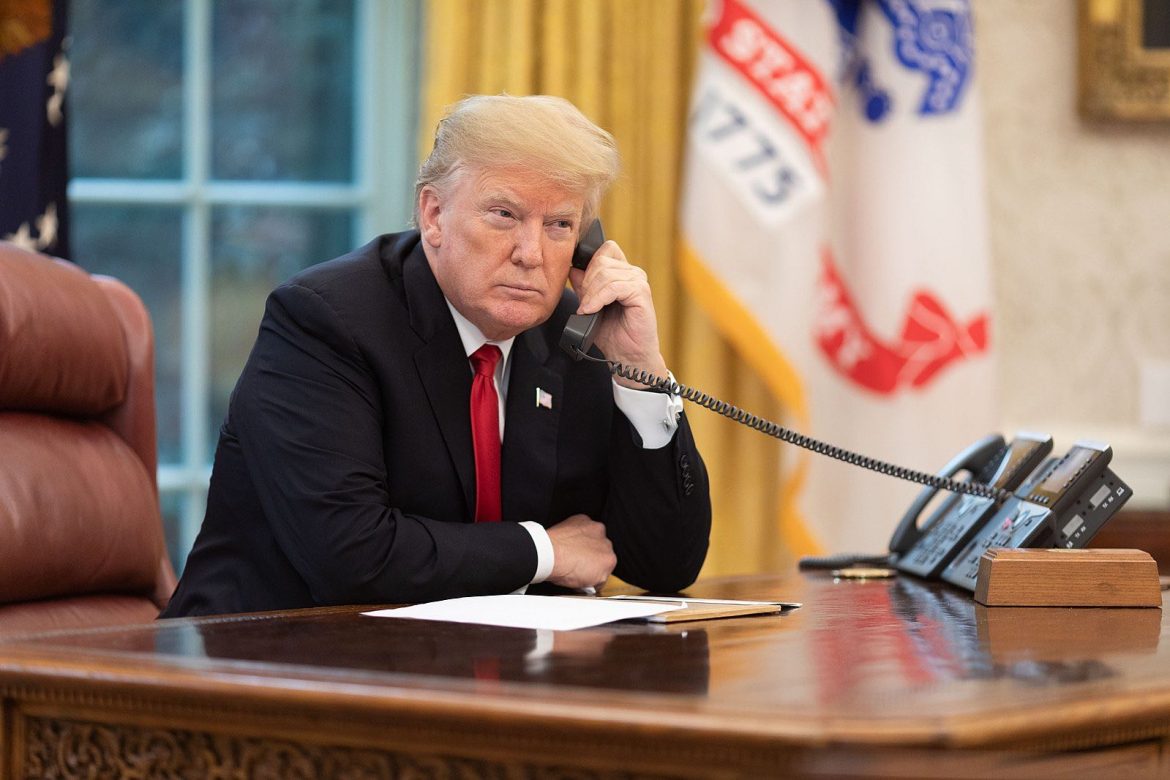
Main Image: President Donald J. Trump in the Oval Office The White House from Washington, DC.

