
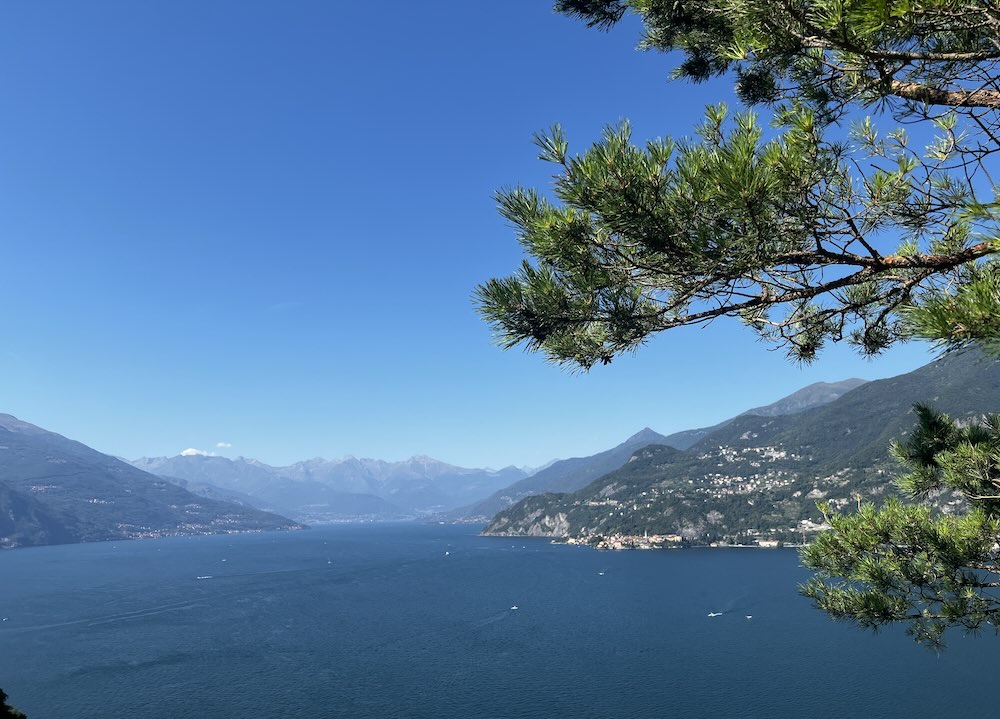
The wooded estate overlooking Bellagio combines one of Lake Como’s finest panoramic walks with a 600-year history and an international centre that has hosted Nobel laureates, writers, judges, economists and political leaders.
Bellagio’s position is difficult to appreciate from its busy waterfront. The town stands on the narrow promontory where Lake Como separates into its two southern branches, one leading towards Como and the other towards Lecco.
The geography becomes much clearer from the gardens of Villa Serbelloni, which cover about 21 hectares of the steep hill above the town. From the upper paths, visitors can see water extending in three directions, with Bellagio below and the mountains, villages and ferry routes of the central lake spread across the horizon.
The estate is now owned by the Rockefeller Foundation, but limited public access is permitted through guided tours organised in Bellagio. The visit lasts about two hours, with much of the first hour spent walking uphill. Groups are limited to 30 people, booking is compulsory and tours are conducted in English and Italian.
This is not a conventional palace visit. The principal experience is the park itself: woodland paths, terraces, old stonework, cypress trees and viewpoints appearing between dense vegetation. The main villa remains a working residential and conference centre rather than a museum.
From medieval stronghold to noble estate
The history of Villa Serbelloni begins long before the arrival of the Rockefeller Foundation.
According to local tradition, Pliny the Younger, the Roman author and administrator born in nearby Como, owned a villa called Tragoedia on the promontory. The precise location has not been established, but the association reflects the site’s long-standing importance.
The original structure of the present villa dates from the 15th century and was built for Marchesino Stanga, the feudal lord of Bellagio. The Sfondrati family subsequently modified and enlarged the property during the following century.
In 1788, the estate was acquired by Count Alessandro Serbelloni, a member of one of Lombardy’s wealthiest noble families. He devoted particular attention to the grounds, creating carriage roads, paths and walks across the promontory. The estate later passed through several owners and was converted into a hotel towards the end of the 19th century.
Its gardens differ from the formal lakeside grounds found at several other Lake Como villas. Rather than arranging the landscape around a single ornamental axis, Villa Serbelloni makes use of the natural contours of the hill. The climb, woodland and changing views are the main attractions.
How the Rockefeller Foundation acquired Villa Serbelloni
The estate’s modern history is linked to Ella Holbrook Walker, an American heiress who became Princess della Torre e Tasso through marriage.
Walker acquired Villa Serbelloni and restored it to use as a private residence. She later gave the property to the Rockefeller Foundation, which opened its Bellagio programme in 1959. The purpose was to create a setting where scholars, artists, policymakers and other specialists could work and meet away from their normal professional surroundings.
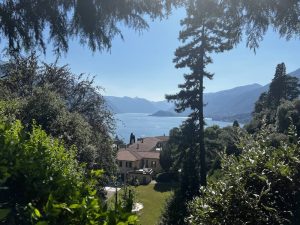
Villa Serbelloni
More than six decades later, the Bellagio Center continues to provide individual residencies and host small international conferences. Residents typically receive four weeks to concentrate on a specific book, research project, artistic work or policy proposal, while conference groups use the estate for tightly focused discussions.
The surroundings are an important part of the model. Villa Serbelloni is sufficiently isolated to offer privacy and concentration, yet it remains connected to Bellagio and the wider transport network of northern Italy.
The Bellagio Center’s best-known residents and guests
The Rockefeller Foundation says the Bellagio Center has hosted more than 85 Nobel laureates, as well as prominent figures from law, economics, literature, politics and international development.
 Among its most widely known alumni is Maya Angelou, the American poet, author and civil rights activist. Angelou’s association with Bellagio places her among a long succession of writers who have used the centre as a place for concentrated work.
Ruth Bader Ginsburg, who served for 27 years as a justice of the US Supreme Court, is another prominent former guest. Her presence reflects the centre’s role as a meeting place not only for academics but also for senior members of the judiciary and public life.
The economists Amartya Sen and Milton Friedman, who represented markedly different schools of economic thought, have both been guests. Sen received the Nobel Memorial Prize in Economic Sciences for his work on welfare economics, poverty and development, while Friedman was one of the most influential advocates of free-market economics in the 20th century.
Other notable figures include Mary Robinson, the former president of Ireland and former UN high commissioner for human rights; Henry Kissinger, the former US secretary of state; and Dikgang Moseneke, the former deputy chief justice of South Africa.
The centre has also hosted later generations of writers and public intellectuals, including Pulitzer Prize-winning journalist Nikole Hannah-Jones.
Ideas developed at Bellagio
Villa Serbelloni is more than an exclusive retreat for prominent individuals. Meetings held there have contributed to organisations and initiatives in agriculture, health, energy and finance.
The Rockefeller Foundation links Bellagio convenings to the development of the international agricultural research network now known as CGIAR, the Global Alliance for Vaccines and Immunization, the Global Impact Investing Network and the Global Energy Alliance for People and Planet.
The centre has also been associated with discussions surrounding the Green Revolution and efforts to expand access to HIV medicines in developing countries.
These connections explain why the villa itself is not fully open to tourists. It remains an active workplace, with residents and conference participants using spaces that might otherwise form part of a historic-house tour.
For visitors, the gardens provide access to the estate’s landscape and history without disturbing that work. The uphill route is demanding, particularly during the hottest part of summer, but it leads to some of the clearest views of central Lake Como.
At the top, Bellagio can be seen not merely as a picturesque resort, but as a strategic promontory shaped by Roman tradition, Lombard nobility, American philanthropy and more than 60 years of international intellectual exchange.

