
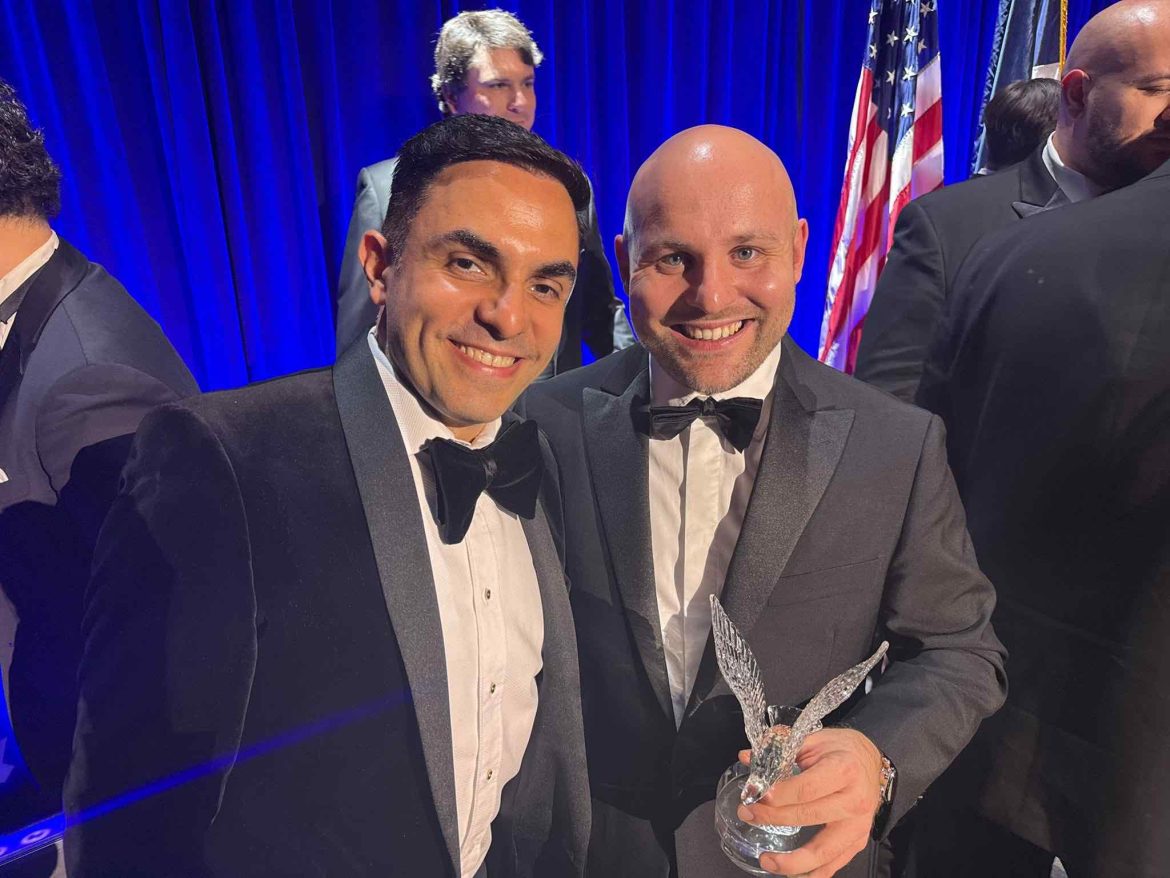
In a striking illustration of the shifting currents in Western politics, a senior German lawmaker from the Alternative für Deutschland, (AfD) used a high-profile New York gala to make a bold pitch for a formal nationalist alliance between like-minded parties on both sides of the Atlantic.
Markus Frohnmaier, foreign policy spokesman for the AfD’s Bundestag faction, shared the stage at the annual New York Young Republican Club gala with figures from the MAGA-aligned Republican establishment, arguing that an American-German partnership rooted in patriotism and cultural defence is both the “nightmare of the liberal elites” and the “hope of the free world”.
The event, attended by around 20 AfD politicians alongside U.S. conservative guests, represents more than ceremonial pageantry. It follows the release of a new U.S. national security strategy that praises patriotic parties in Europe and criticises the continent’s political mainstream for suppressing dissenting voices — language that dovetails neatly with AfD talking points about constrained free speech and liberal dominance.
The AfD’s domestic fortunes have soared in recent years. Recent polls place the party at or near the top of national surveys in Germany, underlining its appeal among voters disillusioned with the traditional political centre. Newspapers and analysts have documented this surge, noting strategic gains in regional strongholds and the party’s ability to exploit debates on immigration and national identity.
Yet the party remains politically isolated. Germany’s other established parties have maintained a cordon sanitaire, refusing formal cooperation on the grounds that the AfD’s ideology — and some of its rhetoric — sits uneasily with Germany’s post-war democratic consensus. The AfD’s critics point to episodes such as an earlier gala where a singer reportedly performed the banned Nazi-era stanza of the German national anthem, fuelling concerns about the resonance of extremist symbols.
Such incidents are not isolated. Coverage over the past year has catalogued controversies involving the AfD’s European Parliament delegation, including allegations of questionable behaviour by prominent figures and accusations that party members have sought sensitive information through parliamentary mechanisms.
Frohnmaier’s speech in New York was not merely rhetorical; it was framed as part of an outreach strategy to cultivate international allies. He reportedly invited U.S. officials and lawmakers to a February congress in Germany timed with the Munich Security Conference, signalling the AfD’s intent to embed itself within broader conservative networks.
This outreach comes amid broader transatlantic unease about political influence. Germany’s Chancellor, Friedrich Merz, speaking before the gala, acknowledged that relations with the United States are undergoing a fundamental shift — a theme echoed by other European leaders who have called for greater strategic autonomy from Washington.
Nevertheless, many in European political circles view the AfD’s U.S. engagements with alarm. Critics argue that overtures to the MAGA base and officials associated with former President Donald Trump risk lending international legitimacy to a party still widely viewed in Germany as outside the democratic mainstream — if not, in some assessments, on the extreme fringes.
Analytical pieces and reporting have highlighted how tensions over the AfD’s classification as a right-wing extremist organisation have spilled into German-U.S. diplomatic sparring, with American figures at times dismissing or attacking German intelligence assessments.
The wider European context: allies and outliers
While the AfD’s outreach to U.S. conservatives fits its broader ideological orientation — strong borders, national sovereignty, criticism of liberal consensus — other European counterparts have been more cautious. Parties such as France’s National Rally (RN) and Spain’s Vox have flirted with similar themes but remain wary of replicating the AfD’s more explicit transatlantic alignment, wary of public backlash and their own domestic political contexts.
The shifting landscape has also triggered public mobilisations. Past reporting has documented mass demonstrations in Berlin against cooperation with the AfD, with hundreds of thousands of citizens demanding that mainstream parties uphold a firewall against far-right influence in parliament.
This reflects the broader paradox facing the AfD: while its electoral support appears resilient — and in some regions ascendant — the political and civil backlash underscores deep societal divisions over how Germany, and Europe at large, confront the challenges of immigration, identity and democratic norms.
What unfolds next could have significant implications for the trajectory of German politics. If the AfD capitalises on international networks and domestic disaffection, its role in shaping national discourse may grow further; but its continued isolation at home suggests limits to how far it can translate populist momentum into governing power without redefining its image in ways that reassure a broader electorate.
The push by figures like Frohnmaier to forge transatlantic alliances with MAGA-aligned forces highlights not just a tactical pivot but a strategic gamble — one that places the AfD at the centre of debates about the future of nationalism, democracy and international cooperation in the 21st-century West. The unfolding story will be watched closely in Brussels, Berlin and Washington alike.
Main Image: Markus Frohnmaier, via X
Click here for more News & Current Affairs at EU Today
Click here to check out EU TODAY’S SPORTS PAGE!
_____________________________________________________________________________________________________________________________

