
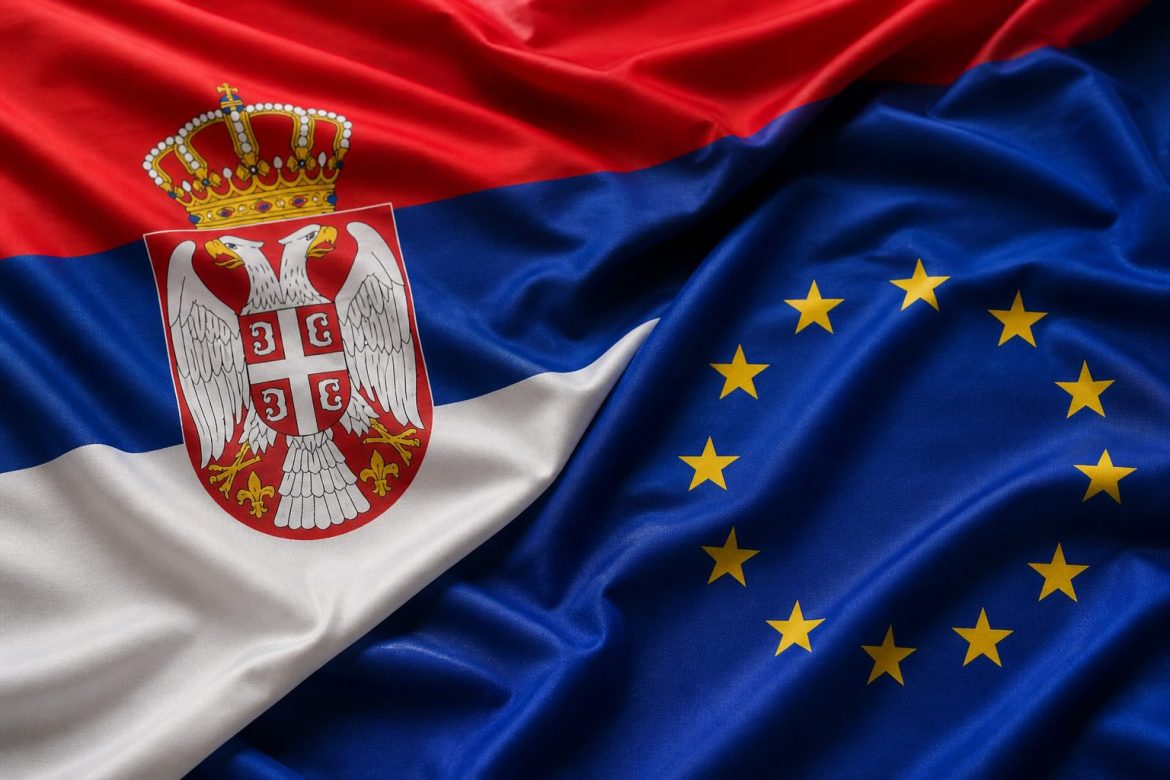
Brussels has suspended payments to Serbia under the Western Balkans Growth Plan, linking further financial support to judicial reform, rule-of-law standards and the implementation of European legal recommendations.
The European Union has suspended payments to Serbia under the Western Balkans Growth Plan, placing Belgrade under renewed pressure to address concerns over judicial reform and the rule of law.
The move was disclosed after Enlargement Commissioner Marta Kos said the EU had stopped payments because of backsliding in the justice sector. The decision directly affects Serbia’s access to financial support under the EU’s wider Growth Plan for the Western Balkans, a programme designed to accelerate economic convergence and support reforms in countries seeking closer integration with the Union.
The Growth Plan is built around a €6 billion Reform and Growth Facility for the Western Balkans for the period 2024 to 2027. Funding is not automatic. It is tied to reform agendas agreed with the European Commission and to progress on areas including public administration, economic governance, democratic standards and the rule of law.
Serbia had already received approval for an initial release of funds earlier this year. A Commission implementing decision dated 12 January 2026 authorised more than €17.5 million in non-repayable financial support and more than €43.5 million in loan support under the first request for payment. The suspension now raises questions over future disbursements and over the political conditions attached to Serbia’s reform agenda.
The immediate issue concerns judicial legislation adopted by Serbia and criticised for weakening guarantees of judicial independence. The EU has linked further payments to the full implementation of recommendations from the Venice Commission, the Council of Europe’s advisory body on constitutional and legal standards. Its recent opinion on Serbia’s judicial framework called for changes in several areas, including safeguards for prosecutors, limits on political influence and broader consultation in the reform process.
Brussels’ position reflects a wider concern that formal alignment with EU rules is not sufficient if implementation undermines the independence of institutions. Serbia has been a candidate country since 2012 and opened accession negotiations in 2014, but progress has remained uneven. Rule-of-law chapters have long been central to the accession process, and the EU has repeatedly stressed that judicial independence, media freedom and the fight against corruption are core requirements for membership.
The latest funding freeze also shows how the EU is using financial conditionality in the Western Balkans. The Growth Plan was presented as a way to bring candidate countries closer to the single market before accession, provided they deliver reforms. That structure gives Brussels a practical lever: access to money can be slowed or stopped when reform commitments are judged to be off track.
For Serbia, the consequences are both financial and political. The sums immediately affected may be smaller than the headline allocation under the Growth Plan, but the signal is significant. If the dispute is not resolved, Belgrade risks losing access to larger tranches of support intended for investment, institutional reform and economic convergence. The freeze also complicates the Serbian government’s attempt to present EU integration as continuing while disputes over domestic governance remain unresolved.
The decision comes at a difficult point in relations between Brussels and Belgrade. Serbia has faced EU criticism over judicial reforms, media conditions, election standards and its foreign-policy alignment. The government has maintained that it remains committed to EU membership, while also preserving close relations with Russia and China. Those tensions have made Serbia one of the more politically sensitive files in the EU’s enlargement agenda.
EU tells Serbia to ‘get concrete’ on reforms and align with Russia sanctions
The Commission’s public Reform and Growth Facility page sets out the conditional structure of the programme and lists Serbia among the countries covered by the mechanism. The underlying logic is clear: financial integration and staged access to EU-linked benefits are meant to move in parallel with measurable reforms.
For Brussels, the credibility of that mechanism depends on enforcement. If Serbia can receive funding despite contested judicial changes, the conditionality attached to the Growth Plan would be weakened. If funds are withheld, the EU shows that the programme is not merely a financial instrument but also a governance test.
The case will now turn on whether Serbia amends the disputed legislation and demonstrates compliance with the required legal standards. Until then, the suspension gives the EU a concrete means of applying pressure without formally halting the accession process.
The broader significance extends beyond Serbia. Other Western Balkan governments will be watching how strictly Brussels applies the Growth Plan’s conditions. The EU has presented enlargement as a strategic priority, but this case underlines that faster integration will still depend on legal and institutional reforms that can be verified, not only promised.

