
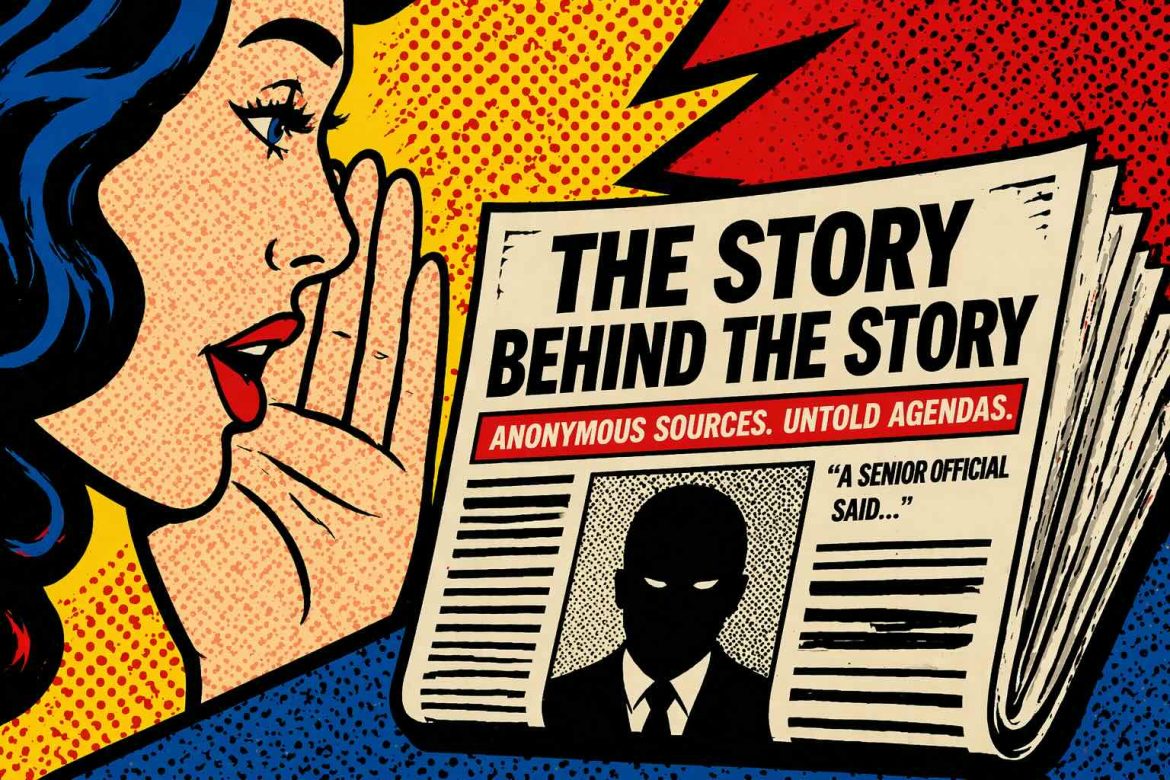
When major outlets rely on unnamed officials, aides and intelligence contacts, the central issue is no longer simply whether the information is true, but why it is being disclosed, by whom, and to what end. In an era of access journalism, anonymous sourcing can serve not only to reveal hidden facts but also to launder elite narratives into the news cycle without accountability.
Anonymous sourcing is not in itself a journalistic failure. In intelligence, diplomacy, defence and internal party politics, some accurate reporting would never appear on the record. Most serious news organisations recognise that reality, but they also set high formal thresholds for using unnamed sources. Reuters says journalists should use named sources wherever possible and that single-source anonymous stories require special authorisation. The Associated Press says a manager must know the source’s identity and vet the material before publication. AFP states that anonymous sourcing should be the exception, not the rule.
The problem is that in political and security journalism anonymity has often moved far beyond exception. It has become part of the routine machinery of “insider” reporting: the unnamed aide, the official familiar with the matter, the person briefed on the conversations, the source close to the negotiations. Poynter warned in 2024 that political reporting was relying heavily on anonymous insiders, often without giving readers enough transparency about motive or context. That matters because anonymity does not merely conceal identity; it also conceals interest.
This is where publications such as Politico, Axios and Punchbowl become relevant. The criticism levelled at this Washington ecosystem is not that every anonymously sourced report is false. It is that their business model is built around proximity to power, rapid tip-based publication, and elite circulation value. Columbia Journalism Review’s profile of Punchbowl situated it directly in the lineage of Politico Playbook, the daily insider memo that became essential reading in Washington. Earlier criticism of Playbook-style journalism argued that it pushed access journalism to a new level, where intimacy with the political class became part of the product itself. In such a system, anonymous sourcing is not an occasional necessity but a structural habit.
That does not make Politico or similar outlets fraudulent. But it does mean readers should approach them differently. When an outlet’s comparative advantage is access, its greatest vulnerability is manipulation. A junior source may leak a fact. A senior source is more likely to place a narrative. The higher the source climbs inside government, intelligence or party leadership, the less likely it is that information is being offered innocently. At that level, leaks are often a method of policy signalling, factional warfare or public framing. Anonymous sourcing then stops being a means of informing the public and becomes a means of directing it. That is the point many readers miss when they treat prestige access as proof of reliability.
The danger is not theoretical. One of the clearest examples remains The New York Times’ pre-Iraq War reporting on weapons of mass destruction. In its later editor’s note, the paper acknowledged “a number of instances of coverage that was not as rigorous as it should have been” and said that controversial information had at times been insufficiently qualified or allowed to stand unchallenged. The issue was not simply factual error. It was the broader failure to challenge claims carried by powerful official and intelligence-linked sources whose interest was to shape the public case for war.
A narrower but still instructive example came from CNN in 2017, when it retracted a story on Anthony Scaramucci after concluding that it did not meet editorial standards. Reporting on the episode said the article had been based on information from an anonymous source. The case showed how even a major outlet can stumble when it gives too much weight to confidential sourcing in a politically charged environment. A famous masthead does not remove the risks created by opacity.
The same pattern appears outside the national-security field. The Columbia review of Rolling Stone’s “A Rape on Campus” called it “a story of journalistic failure that was avoidable”, finding failures in reporting, editing, supervision and fact-checking. Earlier still, The Washington Post’s fabricated “Jimmy’s World” demonstrated how dramatic storytelling protected by source confidentiality can overwhelm verification; the Post later stated plainly that the article was “not factually correct and is a fabrication”. These are not identical cases, but they point to the same structural weakness: once the source is hidden, weak reporting can disguise itself as brave reporting.
So can anonymously sourced reporting be believed? Yes, sometimes. But not on trust alone, and certainly not because the publication is fashionable, influential or well connected. Readers should ask whether the story explains why anonymity was granted, whether it shows how the source knows the information, whether there is corroboration, and whether the material looks like fact or merely unattributed spin. Reuters, AP and AFP all publish standards that recognise this distinction precisely because anonymous sourcing is so easily abused.
The deeper problem is that too much contemporary political journalism confuses closeness to power with independence from it. In reality, those things often move in opposite directions. When anonymity becomes routine, journalism risks becoming a laundering mechanism through which officials, aides and operatives place narratives into the public sphere without taking responsibility for them. That is why the question is not whether anonymous sources should ever be used. It is whether the journalist is using the source, or the source is using the journalist.

