
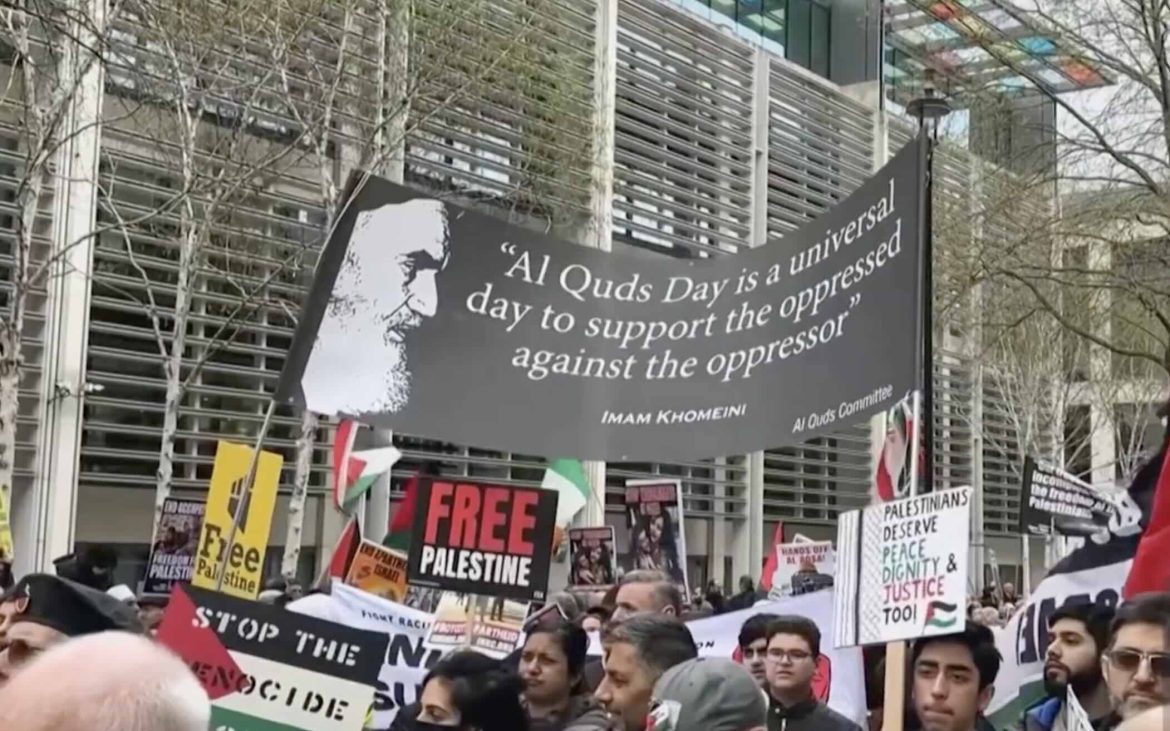
The British government has barred the annual Al Quds Day march from taking place in London after the Metropolitan Police sought powers to prevent what it described as a serious risk of disorder.
Home Secretary Shabana Mahmood approved the request on 10 March, meaning the procession planned for Sunday 15 March cannot go ahead. The ban also covers associated counter-marches and will remain in force for one month from 16:00 on Wednesday 11 March.
The decision marks the first time a protest march has been banned in London since 2012. In its statement, the Metropolitan Police said the legal threshold for such a move was high and that it did not take the step lightly. The force said it had concluded that ordinary public-order conditions, such as restrictions on route, timing or duration, would not be enough in this case.
Al Quds Day, observed towards the end of Ramadan, was established after the 1979 Iranian revolution and is presented by organisers as an expression of solidarity with the Palestinian cause. In London, the annual event is organised by the Islamic Human Rights Commission, which the Metropolitan Police described as supportive of the Iranian regime. The march has long attracted controversy in Britain, with critics arguing that it provides a platform for pro-Iranian messaging and, in previous years, symbols associated with Hezbollah, which is banned in the UK as a terrorist organisation.
Mahmood said she was satisfied that a ban was necessary “to prevent serious public disorder”, citing the expected scale of the demonstration, the likelihood of multiple counter-protests and the wider context of conflict in the Middle East. She added that, while a static demonstration could still take place, police would be able to impose strict conditions on it. She also said she expected “the full force of the law” to be applied against anyone using the occasion to spread hatred or division rather than exercise the right to peaceful protest.
The Metropolitan Police set out a broader security rationale for the ban. Assistant Commissioner Ade Adelekan said the force had to consider the prospect of large numbers of demonstrators and counter-demonstrators converging at a time of “extreme tensions between different factions”. He said police had also taken account of the volatile regional situation and of warnings from Britain’s security services about threats linked to Iran on UK soil. The Met referred to MI5 and Counter Terrorism Policing having publicly said that more than 20 Iranian state-backed plots had been foiled in Britain over the past year.
Police also referred to recent incidents that, in their assessment, underlined the risk of confrontation. These included arrests under the National Security Act linked to alleged surveillance of Jewish communities on behalf of Iran, and a reported stabbing involving opposing views on the Iranian regime. Adelekan said the overall context was “uniquely complex” and the risks were sufficiently severe that allowing the march to proceed could expose members of the public, protesters and police officers to injury, while also creating a risk of property damage.
The Met sought to distinguish the decision from a judgement on the views expressed by organisers. Its statement said the force routinely polices demonstrations from across the political spectrum, including dozens of major pro-Palestinian protests as well as events both for and against the Iranian regime. It said the ban was based solely on a risk assessment relating to this specific march and expected counter-protests, rather than on a preference for one political position over another.
Organisers rejected that account. The Islamic Human Rights Commission condemned the ban and said it was taking legal advice. It argued that the annual demonstration had taken place peacefully for decades and described the government’s action as political rather than operational. The group has nonetheless said that a lawful static protest will still be held on Sunday, subject to police conditions.
The ban follows mounting pressure from politicians across party lines. Labour and Conservative figures had called for the march to be stopped, arguing that it carried wider implications for public safety and national security. Ministers have also sought to frame the move as a narrow public-order response rather than a broader restriction on protest rights. Darren Jones, Chief Secretary to the Treasury, said the right to peaceful protest remained protected, but that incitement to hatred, violence or damage could not be tolerated.
For Britain, the decision is significant less because of the numbers expected on the streets than because it shows how the London authorities now assess the interaction between foreign conflicts, domestic tensions and the practical limits of policing. By allowing only a static protest, the government is attempting to draw a line between the right to assemble and the risk that rival groups, in the present climate, could turn a march into a flashpoint.

