
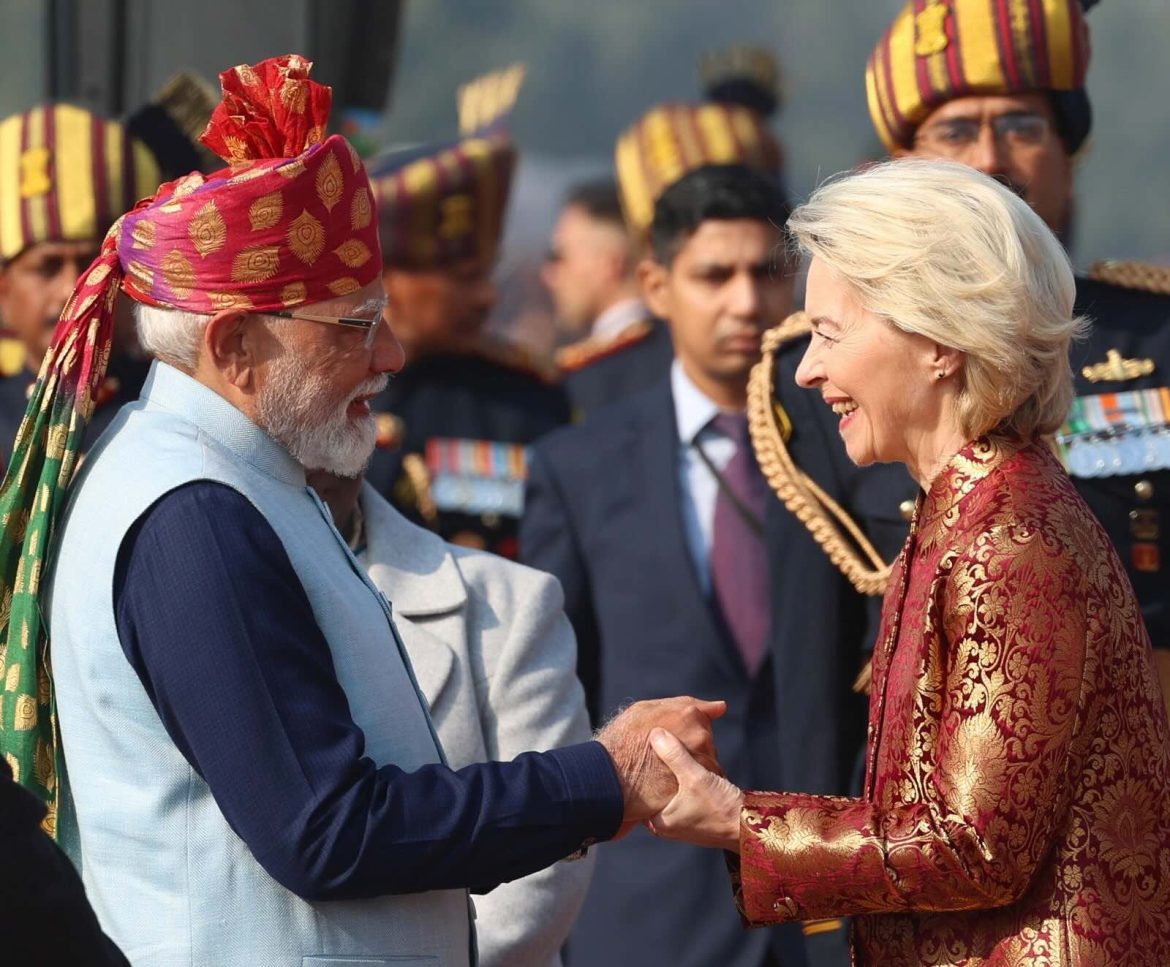
The European Union and India are expected to announce the conclusion of long-running free trade negotiations at an EU–India summit in New Delhi on 27 January, after European Commission President Ursula von der Leyen and European Council President António Costa attended India’s Republic Day celebrations as guests of honour.
According to Reuters, the two sides intend to “conclude negotiations” at the summit, with the political announcement opening a period of legal scrubbing, translation and ratification before signature and entry into force. A separate mobility agreement covering high-skilled workers and students is also expected, alongside a new EU–India security and defence partnership described as Europe’s third such arrangement in Asia, after accords with South Korea and Japan.
The proposed pact has been under negotiation since 2007, with talks relaunched in 2022 after a nine-year pause. Momentum accelerated during 2025 amid wider trade tensions and new tariff barriers affecting both partners. If ratified by the European Parliament, the agreement could take at least a year to clear EU procedures.
The economic case is straightforward. The EU is among India’s top trading partners, alongside the United States and China, with total goods and services trade exceeding $190bn in India’s 2024/25 fiscal year. India exported about $76bn in goods and $30bn in services to the EU, while EU exporters face higher average tariff barriers in India than Indian exporters face in Europe.
The agreement would open the way for lower tariffs on European cars and wine, and for wider EU access in sectors including machinery, aircraft, chemicals and services. For India, the expected gains are concentrated in labour-intensive exports such as textiles, garments and jewellery, and in services. The deal is intended to offset the impact of US tariffs: in August, President Donald Trump doubled tariffs on Indian imports to as much as 50 per cent.
Several of the most difficult questions appear to have been managed by narrowing the scope. Reuters said agriculture and dairy are excluded, reflecting India’s domestic sensitivities and longstanding resistance to broad liberalisation in those sectors. India is also reported to be pushing back against EU demands to eliminate tariffs on more than 95 per cent of goods, signalling a figure closer to 90 per cent.
Autos, wine and spirits remain politically exposed in India. On 25 January, Reuters reported that India is set to cut car import tariffs from levels as high as 110 per cent to 40 per cent for a quota of high-end vehicles, with a further gradual reduction towards 10 per cent over time, while battery electric vehicles would be exempt for the first five years under the reported plan. Reuters described this as a significant opening for EU manufacturers that currently hold a small share of the Indian market.
Beyond tariffs, the negotiating agenda includes data, services and regulation. Reuters reported that India is seeking “data-secure” status under EU rules, easier movement for professionals, and relief from double social security payments. The EU, in turn, is seeking wider access for financial and legal services and commitments on labour, environment and intellectual property, areas where India has traditionally preferred flexibility.
Climate-linked trade measures are also part of the political calculus. Two major Indian concerns are the EU’s carbon border levy and non-tariff barriers such as standards, certification costs and regulatory delays. These issues are likely to shape implementation even if headline tariff lines are settled.
The summit takes place as the EU pursues multiple external trade tracks. On 17 January, the EU and Mercosur signed their partnership agreement and interim trade agreement. EU lawmakers’ moves on the Mercosur file have underlined how parliamentary scrutiny can complicate ratification of large trade packages.
Strategically, Brussels and New Delhi are also formalising defence cooperation. EU foreign policy chief Kaja Kallas has described India as central to diversification efforts and has framed economic security in terms that link trade exposure to strategic risk. In an interview reported by The Indian Express, she said China “weaponizes trade” and argued that economic relations should not come at the expense of security.
Even if the political announcement is made in Delhi, the next phase will be procedural. The European Parliament’s role, the separation of investment protection and geographical indications into parallel tracks, and the management of non-tariff barriers are expected to determine how quickly commercial benefits materialise on both sides.

