
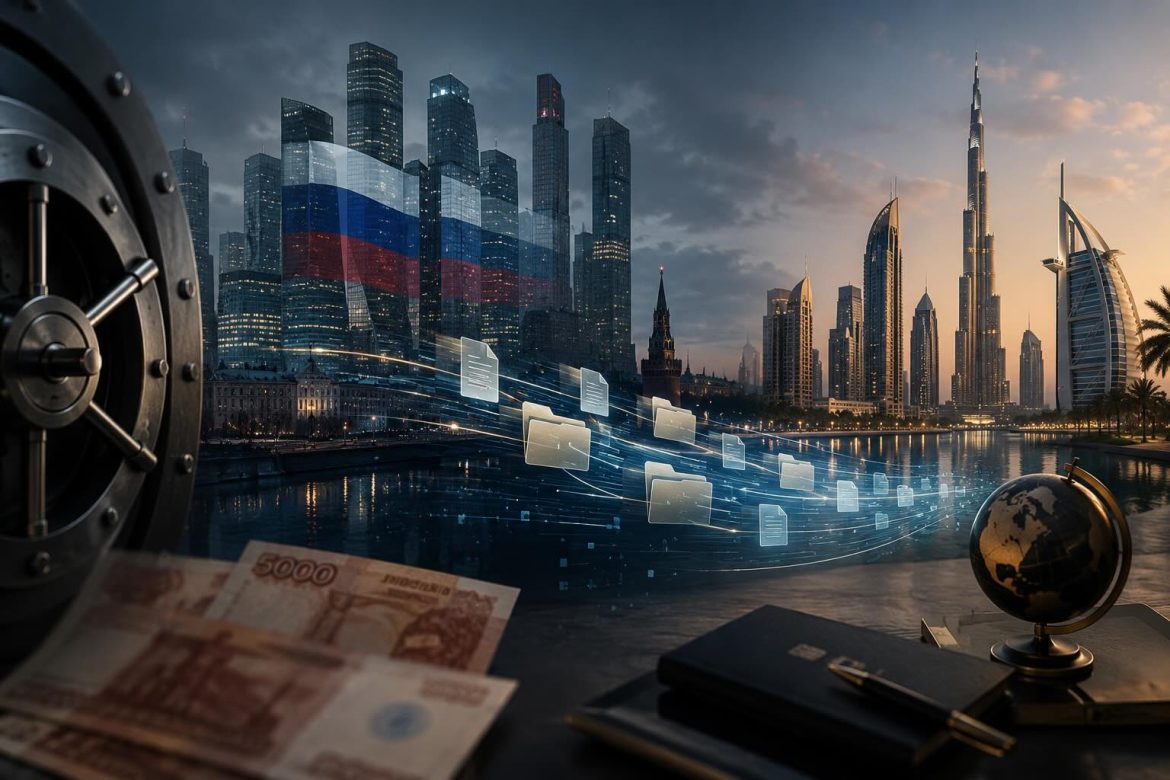
Some of Russia’s wealthiest businessmen are transferring billions of dollars into foreign property, investment structures and digital assets as concern grows over state confiscations, economic stagnation and the stability of the country’s banking system.
Russia’s business elite is moving increasing amounts of money abroad as wealthy individuals seek to protect their assets from possible state seizure and the mounting pressures of the country’s wartime economy.
Several of Russia’s richest businessmen, including figures with longstanding links to the Kremlin, have transferred billions of dollars outside the country over the past year. The transactions have been driven partly by concerns over Russia’s weakening economic outlook and the possibility that the authorities may confiscate private property to meet budgetary or military requirements.
The movement of assets represents a reversal of the trend seen during the first years following Russia’s full-scale invasion of Ukraine. Western sanctions and restrictions on overseas accounts had encouraged many wealthy Russians to return capital to domestic banks and investment vehicles. By 2026, however, the perceived threat has increasingly come from within Russia itself.
According to accounts from businessmen and advisers familiar with the transactions, wealthy Russians are buying foreign property, placing funds in overseas investment structures and using cryptocurrency to move money beyond the immediate reach of the Russian authorities. The United Arab Emirates remains one of the principal destinations, alongside other Middle Eastern and Asian financial centres.
State takeovers weaken confidence
Concerns over property rights have intensified following a series of court cases in which Russian prosecutors secured the transfer of privately owned companies and assets to the state.
The campaign is frequently described inside Russia as “de-privatisation”. The authorities have argued in individual cases that assets were acquired unlawfully during earlier privatisation programmes, that owners held prohibited foreign links or that strategically important businesses should return to state control.
Among the businessmen affected have been Vadim Moshkovich, the founder of the Rusagro agricultural group, gold producer Konstantin Strukov and the owners of Moscow’s Domodedovo airport. The cases have reinforced fears that wealth and political loyalty no longer provide reliable protection against confiscation.
The resulting capital transfers do not necessarily indicate an organised political break with the Kremlin. They do, however, suggest that parts of the Russian business community no longer regard domestic ownership structures as secure.
Banks carry growing wartime liabilities
The capital outflow is taking place alongside increasing concern about Russia’s financial sector.
A European intelligence assessment of the Russian banking system warned that banks were accumulating potentially unsustainable liabilities while supporting defence manufacturers, state-backed construction programmes and heavily indebted households.
The assessment said subsidised lending, restructuring arrangements and government support had concealed part of the deterioration in loan quality. It estimated that about 10 per cent of corporate loans could already be regarded as doubtful, while the proportion of problematic consumer loans was considerably higher at some large retail banks.
More than 500,000 Russians were declared bankrupt during 2025, according to figures cited in the assessment. Russian households have increasingly used several simultaneous loans to meet housing and everyday expenditure, leaving banks exposed to any further economic slowdown.
The Central Bank of Russia has disputed claims that the sector contains critical vulnerabilities. State support, capital controls and continuing income from commodity exports have so far prevented a systemic crisis. Nevertheless, the combination of expensive credit, slowing growth and state-directed lending has narrowed the banks’ room for manoeuvre.
Refinery attacks deepen economic pressures
The financial concerns coincide with sustained Ukrainian attacks on Russian oil refineries, storage facilities and fuel infrastructure.
By mid-July, damage and scheduled maintenance had placed almost 40 per cent of Russia’s refining capacity out of operation, according to industry estimates. Russian energy companies subsequently approached Indian refiners about possible gasoline supplies, despite Russia’s traditional position as a major exporter of petroleum products.
The disruption has contributed to higher wholesale prices, shortages in several regions and difficulties distributing fuel across the country. Russian authorities have used export restrictions, imports and emergency production measures in an attempt to stabilise the market.
Further long-range strikes in July targeted warehouses, fuel depots and industrial facilities that Ukraine said were connected to Russian military supply chains. Russian officials reported civilian casualties at several sites, while Kyiv said some of the facilities handled components used in drone and navigation systems.
The refinery campaign does not directly explain the movement of private wealth abroad. It nevertheless adds to the broader economic uncertainty by affecting fuel supplies, industrial production and export revenue.
Cryptocurrency provides an alternative route
Digital assets have become an increasingly important part of Russia’s parallel payments infrastructure.
One prominent mechanism is A7A5, a rouble-backed stablecoin associated with the A7 payments platform. A7 is controlled by fugitive Moldovan businessman Ilan Șor and is partly owned by Promsvyazbank, a sanctioned Russian state bank that services the defence sector.
Russia’s rouble-backed stablecoin exposed as major sanctions-evasion channel
The platform was established to facilitate cross-border payments outside conventional Western banking channels. Its token allows roubles to be converted into a digital asset that can subsequently be traded through foreign cryptocurrency exchanges or intermediary jurisdictions.
An investigation into network found that the system had been used both for sanctions circumvention and for moving money connected to Russian political influence operations. Separate analysis has identified Șor and Promsvyazbank as central figures in the construction of a parallel Russian financial system.
Evidence of strain, not imminent collapse
Russia’s economy remains capable of financing the war, supported by commodity exports, state spending and trade with China and other non-Western partners. Its banking system also remains under tight government control, allowing the authorities to postpone or redistribute financial losses.
The available evidence does not establish that an immediate banking collapse is inevitable. It does, however, show a convergence of pressures: deteriorating loan quality, expensive borrowing, state appropriation of private assets, disruption to the energy sector and the movement of private capital abroad.
For Russia’s wealthy elite, the principal calculation appears to have changed. The problem is no longer only whether assets may be frozen in the West. It is whether money and property retained inside Russia can remain beyond the reach of the state.

