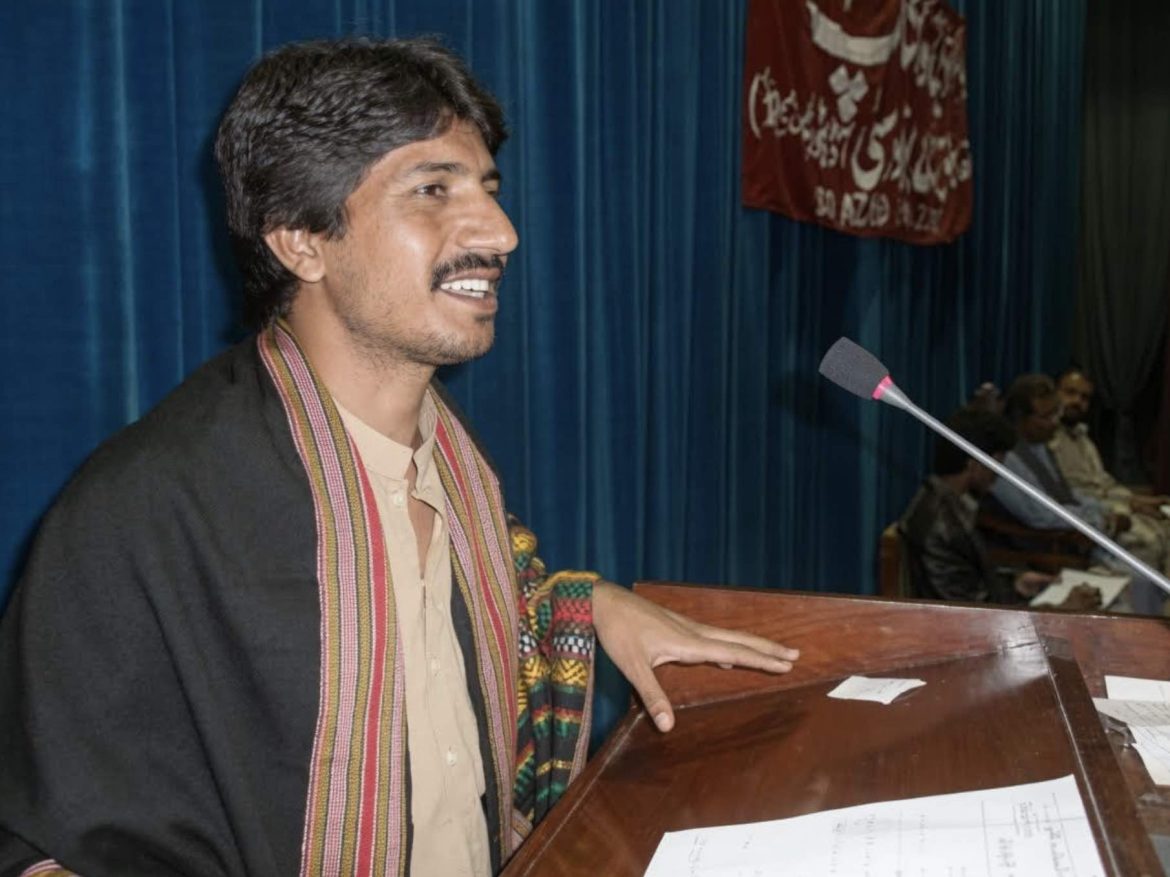
Dr Naseem Baluch, Chairman of the Baloch National Movement (BNM), has urged the European Parliament to reassess Pakistan’s preferential trade status under the EU’s GSP+ scheme, arguing that systematic abuses in Balochistan are incompatible with the conditions attached to the regime.
Speaking at a conference in the European Parliament on Pakistan’s GSP+ status, hosted by Romanian MEP Georgiana Teodorescu (ECR), Dr Baluch thanked MEPs and guests “for giving voice today to one of the most silenced and persecuted nations of our time, the Baloch people”.
He described Balochistan as “a region rich in resources but deprived of rights”, and said he was addressing the Parliament “as a witness to a decades-long humanitarian tragedy that continues with alarming intensity”. According to his account, Pakistan’s security establishment has intensified a campaign of repression against “peaceful political leaders, students, human rights defenders and political activists”.
Dr Baluch focused on the killing of Chairman Zubair Baloch, a young political figure he described as believing only in “dialogue, democratic rights and peaceful political struggle”. His death by gunfire, he said, was “not just a tragedy” but “a reflection of policy” intended to extinguish emerging Baloch leadership.
Advocate Zubair Killed by Pakistan Army — Irrefutable Evidence of State Terrorism
> 🎥 Watch in Video: A destroyed home by the Pakistan Army & Chairman Zubair Baloch’s speech against enforced disappearances in #Balochistan.
Advocate Zubair Baloch was a peaceful political… pic.twitter.com/hgAbKZFPCf
— BNM (@BNMovement_) September 24, 2025
Enforced disappearances, he told the meeting, remain “the darkest feature of life in Balochistan”. Citing figures compiled by Baloch human rights groups, he said 234 new cases of enforced disappearances had been recorded in the first three months of 2025 alone. Over the past two decades, thousands of people had been abducted, many later found dead with signs of torture, he alleged.
He referred to mass graves reported in various parts of the province. In Dasht, near Quetta, he described a burial ground known locally as “the cemetery of the unknowns”, said to contain hundreds of unidentified bodies. “Sons, brothers, fathers who vanished only to reappear as nameless remains,” he told participants, adding that these cases had been documented by UN working groups, Amnesty International, Front Line Defenders and international media, and that “the world cannot claim ignorance”.
The BNM chairman said the situation had “taken an even more dangerous turn” with the deployment of armed drones over Balochistan. He referred to reported strikes in the Zehri area that killed four children and other civilians, arguing that such actions amounted to the use of advanced weaponry against an unarmed population. “This is not counterterrorism,” he said. “It is a war crime.”
Dr Baluch alleged at least 22 extrajudicial killings over a three-month period, attributing them to police counterterrorism departments and “state-backed death squads”. In many cases, he claimed, victims had previously been reported as disappeared; their bodies were later returned to families bearing marks of torture. Peaceful protests were criminalised, political parties banned, and leaders forced into exile or killed, he said. Even mothers holding photographs of missing relatives had been labelled security threats.
According to his remarks, Pakistan had simultaneously encouraged religious extremist groups in Balochistan in order to weaken secular and democratic currents in the Baloch movement. This was described as a deliberate strategy “to fracture society, undermine progressive voices and destabilise the region”.
Turning to resources and economic policy, Dr Baluch said that “billions in minerals” were extracted each year from Balochistan, benefiting companies that enjoy access to the EU market under the GSP+ scheme, while local communities lack clean water, functioning schools and basic infrastructure. “This is not development,” he said. “This is the continuation of colonial extraction under military occupation.”
He linked the situation in Balochistan to wider patterns affecting other communities in Pakistan, including Pashtuns, Sindhis, Kashmiris, Christians, Ahmadis, Hindus and residents of Gilgit-Baltistan, who he said faced similar practices of enforced disappearances, arbitrary detention and political repression. “This reflects not a regional issue but a structural one,” he told the conference.
Pakistan has benefited from GSP+ preferences since 2014, gaining broad duty-free access to the EU market in return for ratifying and implementing 27 international conventions covering human rights, labour rights, environmental protection and good governance. EU institutions are currently revising the GSP framework, with negotiators announcing plans to reinforce the link between trade benefits and respect for human rights and other commitments.
Dr Baluch argued that Pakistan’s record in Balochistan and elsewhere was incompatible with this conditionality. “When a state engages in enforced disappearances, drone attacks on civilians, torture, mass graves and political repression, it cannot be treated as compliant,” he said. “The credibility of the GSP+ framework depends on its willingness to enforce the standards it demands.”
He called on the European Parliament to give full weight to findings by UN mechanisms and international human rights organisations; to reassess Pakistan’s GSP+ status “in light of overwhelming evidence”; to demand transparency, accountability and measurable improvements; and to support an independent investigation into enforced disappearances, extrajudicial killings and mass graves in Balochistan.
Despite the scale of abuse he described, Dr Baluch emphasised that Baloch resistance remained “peaceful, intellectual and political”. “Our struggle is not against any nation,” he said. “It is against oppression, exploitation and the denial of basic humanity.” The Baloch people, he concluded, sought what “every nation seeks: freedom, dignity and the right to self-determination”, and he appealed to Europe “to stand with us, to stand with human rights and to stand with freedom”.
Pakistan’s GSP+ record under formal scrutiny in new EU Today white paper

