
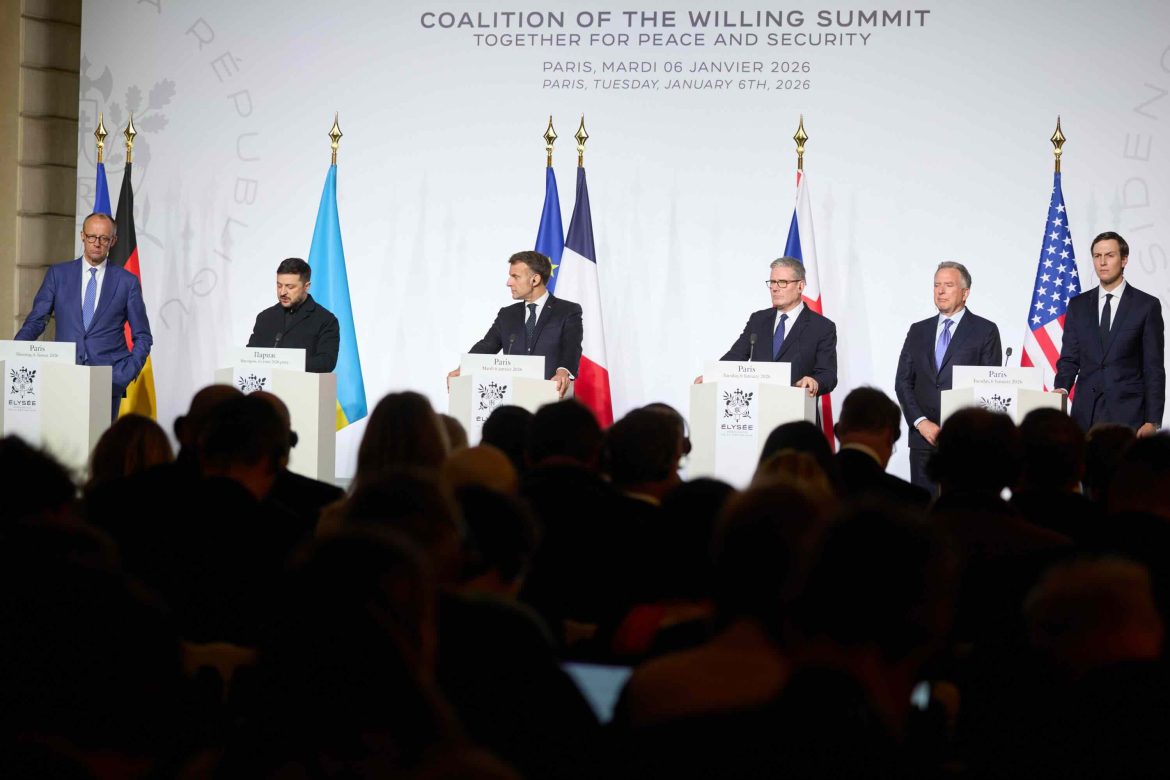
Leaders from Ukraine’s key partner countries met in Paris on 6 January 2026 and issued a declaration on “robust security guarantees” tied to any future ceasefire or peace arrangement.
The statement, agreed by the “Coalition of the Willing” with Ukraine and the United States, says the guarantees would be “politically and legally binding” and would be activated only once a ceasefire enters into force.
The declaration sets out five components. First, coalition members say they will participate in a proposed US-led ceasefire monitoring and verification mechanism. The text envisages continuous monitoring and provides for coalition representation on a “Special Commission” intended to examine breaches, attribute responsibility and determine remedies.
Second, the coalition commits to long-term support for Ukraine’s armed forces, described as the “first line of defence and deterrence”. Measures listed include long-term defence packages, support for financing weapons purchases, cooperation on Ukraine’s national budget to fund the armed forces, access to defence depots that could deliver rapid additional support if Ukraine is attacked again, and practical and technical support for building defensive fortifications.
Third, the declaration proposes a European-led “Multinational Force for Ukraine”, assembled from contributions by willing states within the coalition. It says “coordinated military planning” has been conducted to prepare reassurance measures in the air, at sea and on land, and to support the regeneration of Ukraine’s armed forces. The text adds that these measures would be implemented at Ukraine’s request once a “credible cessation of hostilities” has taken place. It also states that the reassurance effort would be European-led, with involvement also of non-European members of the coalition, and with the proposed support of the United States.
Fourth, allies agree to finalise binding commitments to support Ukraine if it faces a future armed attack by Russia, linking the guarantees to actions taken “in order to restore peace”. The declaration lists possible tools: the use of military capabilities, intelligence and logistical support, diplomatic initiatives, and additional sanctions.
Fifth, the coalition says it will deepen defence cooperation with Ukraine, including training, defence-industrial joint production and intelligence cooperation. It also says a US/Ukraine/coalition coordination cell will be established at the coalition’s operational headquarters in Paris.
Reporting around the meeting highlighted parallels with NATO’s mutual-defence model. Reuters quoted Italian Prime Minister Giorgia Meloni describing work on security commitments “inspired” by NATO’s Article 5, embedded in a wider package of agreements coordinated with Washington. She reiterated that Italy would not deploy troops to Ukraine and said participation in any future multinational force would be voluntary and subject to national constitutional procedures.
Alongside the collective declaration, the UK and France announced a separate declaration of intent on deploying forces after a peace deal, signed with President Volodymyr Zelenskyy. In remarks published by Downing Street, Prime Minister Sir Keir Starmer said the step would pave the way for a legal framework under which British, French and partner forces could operate on Ukrainian territory, including securing Ukraine’s skies and seas and supporting the rebuilding of Ukraine’s armed forces. He said that, following a ceasefire, the UK and France would establish “military hubs” across Ukraine and build protected facilities for weapons and military equipment to support Ukraine’s defensive needs.
Public statements left several operational questions open, including troop numbers, basing, sustainment and command arrangements. Associated Press reporting from Paris noted that details such as the size of any supporting force and financial commitments were not made public. Reuters reported that the United States, represented by special envoy Steve Witkoff, backed the approach and described the guarantees as intended both to deter and to defend in the event of renewed attacks.
NATO’s Secretary General, Mark Rutte, attended the Paris meeting, which NATO said was co-hosted by Emmanuel Macron and Starmer. NATO’s advisory said there would be no media opportunity, and the Paris declaration frames the arrangements as coalition-led rather than a NATO mission.
The Paris text repeatedly ties its guarantees to each country’s “legal and constitutional arrangements”, signalling that national approval processes will shape commitments and timelines. The next step for the coalition is to translate the declaration into country-by-country pledges and detailed monitoring procedures that could be activated if a ceasefire is reached.

