
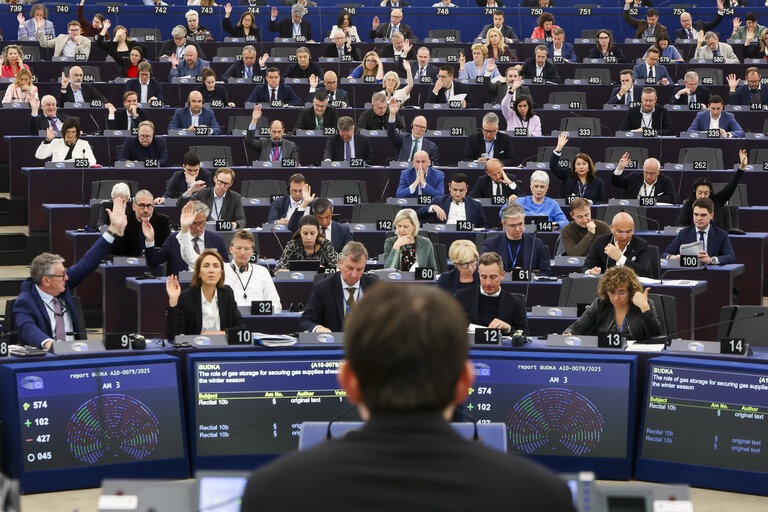
The European Parliament has taken a decisive step to bolster the bloc’s defences against potentially hostile foreign takeovers, adopting a sweeping reform of the EU’s foreign investment screening rules.
The move, passed on Thursday with 378 votes in favour, 173 against and 24 abstentions, signals a growing determination in Brussels to shield critical sectors of the economy from external threats, particularly from authoritarian powers such as China.
Under the revised rules, member states will be obliged to scrutinise foreign investments in a broad range of sensitive sectors — including media, critical raw materials and transport infrastructure — in an effort to detect and neutralise security or public order risks. The new framework will also give the European Commission greater powers to intervene in disputes and ensure consistency across the bloc
Raphaël Glucksmann, a French Socialist MEP who led the legislative push, described the current system as “fragmented, costly for investors, and insufficiently effective.” In a statement after the vote, he warned that Europe’s openness had left key industries dangerously exposed. “Leaving large industrial plants, energy grids, and media giants open to foreign takeovers — whether from China, the US, or elsewhere — ultimately puts our security and economic sovereignty on shaky ground,” he said.
The new legislation represents the EU’s most ambitious attempt yet to forge a unified approach to foreign direct investment (FDI). It reflects growing concern in European capitals that the continent’s strategic industries — from semiconductor producers to lithium extractors — are increasingly vulnerable to acquisition by non-EU entities, often with opaque ownership structures and links to authoritarian governments.
In addition to mandating national screening in high-risk sectors, the new law harmonises screening procedures and allows Brussels to initiate reviews even in the absence of a member state’s request. Crucially, it also closes a gaping loophole by covering intra-EU transactions where the ultimate owner is based in a third country — a structure commonly used to mask the origin of investment funds.
If an investment is found to pose a threat, national authorities will have the power to impose mitigating conditions — or to block the deal outright.
While the move was welcomed by a majority in the Parliament, opposition came from liberal and free-market quarters who fear the bloc is slipping into protectionism. Critics argue that the EU risks undermining its own single market principles and deterring legitimate foreign capital, particularly at a time when growth and innovation depend heavily on international partnerships.
But supporters of the reform counter that Europe has been naïve for too long. “This isn’t about closing our doors — it’s about putting up a lock where there’s been none,” said one senior EU diplomat. “The world has changed. Foreign investment is no longer just a commercial issue; it’s a geopolitical one.”
Indeed, the current screening mechanism, which has been in place since October 2020, was born out of mounting fears that foreign powers — most notably Beijing — were exploiting the EU’s open markets to gain strategic leverage. The Commission has flagged numerous cases in recent years where companies tied to foreign governments have tried to acquire control over critical EU firms, often in key technology and infrastructure sectors.
Glucksmann and his allies argue that the updated rules strike the right balance between openness and prudence. “Screening procedures will now be streamlined across member states, keeping the single market open and attractive, while also protecting our industries,” he said. “The Commission will have the authority to take final decisions in instances of disagreement, ensuring a more unified approach across the EU.”
The law is not yet set in stone. Now that the Parliament has adopted its position, negotiations with member states — who have historically been wary of ceding too much sovereignty to Brussels — will begin. The final legislative text must be agreed by both the European Parliament and the Council before it can enter into force.
Still, the message from Brussels is clear: economic sovereignty is no longer a luxury — it’s a necessity. In a world of weaponised trade, cyber-sabotage and strategic dependencies, the EU is waking up to the reality that who owns what matters as much as how well it is run.
With this vote, Europe takes one step closer to reclaiming control of its economic destiny — and shielding its core industries from the sharp edge of geopolitical ambition.
Main Image: Photographer: Fred MARVAUX © European Union 2025 – Source : EP Usage terms: Identification of origin mandatory

