
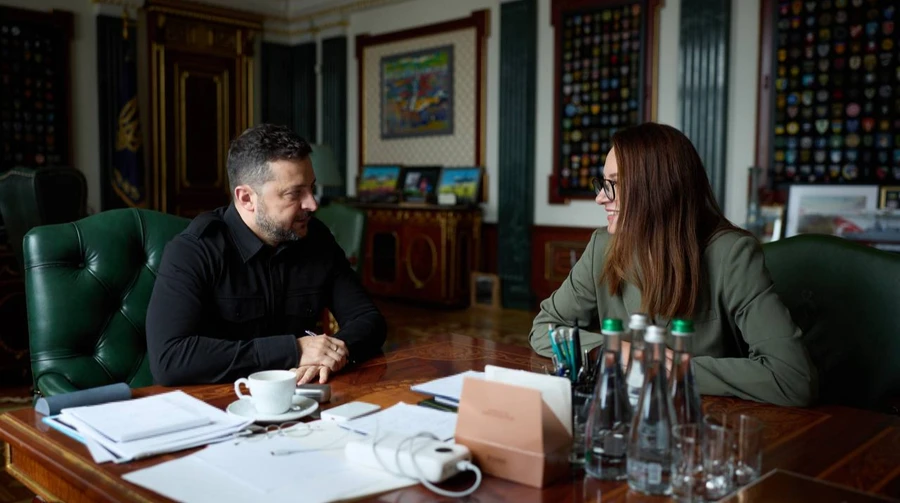
President Volodymyr Zelenskyy has triggered a broad reshuffle in Kyiv, replacing Prime Minister Yulia Svyrydenko as Ukraine tries to tighten wartime government, diplomacy and law-enforcement oversight.
KYIV – President Volodymyr Zelenskyy has opened a major wartime political reset by removing Prime Minister Yulia Svyrydenko, a decision that automatically puts Ukraine’s cabinet into transition and raises immediate questions over how Kyiv will manage defence procurement, energy security, reconstruction money and relations with its Western partners.
Svyrydenko, who became prime minister in July 2025 after serving as economy minister, stepped down as Zelenskyy said the state needed a new political strategy. The president has framed the move as a personnel refresh rather than a crisis, saying experienced officials would be assigned to priority foreign-policy portfolios and that changes in senior law-enforcement roles were also expected.
The timing makes the reshuffle more consequential than an ordinary cabinet change. Ukraine is still fighting Russia under martial law, relying heavily on external military support, and negotiating the practical details of long-term reconstruction and European Union accession. A change at the top of government therefore touches almost every operating file in Kyiv, from weapons supply to budget discipline.
Svyrydenko had been closely associated with Ukraine’s economic diplomacy. Her earlier role in securing a minerals agreement with the United States made her a familiar figure in Washington and linked her to one of Kyiv’s attempts to tie American commercial interests more firmly to Ukraine’s security. Zelenskyy has suggested she may continue in a senior external role, which would allow him to preserve her international relationships while reorganising the domestic chain of command.
The immediate question is who takes over the premiership. Ukrainian and international reporting has pointed to several possible contenders, including figures with experience in energy, defence or previous cabinet management. Each option would signal a different priority: energy resilience after repeated Russian attacks, faster defence-industrial expansion, or tighter coordination between parliament, ministries and the presidency.
For the EU, the reshuffle matters because the prime minister’s office has a central role in translating accession commitments into laws, administrative changes and anti-corruption safeguards. Brussels has supported Ukraine’s European path, but the process requires sustained attention to public procurement, judicial integrity, competition policy and state capacity. Any prolonged uncertainty in Kyiv could slow implementation, even if the strategic direction remains unchanged.
The law-enforcement element is just as sensitive. Zelenskyy’s reference to changes in senior agencies comes as Ukraine faces intense scrutiny over wartime corruption risks. Donor governments and Ukrainian civil society have repeatedly argued that military urgency cannot become a shield for opaque procurement or political protection. A reshuffle that strengthens accountability could reassure partners; one perceived as centralising control could have the opposite effect.
The move also shows the continued dominance of the presidency in Ukraine’s wartime system. Elections remain suspended under martial law, and Zelenskyy’s party still gives him a path to parliamentary approval for a new government. That may allow the transition to move quickly, but it also concentrates responsibility for the result. If the new team improves coordination, the president will claim a necessary reset. If ministries stall, he will own the disruption.
Ukraine’s partners are likely to judge the change by performance rather than personality. They will look for faster delivery of military contracts, clearer energy planning before winter, credible management of reconstruction funds and no retreat from EU-related reforms. Kyiv’s challenge is to prove that political renewal can happen without weakening the state at the point of maximum pressure.

