
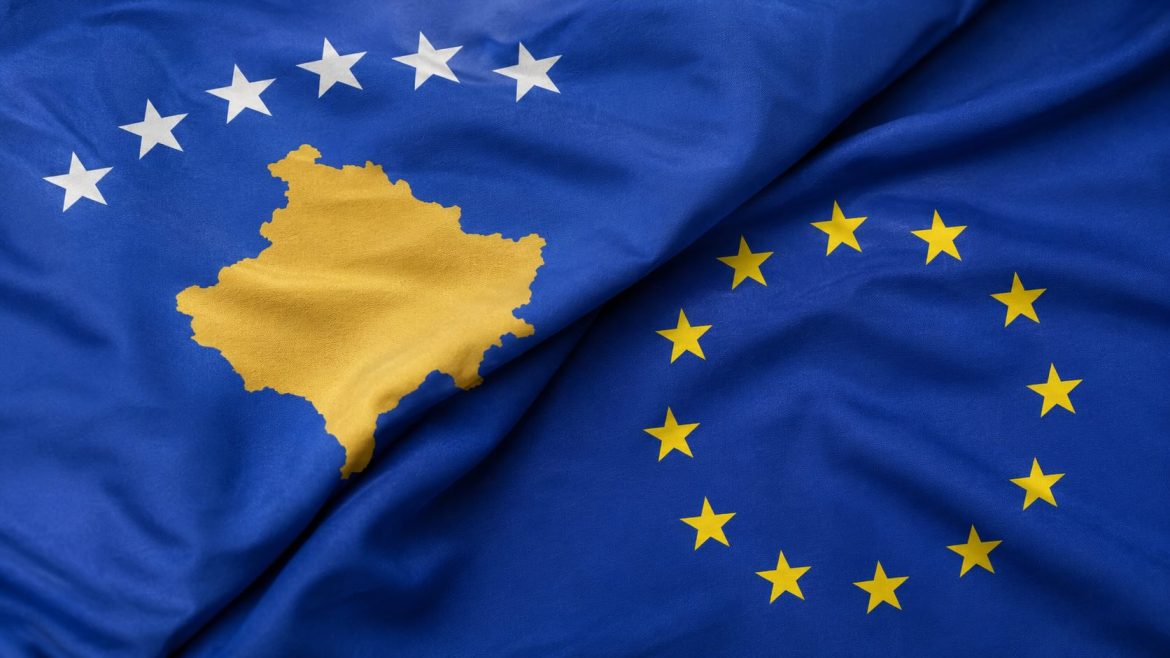
Kosovo is voting in its third parliamentary election in 18 months, with the country’s prolonged political deadlock again testing its ability to build the stable institutions required for closer integration with the European Union.
The ballot was triggered after repeated failures to resolve a constitutional and political impasse over the election of a new president. According to current reporting from Pristina, the snap vote is being held because Kosovo’s fragmented parliament failed to elect key leadership positions, leaving the country without stable institutions and delaying reforms linked to its EU ambitions.
Prime Minister Albin Kurti’s Vetevendosje party has remained the dominant force in Kosovo’s political landscape, but it has been unable to secure the broader parliamentary support needed to settle the presidency and stabilise the country’s institutions. The previous election left Kurti’s party ahead, but without the wider consensus required for key appointments in the 120-seat Assembly.
The election is therefore not only a domestic contest. It is also a test of Kosovo’s capacity to function as a partner for deeper European integration at a time when the EU is trying to revive credibility in the Western Balkans. In its latest enlargement assessment, the European Commission said the delay in forming institutions had slowed EU-related reform progress, and called for cross-party cooperation to return Kosovo to its European path.
Kosovo declared independence from Serbia in 2008, but its statehood remains contested by Belgrade and by several countries that have not recognised it. That unresolved status continues to shape its foreign policy, its relations with NATO and the EU, and its position in the EU-facilitated Belgrade-Pristina dialogue, which is intended to reach a comprehensive normalisation agreement between the two sides.
The repeated parliamentary elections now add a second obstacle. Even where Kosovo has a clear pro-Western orientation, its institutions have struggled to produce durable governing arrangements. The immediate issue is parliamentary arithmetic. Kosovo’s Assembly requires broad consensus for some key institutional decisions, including the election of the president. Vetevendosje won a strong result in the previous election, but not enough to act alone on matters requiring wider support.
Opposition parties have refused to give Kurti the support required to install his preferred candidate, turning the presidency into a trigger for wider instability. The result has been a cycle of elections, failed bargaining and institutional paralysis, with the risk that another vote may reproduce the same arithmetic rather than resolve it.
For voters, the repeated elections have become a source of frustration. Kosovo remains one of Europe’s poorest countries, with many citizens more concerned about jobs, prices, public services and emigration than another round of party manoeuvring. The political impasse has delayed reforms, slowed decision-making and complicated access to international funding.
For the EU, the situation is uncomfortable. Enlargement policy depends on the argument that reform-minded governments will be rewarded with closer ties to Brussels. Kosovo’s crisis shows the opposite problem: a country with a broadly pro-European public and political class can still find itself blocked by institutional weakness and party rivalry.
The Serbia factor remains central. Kurti has built much of his political identity around a firm position towards Belgrade, resisting concessions that he argues would weaken Kosovo’s sovereignty. His critics accuse him of deepening polarisation and failing to build the compromises needed for stable government. That tension is likely to continue even if Vetevendosje again emerges as the largest party.
The EU-mediated dialogue with Serbia has already been strained by repeated disputes over northern Kosovo, minority rights, security incidents and implementation of previous agreements. A Kosovo government weakened by internal deadlock will have limited room to negotiate, while a government that takes a harder line may struggle to satisfy EU expectations. Either outcome leaves Brussels managing an enlargement and security file with few easy options.
The election also comes at a difficult moment for the wider Western Balkans. The EU has sought to regain influence in the region amid concern over Russian, Chinese, Turkish and Gulf engagement. Montenegro, Albania, North Macedonia, Bosnia and Herzegovina, Serbia and Kosovo are all moving at different speeds, but the credibility of the whole enlargement process is affected when one part of the region remains politically stalled.
Kosovo’s allies will be looking for more than a winner. They will want a functioning parliament, a president elected within constitutional deadlines, a government able to pass reforms, and a renewed capacity to engage in talks with Serbia. Without that, another election could produce the appearance of democratic activity without resolving the institutional crisis.
There is no guarantee that Sunday’s vote will end the deadlock. Analysts expect Vetevendosje to remain strong, but not necessarily strong enough to govern without compromise on the key questions that caused the crisis. If the result merely reproduces the same parliamentary balance, Kosovo could face another period of negotiation, delay and uncertainty.
That would be a problem not only for Pristina but for Brussels. The EU’s Western Balkans policy rests on the premise that candidate and potential candidate countries can align reforms with European standards while maintaining functioning democratic institutions. Kosovo’s repeated elections show how difficult that can be when party rivalry blocks institutional continuity.
The ballot may therefore decide more than the composition of Kosovo’s next parliament. It will indicate whether the country can move beyond electoral repetition and towards stable governance. For the EU, the question is whether enlargement policy can still offer a practical route forward for a state whose European ambitions are clear, but whose political system remains trapped in deadlock.

