
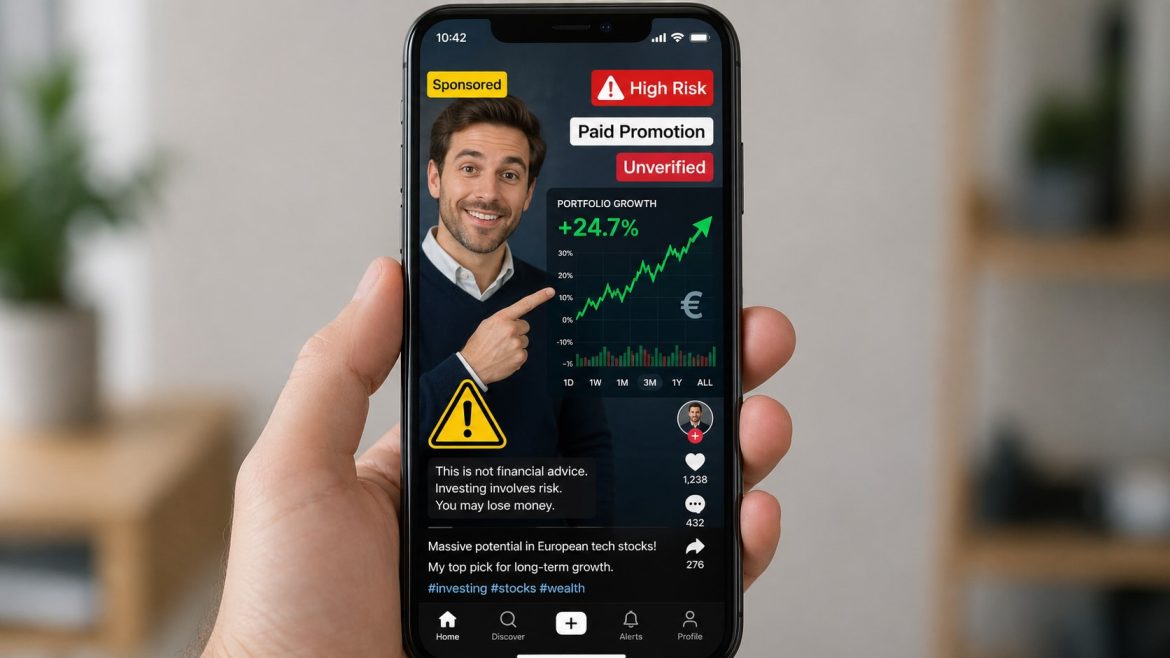
MEPs are preparing to call for minimum EU standards on financial influencers, citing concerns over hidden advertising, conflicts of interest, misleading claims, online scams and AI-enabled deepfakes.
MEPs are preparing to call for minimum standards for financial influencers as the European Parliament turns its attention to the growing role of social media in retail investment decisions.
The draft text is due to be debated on Monday 27 April, with a vote scheduled for Thursday 30 April. It forms part of an own-initiative procedure on financial literacy and the rise of financial influencers in the context of the EU’s Savings and Investments Union.
The issue has moved up the parliamentary agenda because online financial communication has become a regular source of investment information, particularly for younger people. Financial influencers can help explain markets and investment products to wider audiences, but lawmakers are concerned that the same channels can also expose consumers to hidden advertising, conflicts of interest, misleading claims and fraud.
The Parliament briefing says the draft text calls for minimum standards for social media financial communications. These would be intended to address aggressive marketing practices and online fraud, including scams using AI-enabled deepfakes. The concern is not only that inaccurate information circulates quickly, but that financial promotion can be presented as informal advice, lifestyle content or personal opinion rather than advertising or paid communication.
The proposal comes at a time when retail investment is an important part of the EU’s wider financial-policy agenda. The Savings and Investments Union is intended to encourage more European savings to move into productive investment. That policy objective depends partly on trust. If retail investors are drawn into unsuitable products or scams through online promotion, the credibility of broader market-participation efforts is weakened.
For Brussels, the challenge is to distinguish between financial education and financial promotion. Social media content can introduce citizens to basic financial concepts, investment risk and long-term saving. It can also simplify complex products or obscure risks. The problem becomes more acute when content creators receive payment, commission, token allocations or other financial benefits that are not clearly disclosed.
The draft text is therefore expected to focus on minimum standards rather than a blanket restriction on financial discussion online. Such standards could cover transparency over commercial relationships, clearer labelling of promotional material, duties around misleading claims and stronger safeguards for audiences exposed to high-risk products. The Parliament briefing does not set out a final legislative model, and any binding rules would require further institutional work.
The report also calls for stronger financial education, including age-appropriate learning in schools and adult education. It places particular emphasis on digital and media literacy, including basic cybersecurity awareness. The argument is that citizens need the skills to identify scams, assess online claims and understand when apparently neutral financial content may have a commercial purpose.
This education element is likely to be central to the debate. Financial scams increasingly rely on a combination of social trust, platform reach and technical sophistication. AI-generated images, synthetic voices and manipulated videos can make false endorsements or fabricated investment narratives appear more credible. That creates a policy problem that sits between financial regulation, consumer protection, digital enforcement and public education.
The EU already has rules governing advertising, consumer protection, financial services and online platforms. The question for lawmakers is whether those frameworks are sufficient for a market in which investment-related content can be produced quickly, distributed widely and monetised through sponsorship, affiliate arrangements or platform traffic. The Parliament’s own-initiative report will not itself create binding law, but it can shape the policy direction and increase pressure for further regulatory action.
The file is being handled under procedure 2025/2209(INI). The debate and vote will indicate how far MEPs want the EU to move towards more explicit rules for influencers who discuss investment products, market opportunities or personal finance online.
The immediate question is whether Parliament’s call for minimum standards can be turned into a practical framework. Any future EU approach would need to avoid treating all financial commentary as regulated advice, while still addressing paid promotion, undisclosed interests and deceptive content. That balance will determine whether the initiative becomes a useful consumer-protection measure or another difficult regulatory file in the EU’s expanding digital-finance agenda.

