
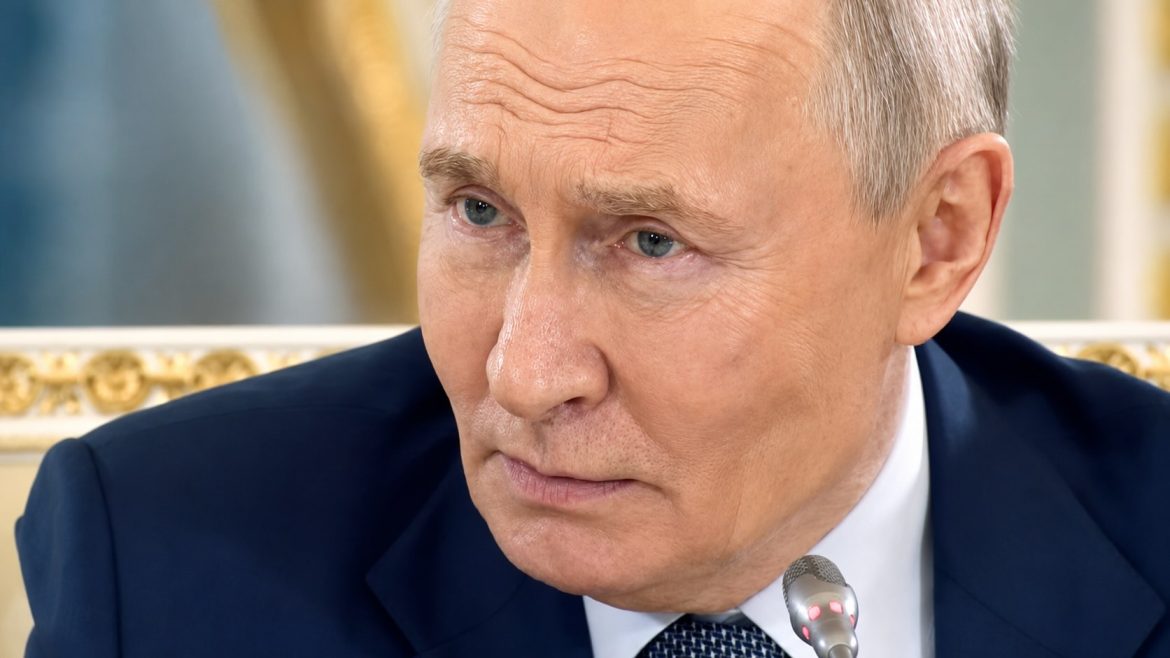
Vladimir Putin has said Russia is ready to resume gas supplies to Germany through the remaining intact line of Nord Stream 2, reopening a politically sensitive energy question that Berlin has spent more than three years trying to close.
Speaking at the St Petersburg Economic Forum, the Russian president said the surviving line of the Nord Stream 2 pipeline could send gas to Germany “tomorrow” if Berlin agreed to buy Russian gas and if US sanctions on the project were lifted. He said Russia could supply up to 28 billion cubic metres of gas a year through the route.
The offer is unlikely to produce an immediate policy shift in Berlin. Germany has repeatedly said it is not in talks to revive pipeline imports from Russia, and its post-2022 energy policy has been built around reducing dependence on Moscow. But Putin’s statement is politically significant because it targets a real pressure point in Germany: energy costs, industrial competitiveness and the continuing debate over the price of cutting Russian gas out of Europe’s largest economy.
Before Russia’s full-scale invasion of Ukraine, Germany relied heavily on Russian gas for industry, heating and electricity generation. Nord Stream 1 had been a central supply route, while Nord Stream 2 had been completed but never certified. Berlin suspended certification shortly before the invasion in February 2022. Later that year, explosions damaged both Nord Stream 1 lines and one of the two Nord Stream 2 lines, leaving one strand of Nord Stream 2 technically intact.
The damaged pipelines became a symbol of Germany’s failed bet that deep energy interdependence with Russia could support stability. Since then, Germany has replaced much of the lost Russian pipeline supply through liquefied natural gas imports, Norwegian gas, demand reduction and new infrastructure. That adjustment came at a cost. High energy prices have contributed to pressure on German manufacturers, especially in energy-intensive sectors such as chemicals, metals, glass and paper.
Putin’s offer is therefore directed not only at the German government, but at German domestic politics. On the same day, a senior official from the Alternative for Germany, Markus Frohnmaier, met Russian figures including Gazprom chief Alexei Miller and Putin’s investment envoy Kirill Dmitriev during the St Petersburg forum, despite warnings from Germany’s foreign ministry. Frohnmaier has called for the recommissioning of Nord Stream as part of a broader argument that Germany should restore energy ties with Russia.
That gives the issue a domestic political dimension. The AfD has used high energy costs and economic stagnation to attack the government’s Russia policy, arguing that sanctions and the break with Moscow have harmed German industry. Mainstream German parties, by contrast, have treated renewed Russian gas dependence as a strategic risk and a political concession to the Kremlin.
The legal and diplomatic obstacles are also substantial. Nord Stream 2 remains subject to US sanctions, and any attempt to restart flows would immediately raise questions in Washington and Brussels. It would also conflict with the EU’s wider effort to reduce and ultimately end Russian fossil-fuel imports. The European Commission has proposed a roadmap to phase out remaining Russian gas supplies, including liquefied natural gas, by 2027.
For Ukraine and its supporters, restarting Nord Stream would be more than an energy decision. It would provide Moscow with additional revenue while Russia continues its war. It would also weaken the strategic effect of European sanctions and revive a direct energy link that many Central and Eastern European states opposed long before 2022. Poland, the Baltic states and Ukraine had warned for years that Nord Stream increased Europe’s dependence on Russia while bypassing transit countries.
Russia’s position is different. Moscow has lost much of its former European gas market and has had to redirect energy exports where possible. By presenting Nord Stream 2 as an available option, Putin is seeking to show that Europe’s energy costs are the result of political choices in Berlin, Brussels and Washington rather than Russian policy. The message is aimed at German businesses and voters as much as at policymakers.
The offer also comes at a time when German industry remains under pressure from weak growth, high input costs and competition from the United States and China. For some companies, cheaper gas would be commercially attractive. But the political price of accepting Russian pipeline gas would be high, particularly while the war in Ukraine continues and while Germany remains one of Kyiv’s main European supporters.
The question is therefore not whether the remaining Nord Stream 2 line can technically carry gas. The harder issue is whether Germany is prepared to reverse one of the central strategic decisions it made after 2022. Doing so would require Berlin to justify renewed dependence on Moscow, negotiate around US sanctions, confront opposition inside the EU, and absorb the diplomatic cost with Ukraine.
For now, Putin’s offer is best understood as political pressure rather than a practical energy proposal. It exploits Germany’s unresolved tension between industrial competitiveness and strategic security. It also tests whether the debate over Russian gas can be reopened through economic strain, domestic opposition politics and the continuing appeal of cheaper energy.
Germany’s answer is likely to matter beyond the pipeline itself. If Berlin rejects the offer, it will reaffirm the post-2022 energy break with Moscow despite the economic cost. If the debate gains ground domestically, Nord Stream may return as a fault line in German politics, even without gas flowing through it.

