
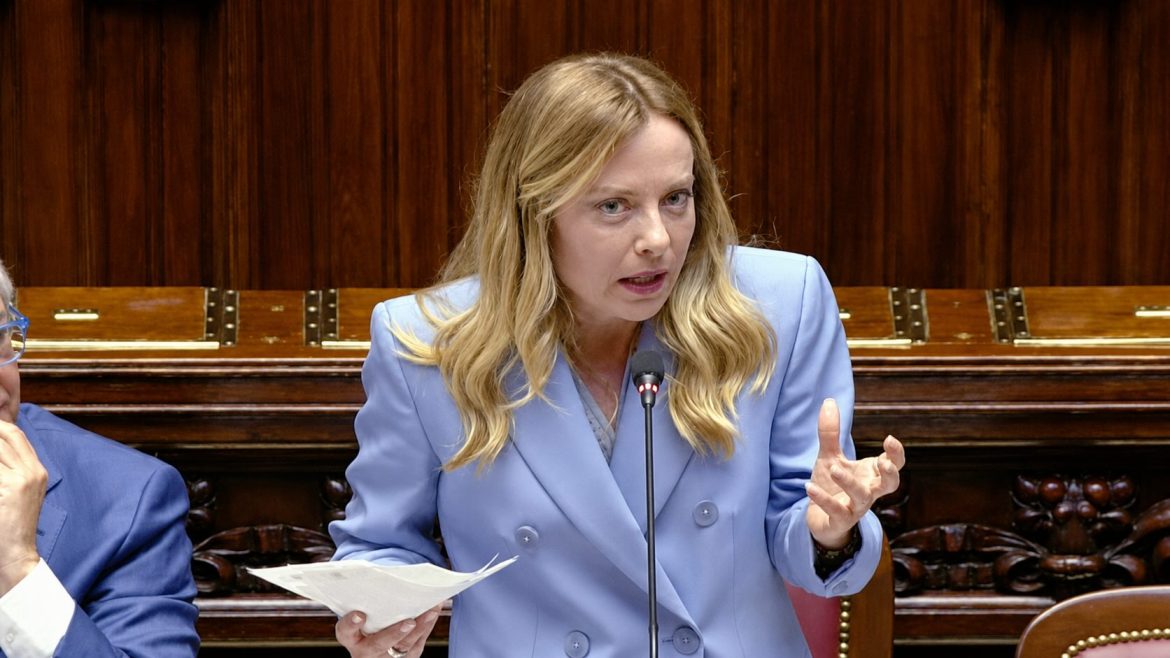
Italian Prime Minister Giorgia Meloni has challenged the role of smaller European formats in any future talks with Russia, arguing that Ukraine’s allies should appoint a single representative rather than allow a limited group of capitals to speak for the wider European Union.
Her intervention adds a new layer to the debate over Europe’s role in any diplomatic process linked to Russia’s war against Ukraine. The issue is no longer only whether Europe should speak to Moscow, but who would have the authority to do so.
Speaking to lawmakers in Rome, Meloni said European allies of Ukraine should designate one representative for talks with Russia and questioned whether smaller formats could legitimately represent the whole bloc. Her remarks, reported from Rome on Thursday, were directed in particular at the informal E3 grouping of Britain, France and Germany.
The E3 has become one of the main European diplomatic formats on Ukraine. Its leaders met President Volodymyr Zelenskyy in London earlier this week, where they endorsed his proposal for direct ceasefire talks with Russia and set out European conditions for any future settlement. Those conditions included an immediate ceasefire, security guarantees for Ukraine, and the continued immobilisation of Russian assets until Moscow compensates Ukraine for war damage.
That meeting, however, also exposed the limits of the format. Britain is no longer an EU member state. France and Germany are the bloc’s two largest powers, but they do not speak for all member states. Poland and Italy, both central to Europe’s Ukraine policy in different ways, were not part of the London meeting.
Meloni’s criticism follows similar concerns from Warsaw. Polish Prime Minister Donald Tusk said this week that Poland should be involved in talks on ending the war in Ukraine, arguing that Warsaw’s support for Kyiv and its position on NATO’s eastern flank made its exclusion difficult to justify. EU Today has already reported on Poland’s demand for a place in Ukraine talks, which now appears to be part of a wider dispute over diplomatic representation.
The Italian position is different from a call to soften policy towards Moscow. Meloni has remained a strong supporter of Ukraine and has repeatedly backed pressure on Russia. In April, she said economic pressure remained the most effective instrument for pushing Moscow towards peace, in comments linked to the debate over Russian energy imports and sanctions.
Her latest argument is instead about control of the diplomatic process. If talks with Russia begin, Rome does not want Europe represented by a narrow group of capitals whose political weight is not matched by a formal mandate from the EU as a whole.
That concern has practical consequences. Any future Ukraine settlement would affect the security of all European states, not only those sitting in the negotiating room. It would raise questions over sanctions, frozen Russian assets, security guarantees, reconstruction financing, defence commitments and the future relationship between Europe, Russia and the United States.
For Poland, the issue is immediate geography and security. Poland borders both Ukraine and Belarus, hosts large numbers of Ukrainian refugees, and has become a major logistics hub for military and humanitarian support. Warsaw argues that a diplomatic process affecting Ukraine’s future cannot be shaped without one of Kyiv’s most important neighbouring supporters.
For Italy, the issue is political legitimacy and European balance. Rome has often objected to formats in which France and Germany appear to set the direction of European policy before seeking broader endorsement. Meloni’s intervention suggests that Ukraine diplomacy is now entering the same institutional dispute that has appeared in other areas of EU policy: whether Europe is led by its largest capitals or by a structure that gives other member states a direct voice.
The debate also reflects uncertainty over the United States. Since Donald Trump returned to the White House, European governments have had to consider whether Washington could move towards a negotiating position that does not fully reflect Europe’s long-term security interests. That makes European coordination more important, but also more difficult.
If Europe is divided over who represents it, Moscow will have an opening. Russia has long sought to exploit differences between European states, between the EU and Britain, and between Europe and the United States. A fragmented diplomatic format could make it easier for Moscow to test which capitals are prepared to compromise, which are more cautious, and which are excluded from the process.
The matter is also likely to follow leaders into the G7 summit in Évian, where Ukraine, Iran and relations with the United States are expected to dominate discussions. The summit will bring together the United States, Canada, Britain, France, Germany, Italy, Japan and the European Union. That makes it an obvious setting for the question Meloni has raised: whether Europe can coordinate its position before wider diplomacy begins.
The immediate difficulty is that no single European representative currently has an undisputed mandate to negotiate with Russia on Ukraine. The EU’s foreign policy chief can speak for the bloc in institutional terms, but member states retain control over national security and foreign policy decisions. Britain remains central to Ukraine’s defence but is outside the EU. France and Germany have diplomatic weight but face resistance from other capitals when they act through smaller formats.
Meloni’s intervention therefore points to a structural weakness in Europe’s Ukraine policy. The EU has shown unity on sanctions and financial support, but diplomacy over a possible settlement is more sensitive because it touches directly on sovereignty, national security and post-war order.
The dispute over the E3 is not procedural. It is about who would define Europe’s position if talks with Russia move from speculation to negotiation. For Ukraine, the answer matters because the composition of the room could influence the terms placed on the table. For Europe, it matters because any settlement reached without a broad mandate would be difficult to defend, finance and enforce.
The question now is whether Meloni and Tusk are pushing for a better-coordinated European position, or whether their objections will expose another division at the moment Europe most needs one voice.

