
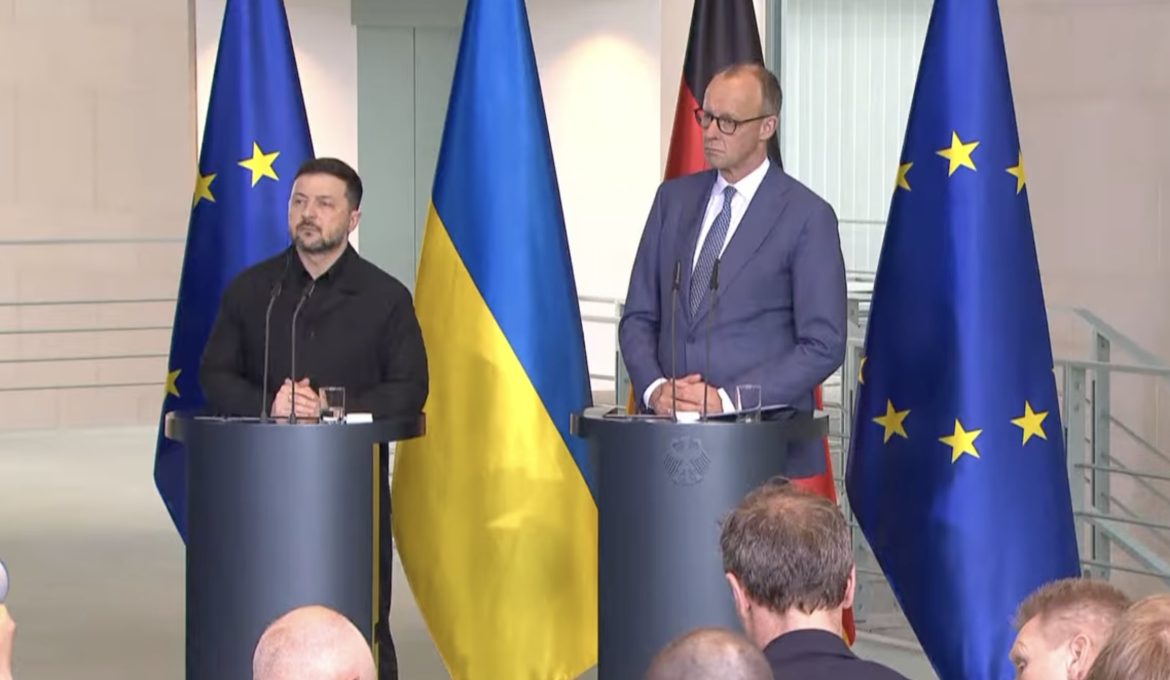
President Volodymyr Zelenskyy has rejected the idea of Ukraine accepting a reduced form of membership in the European Union, arguing that Kyiv’s future role in Europe cannot be separated from its military strength and security contribution.
Speaking in Berlin on Tuesday alongside German Chancellor Friedrich Merz, Zelenskyy said Ukraine was not seeking a “lite” version of either EU or NATO membership. His comments followed questions about proposals reportedly discussed within the EU under which Ukraine could join the bloc while receiving limited powers in decision-making.
“Everyone in Europe knows our position. We do not need an EU ‘lite’, just as we do not need NATO ‘lite’,” Zelenskyy said. “Europe and NATO countries need Ukraine as a full and strong partner. They need our army, a strong army. Nobody needs a Ukrainian army ‘lite’. What kind of protection would that provide?”
The remarks underline Kyiv’s concern that political pressure to accelerate enlargement could result in a compromise arrangement falling short of full membership. Ukraine has repeatedly argued that its accession to the EU should be treated not only as a matter of institutional reform, but also as a strategic response to Russia’s war.
The Berlin meeting came as Germany and Ukraine announced deeper defence co-operation, including agreements on drone production and advanced defence systems. Merz said support for Ukraine was also an investment in European security and defence industry capacity. Germany has become Ukraine’s largest European military supporter, with Reuters reporting that Berlin has provided about €55 billion in aid since Russia’s full-scale invasion in 2022.
Merz, however, cautioned that Ukraine’s EU accession could not happen quickly. His position reflects wider hesitation among several member states over the feasibility of admitting Ukraine by 2027, despite continuing debate in Brussels over accelerated or phased accession models.
Ukraine was granted EU candidate status in June 2022, and accession negotiations were formally opened later. The central question now is whether the EU can reconcile geopolitical urgency with its existing enlargement procedures, which require extensive legal, economic and institutional alignment.
For Kyiv, the issue is also political. A reduced form of membership, especially one limiting Ukraine’s role in EU decision-making, could be seen domestically as a second-tier settlement after years of war and reform. Zelenskyy’s comparison with a “lite” Ukrainian army was intended to frame the debate in security terms: Europe cannot expect Ukraine to act as a front-line strategic partner while offering only partial integration.
The discussion also comes amid shifting EU politics. The recent defeat of Viktor Orbán in Hungary may reduce one of the main obstacles to Ukraine-related decisions in Brussels, although it does not remove broader caution among governments concerned about budgetary costs, agricultural competition, institutional voting power and the implications of admitting a large country at war.
Zelenskyy’s position is therefore clear: Ukraine wants full membership, not a provisional status designed to satisfy political symbolism while withholding influence. For Berlin and other EU capitals, the challenge is how to maintain credibility on enlargement while ensuring that accession remains legally and institutionally workable.
The Berlin visit showed both sides of the issue. Germany is expanding practical defence co-operation with Ukraine, particularly in drones and military production. At the same time, Merz made clear that EU accession remains a complex and lengthy process.
Ukraine’s message, however, is unlikely to change. Kyiv sees EU and NATO integration as part of the same strategic question: whether Europe intends to treat Ukraine as a buffer state, a candidate in waiting, or a full participant in the continent’s political and security order.

