
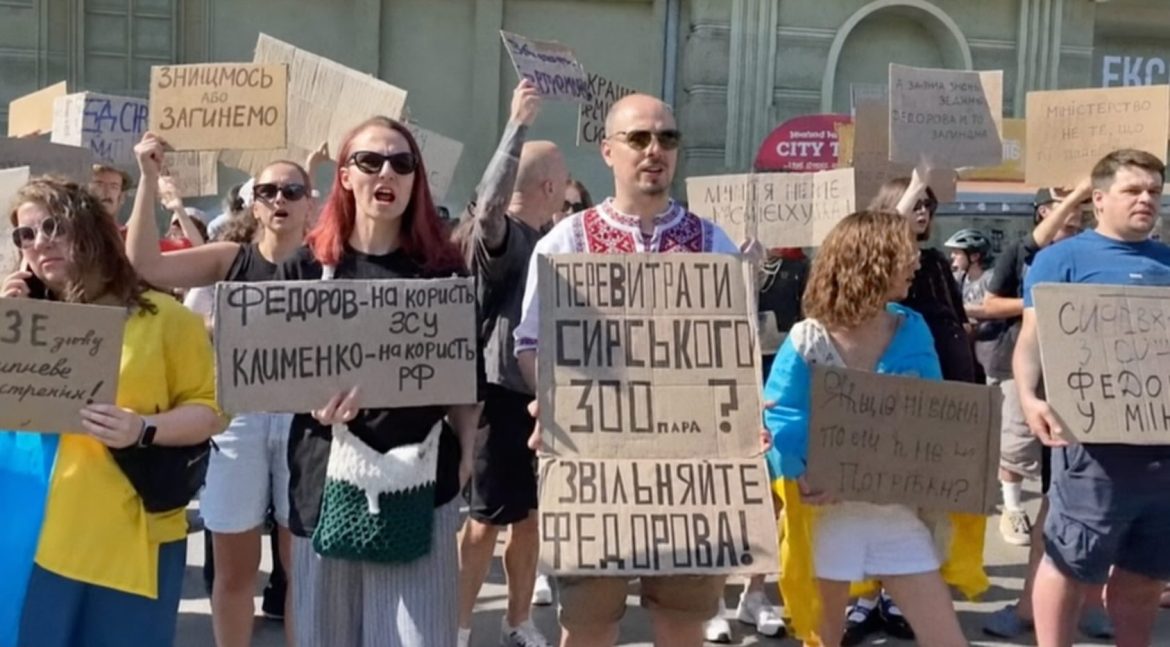
Demonstrations in Kyiv and several regional cities have called for Mykhailo Fedorov to remain Ukraine’s defence minister, while European Defence Commissioner Andrius Kubilius has warned that his departure raises questions about the continuity of EU-backed weapons and drone programmes.
Protests have taken place in Kyiv and several other Ukrainian cities against the removal of Mykhailo Fedorov as defence minister, adding public and European pressure to President Volodymyr Zelenskyy’s latest government reshuffle.
Several hundred people assembled on Franko Square, close to the presidential administration in central Kyiv, on Thursday morning. Demonstrators carried cardboard placards reading “Fedorov is defence minister”, “Hands off Fedorov”, “Do not touch what works” and “For what?”
Participants also chanted in support of the outgoing minister. Similar demonstrations were reported in Ivano-Frankivsk, Vinnytsia, Lutsk, Dnipro, Odesa and Lviv. The protests have been described as “cardboard protests” because participants were encouraged to bring handwritten signs made from packing boxes.
The format recalls the wartime demonstrations held in July 2025, when Ukrainians opposed legislation affecting the independence of the National Anti-Corruption Bureau and the Specialised Anti-Corruption Prosecutor’s Office.
Thursday’s demonstrations were called after it became clear that Fedorov would not be reappointed to the Ministry of Defence in the incoming government. The cabinet reshuffle and public response have placed Zelenskyy’s defence-sector personnel decisions under unusual scrutiny during the continuing war with Russia.
Interior Minister Ihor Klymenko is expected to replace Fedorov, although the appointment requires parliamentary approval. Fedorov is reportedly expected to remain within the president’s team, but no new position has been announced.
The change follows the Verkhovna Rada’s acceptance on 14 July of Prime Minister Yulia Svyrydenko’s resignation, which brought down the government under Ukraine’s constitutional procedure. Parliament was expected to vote on the composition of the new cabinet on 16 July.
Fedorov published an account of his work at the Defence Ministry on Wednesday, listing completed projects and initiatives that had not yet been implemented. He said he would continue his mission of defeating Russia through “asymmetry, the speed of innovation and the strength of organisation”.
Zelenskyy had appointed Fedorov defence minister in January, saying that the former digital transformation minister was closely involved in Ukraine’s Drone Line programme and would be responsible for accelerating digital and organisational changes in the armed forces.
His short tenure was associated with an expansion of drone procurement, interceptor programmes, digital management systems and measures intended to prevent Russian forces from using Starlink terminals. In March, Fedorov told a government meeting that Ukraine had identified its 2026 requirements for drones, artillery, air defence and other strike capabilities.
Kubilius seeks continuity
The proposed change has also prompted a public intervention from European Commissioner for Defence and Space Andrius Kubilius, who described the news as a “big surprise”.
Kubilius said EU officials had worked closely with Fedorov and Deputy Defence Minister Serhiy Boiev on arrangements for financing weapons production in Ukraine. He said the first list of eligible weapons and an initial timetable for using European funding for drone production had already been approved.
The commissioner’s immediate concern is whether those agreements and procedures will survive the change of minister. The EU’s Ukraine Support Loan allocates €60 billion to defence requirements in 2026 and 2027. Of that amount, €28.3 billion is scheduled to support Ukrainian defence capabilities and industrial production in 2026.
Kubilius said the first funds had reached Ukraine and another tranche was expected during the week. The money could be used for missiles, combat aircraft and other priority equipment.
He also referred to planned work on the Freya anti-ballistic system and Ukrainian production of ballistic missiles, arguing that these programmes must continue regardless of personnel changes. Kubilius had previously identified implementation of the €60 billion defence package as a central element of EU-Ukraine defence co-operation.
The reshuffle therefore concerns more than the identity of the next minister. Kyiv must now demonstrate that procurement schedules, industrial contracts, drone production and joint programmes with European partners will continue without administrative delay.
Neither Zelenskyy’s office nor Fedorov had initially issued a response to Thursday morning’s demonstrations. Parliament’s vote on the new cabinet will determine whether the protests and questions from Brussels alter the proposed defence appointment.

