
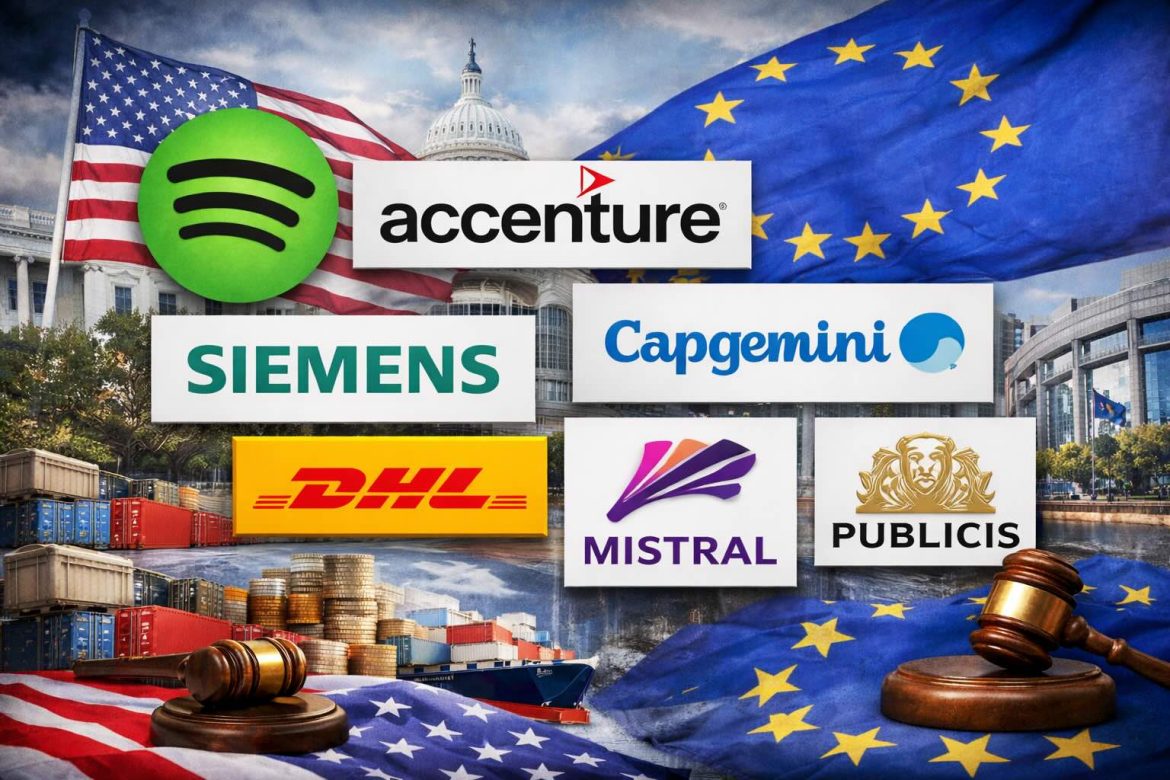
The Trump administration has warned that it could impose fees or restrictions on European service providers, naming companies including Spotify, as it escalates a dispute with Brussels over the European Union’s regulation of the technology sector.
In a statement posted by the Office of the United States Trade Representative (USTR) on Tuesday, 16 December, Washington accused the EU and some member states of a “continuing course” of lawsuits, taxes, fines and directives that it said disadvantage American service providers. The USTR said European companies had, by contrast, been able to operate in the United States “freely” for decades.
The post listed a series of European firms that it said could face responsive measures if the EU continued what Washington described as discriminatory treatment. Alongside Spotify, the names included Accenture, DHL and Siemens, as well as Amadeus, Capgemini, Mistral, Publicis and SAP. The USTR said US law allows the assessment of fees or restrictions on “foreign services”, among other actions.
The warning was framed as part of a broader argument that EU regulatory enforcement has largely fallen on US-headquartered technology groups. The USTR cited recent years of investigations and penalties involving Google, Apple, Amazon, Microsoft, Meta and X, presenting these actions as a pattern of pressure directed at American companies.
The immediate backdrop is the European Commission’s decision earlier this month to fine X €120 million (about $140 million) under the Digital Services Act (DSA), in the first sanction under the bloc’s flagship online content legislation. The case followed a two-year investigation and was presented by EU officials as an enforcement action focused on compliance requirements rather than national origin.
The USTR statement also argued that US service companies provide services that support European jobs and investment, and suggested the dispute could extend beyond the EU if other governments followed what it described as an “EU-style strategy” for regulating technology firms.
In Brussels, the European Commission rejected the claim that its rulebook is discriminatory. Thomas Regnier, a Commission spokesman, said EU rules apply “equally and fairly” to all companies operating in the bloc and that enforcement is carried out “without discrimination”. He added that the EU would continue to work with the United States within existing trade commitments and remain engaged on transatlantic trade issues.
The confrontation sits within a wider transatlantic argument about how to police dominant online platforms and digital markets. The EU’s recent legislative package, including the DSA and the Digital Markets Act, is designed to require large platforms to meet stricter obligations on transparency, content governance and market conduct. European officials argue the framework is technology-neutral and applies by reference to activity and scale, rather than nationality.
US officials, by contrast, have increasingly treated EU digital regulation as a trade issue. The US government has linked reductions in US steel import tariffs to weaker EU digital rules and has instructed diplomats to lobby against the EU’s laws, indicating that the dispute is not confined to a single enforcement decision.
For the European companies named by the USTR, the episode introduces uncertainty even if no concrete measures are announced. Some of the firms listed are not consumer-facing technology platforms but major service providers, consultancies and enterprise suppliers with significant US operations or US-listed securities. Spotify, although headquartered in Europe, is listed in the United States and has its largest user bases across multiple markets, including North America and Europe.
The USTR did not set out a timetable for action, nor did it specify which legal mechanisms would be used. In practice, any move to impose fees or restrict access for European services could raise complex questions about coverage under trade agreements, potential retaliation, and the scope of US authorities over cross-border services.
The EU, meanwhile, faces its own balancing act. European policymakers have made digital regulation a central element of the bloc’s single-market agenda, arguing that consistent enforcement is needed to protect users and ensure fair competition. At the same time, Brussels has sought to prevent regulatory disputes from spilling into wider trade relations with Washington.
With both sides publicly hardening their positions, the next test is whether the USTR’s warning becomes a negotiating lever or the opening step in a more formal trade confrontation over the EU’s approach to technology regulation.

