
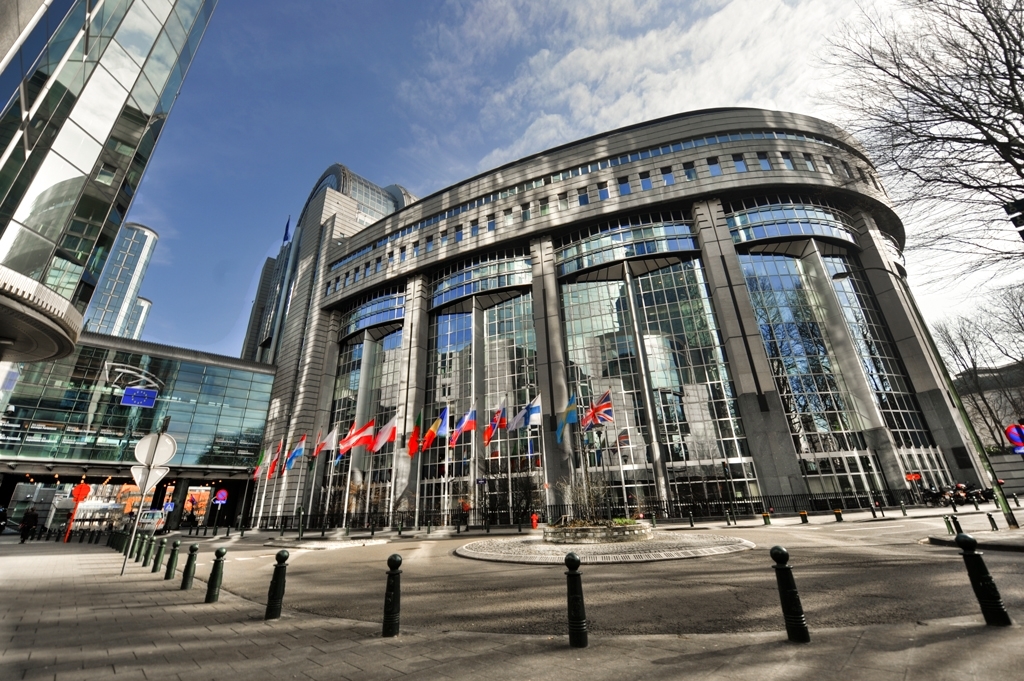
Belgian police have conducted a series of raids as part of an investigation into corruption within the European Parliament.
The alleged wrongdoing, masked under the guise of commercial lobbying, has led to several detentions and has cast a yet another shadow over the integrity of Brussels’ political landscape.
Authorities confirmed that searches took place at 21 locations across Brussels, Flanders, and Wallonia, alongside coordinated actions in Portugal and France. The investigation, which centres on bribery, forgery, and potential money laundering, has prompted renewed scrutiny of foreign influence within EU institutions.
At the heart of the scandal lies Chinese tech giant Huawei.
According to Belgian newspaper Le Soir, the probe focuses on Huawei’s lobbying activities in Brussels since 2021. The Belgian prosecutor’s office has indicated that corruption allegedly took place “regularly and very discreetly” under the pretext of legitimate lobbying, involving excessive gifts such as lavish dinners, travel expenses, and invitations to prestigious football matches.
Belgian police, acting on judicial orders, sealed two offices within the European Parliament. These offices reportedly belong to parliamentary assistants suspected of involvement in the illicit activities. Officials confirmed that no sitting MEPs were directly targeted in Thursday’s raids, though up to 15 former and current MEPs are believed to be under investigation.
A European Parliament spokesperson stated: “We received a request from the Belgian authorities to cooperate and support the investigation. We will honour that request quickly and fully.”
In addition to the Belgian raids, a suspect was arrested in France following the issuance of a European arrest warrant, while local police searched an address in Portugal.
Huawei, a global telecommunications leader, has responded to the allegations with measured caution. A company spokesperson said: “We take these allegations seriously and will urgently communicate with the investigation.”
The company further reiterated its stance against corruption, stating: “Huawei has a zero-tolerance policy towards corruption or other wrongdoing, and we are committed to complying with all applicable laws and regulations at all times.”
Nevertheless, reports indicate that several suspected lobbyists linked to Huawei have been detained. They stand accused of attempting to bribe current or former MEPs in order to influence EU trade policy in the company’s favour.
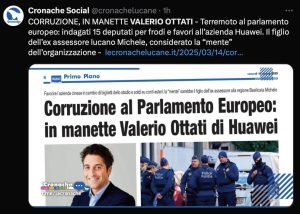
One notable suspect is Valerio Ottati, a 41-year-old Belgian-Italian lobbyist for Huawei.
Having joined the company in 2019, Ottati previously worked as an assistant to two Italian MEPs affiliated with both centre-right and centre-left parties. Both politicians were members of a European Parliament group focusing on China policy, raising further questions about Huawei’s long-standing efforts to cultivate influence in Brussels.
The prosecutor’s office has laid out the suspected mechanisms of corruption, which reportedly included monetary compensation for political positions, extravagant hospitality, and undisclosed financial transactions. These inducements were allegedly designed to encourage European lawmakers to advocate for Huawei’s interests within the EU’s legislative framework.
While bribery, forgery, and money laundering are under investigation, authorities have clarified that they are not currently examining foreign interference—a charge that could carry even graver implications. However, sources close to the investigation have suggested that Huawei may have at least facilitated, if not orchestrated, some of the alleged misconduct.
As authorities continue to interrogate suspects, further revelations are expected in the coming weeks. Whether the accused individuals acted independently or were directed by Huawei’s senior management remains an open question.
The European Parliament, already reeling from past corruption scandals, faces fresh demands for increased transparency and stricter oversight of lobbying activities. The unfolding investigation could have far-reaching consequences, not only for those implicated but also for the broader landscape of EU-China relations.
For now, Brussels watches with bated breath as investigators seek to untangle what could prove to be one of the most significant lobbying scandals in recent EU history.
_____________________________________________________________________________________________________________________

Eva Kaili, Greek MEP at the centre of the Qatargate scandal
QATARGATE: “EU SHOULD ‘QUESTION ITS OWN INTEGRITY’ IN CORRUPTION SCANDAL” SAYS DOHA NEWS
Qatar has weighed into the Qatargate controversy by alleging that “the impact of corruption within the EU from all member states combined allegedly amounts to nearly 1,000 billion Euros, or 6.3% …
_____________________________________________________________________________________________________________________

