
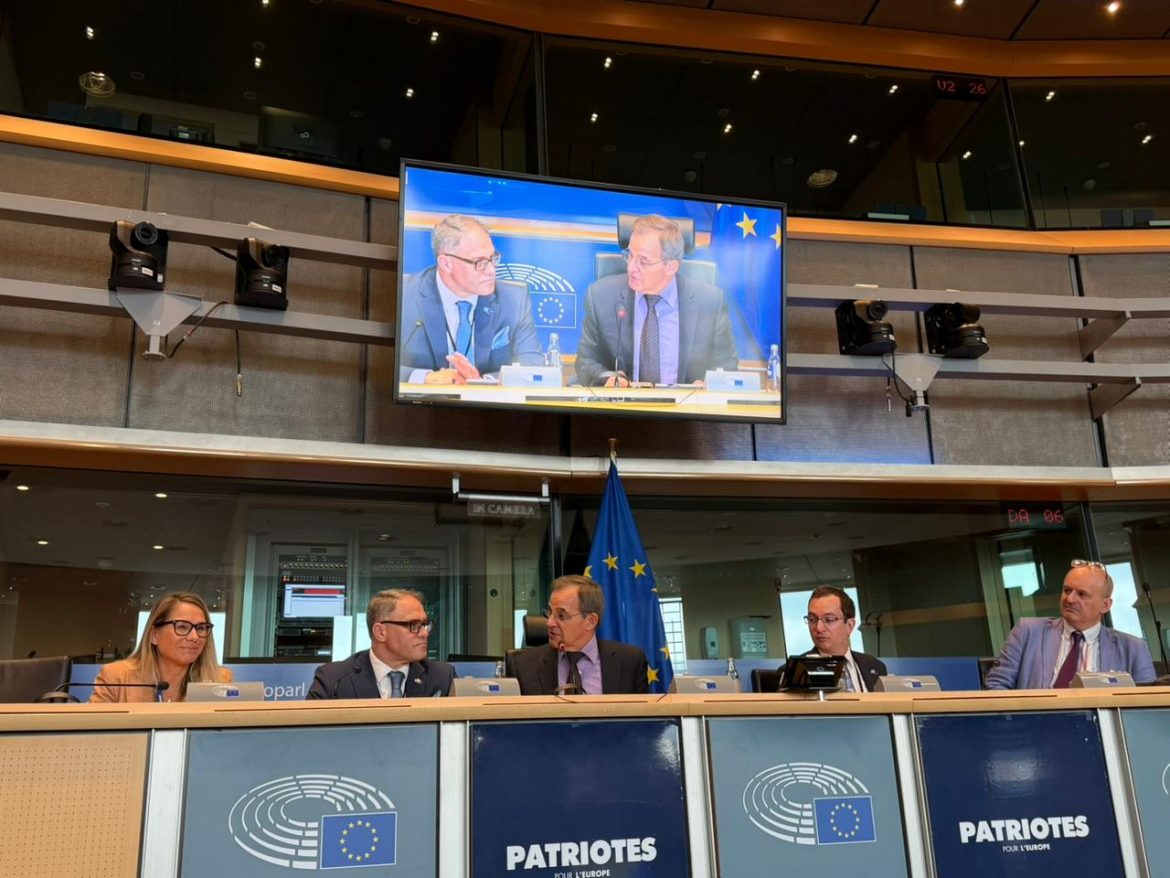
Political modernisation in Kazakhstan and the future of the EU-Kazakhstan strategic partnership took centre stage at a dedicated roundtable conference held on Thursday 11th June at the European Parliament.
Organised by the “Patriots for Europe” political group, the event drew substantial cross-factional interest, attracting members from three distinct European Parliament political groups, including key representatives from the Delegation for relations with the countries of Central Asia and Mongolia (DCAS).
The discussion, initiated by Thierry Mariani, a prominent French MEP and leading member of the “Patriots for Europe” group, brought together European lawmakers, diplomats, and international analysts.
The Kazakh delegation was led by Roman Vassilenko, Ambassador Extraordinary and Plenipotentiary of the Republic of Kazakhstan to the Kingdom of Belgium and Head of the country’s Mission to the European Union and NATO.
A Transition in a Challenging Geopolitical Arena
Opening the floor, Alberto Turkstra, Project Director of the Brussels-based «Diplomatic World» magazine, underlined the immediate relevance of Kazakhstan’s domestic political processes to the European Union’s own strategic and economic interests in the region.
In his address, MEP Thierry Mariani emphasised that Central Asia’s geopolitical weight in European foreign policy is growing exponentially.
He pointed out that Kazakhstan has been undergoing profound systemic changes since 2022, following a series of unprecedented constitutional reforms launched by President Kassym-Jomart Tokayev to decentralise power and reinforce democratic accountability.
“Despite deeply constrained geopolitical context, Astana chooses the path of gradual, sovereign modernisation at its own pace. It is precisely this pragmatism that we must understand, and we must never substitute it with our own rigid templates of perception.” — Thierry Mariani, MEP
Mariani further noted the significance of the next major step in this political evolution: the transition towards a single-chamber legislative framework, scheduled to fully materialise following the institutional restructuring that consolidates the parliamentary architecture. This transition, he argued, represents a tangible and visible maturation of the state structure under challenging regional conditions.
Strengthening Democratic Institutions
The sentiment of constructive engagement was echoed by Virginie Joron, a member of the European Parliament’s Central Asia Delegation (DCAS). She confirmed that the ongoing institutional adjustments in Kazakhstan are being closely monitored and viewed with genuine interest within the European Parliament.
“It is of great importance to me to continue this partnership and dialogue, because sometimes in Europe they do not fully understand what exactly is happening in Central Asia and in Kazakhstan in particular,” she said.
“The day’s main conclusion was that we have seen that Kazakhstan and the European Union have similar views on the geopolitical situation, as well as on solving problems with raw materials (which is critically important for the EU), climate change and innovation. It was very helpful to hear from the Kazakhstan Ambassador that we are on the same level of strategic understanding.
“When I visited Kazakhstan in November 2024, I had a clear feeling that the citizens supported the government and were following these reforms. We have not seen mass street protests — for example, in France, if people disagree with something, they immediately take to the streets. In Kazakhstan, even when the reforms were just being prepared, the situation remained stable.
“I see that the president Tokayev is doing a lot for the country, opening up a space for discussion and holding a national referendum. Holding a referendum is a unique precedent for Central Asia. The fact that the government is opening new institutions and holding a plebiscite indicates the president’s real desire to be closer to the citizens and respond to their request for democratisation.”
The event concluded with a shared consensus that future relations between Brussels and Astana must be viewed through a comprehensive lens—one that embraces mutual strategic clarity and moves past superficial assessments to appreciate the pragmatic steps being taken on the ground.
Click here for more News & Current Affairs at EU Today
Click here to check out EU TODAY’S SPORTS PAGE!
___________________________________________________________________________________________________________________

