
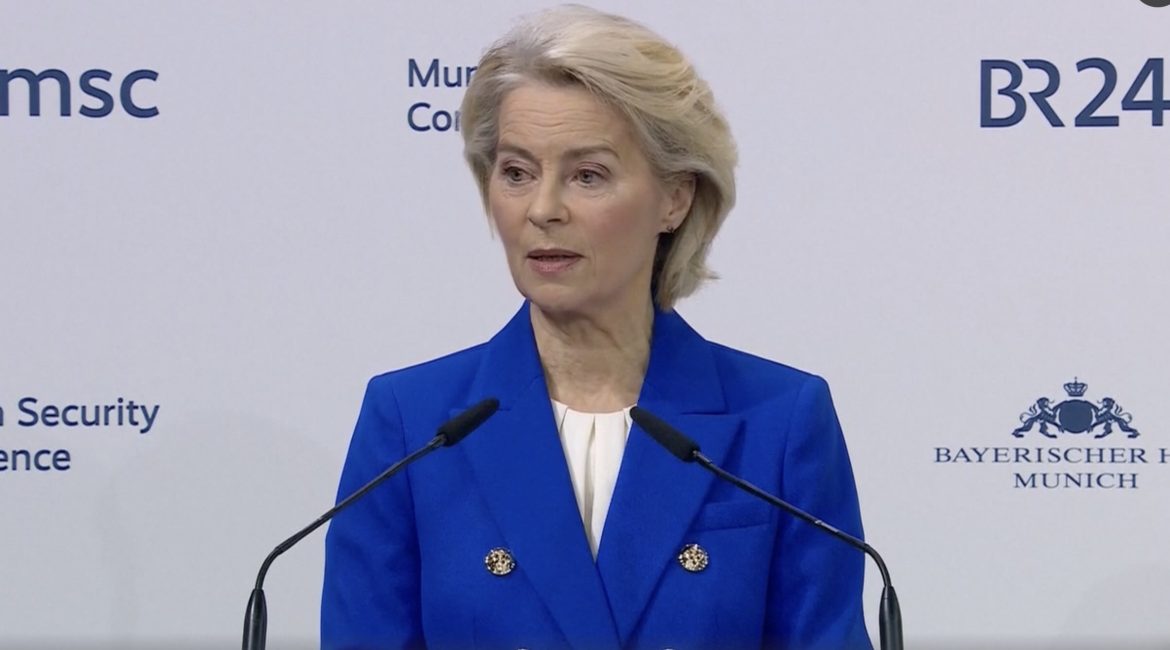
Ursula von der Leyen’s Munich Security Conference speech on 14 February 2026 was less a rallying call than a bid to redefine what “European security” now means in institutional terms: a shift from reliance to responsibility, from declarations to mechanisms, and from unanimity to workable decision-making.
Her central line — “Europe must become more independent. There is no other choice” — was not presented as a slogan, but as the organising principle for defence spending, industrial policy, treaty obligations, and partnerships.
The most consequential part of the speech was her attempt to move the debate away from NATO burden-sharing and towards the EU’s own legal and political toolkit. Von der Leyen argued that Article 42(7) — the EU’s mutual defence clause — should be “brought to life”, calling it “not an optional task” but “an obligation” and framing it as a core meaning of the Union: “one for all and all for one”. That is a deliberate challenge to the comfortable ambiguity that has surrounded 42(7) since it was invoked after the 2015 Paris attacks but never turned into a standing doctrine. She was, in effect, asking whether the EU can act as a security actor even when NATO remains the main military structure.
This connects directly to how Europe has evolved since the last Munich conference. In 2025, JD Vance’s address was widely interpreted by European officials as a warning that the United States might define transatlantic solidarity more narrowly, and judge European partners not only by defence budgets but by internal political disputes. Rubio’s speech struck a warmer tone — insisting the United States had no intention of walking away from the transatlantic alliance — but it offered few operational specifics and largely skirted the central European preoccupations of Russia and NATO. The difference matters. In 2025, Europe heard a political critique. In 2026, it heard reassurance without operational guarantees. Von der Leyen’s answer was to treat “independence” as insurance against ambiguity, not as a divorce from the United States.
Her numbers were chosen to make that case. She said European defence spending in 2025 was up close to 80 per cent compared with pre-war levels, and that the EU is “mobilising up to EUR 800 billion”, citing the SAFE programme and investments ranging from air and missile defence to drones and military mobility. The claim is not simply that Europe is spending more, but that it is trying to spend in a way that produces capabilities rather than announcements — an implicit acknowledgement of Europe’s long-running problem: fragmented procurement and slow delivery.
The speech’s Ukrainian subtext was equally clear. Von der Leyen treated Ukraine as a teacher of modern war, arguing that deterrence depends on industrial capacity: producing, scaling, sustaining. She cited drones as responsible for around 80 per cent of battlefield damage in Ukraine and spoke of tearing down the wall between civilian industry and defence, speeding “dual use” innovation in AI, cyber, space and unmanned systems. Her reference to an EU defence innovation office in Kyiv was not decorative; it was a statement that Europe intends to absorb wartime adaptation into its own defence economy.
Her insistence on faster decision-making sharpened that point. She suggested relying on qualified majority outcomes rather than unanimity in certain cases, arguing that the EU should “use the treaty we have” and be “creative”. This is directly related to a live problem: the ability of individual leaders to slow or block common positions on Ukraine, sanctions, and financing. The Hungarian election campaign illustrates the pressure point. Viktor Orbán has framed the 12 April 2026 parliamentary vote as “war or peace”, reinforced by state-backed messaging against EU financial aid for Ukraine and against Kyiv’s EU membership. Whether Orbán retains power or is constrained after the election, the broader issue remains: can the EU sustain wartime policy when unanimity creates leverage for domestic political bargaining?
Von der Leyen also used the stage to pull the UK back into the European security picture. She referenced the UK-led Joint Expeditionary Force and argued that “10 years from Brexit” Europe’s futures remain “as bound as ever”, calling for closer cooperation “on security, on economy, on defending our democracies”. This is not a sentimental appeal; it is an operational one. If Europe is constructing a layered security system — NATO, EU mutual defence, and flexible coalitions — the UK is a necessary node for the North Atlantic, the High North, and the Baltic.
Finally, von der Leyen widened the lens beyond Europe by pointing to a world in which intimidation is becoming more overt and more public — and Munich itself supplied the example. China’s foreign minister Wang Yi used unusually sharp language towards Japan, accusing it of still paying homage to wartime criminals and warning that a return to an “old path” would be a dead end; he coupled that historical charge with a forward-looking threat that if Japan “plays dangerous games” the costs would be “faster” and “more destructive”.
The parallel is uncomfortable but instructive: Munich has been the stage before for a major power using the conference to shift from coded grievance to explicit signalling — Vladimir Putin’s 10 February 2007 address did precisely that, laying down a confrontational line in a forum built for managed reassurance.
Taken together, the evolution since Munich 2025 is less about Europe discovering threats than about Europe testing whether it can turn treaty clauses, budgets and industrial policy into credible deterrence. Von der Leyen’s speech was a demand for institutional maturity: mutual defence as practice, not sentiment; partners as force multipliers; and decision-making designed to endure political obstruction.

