
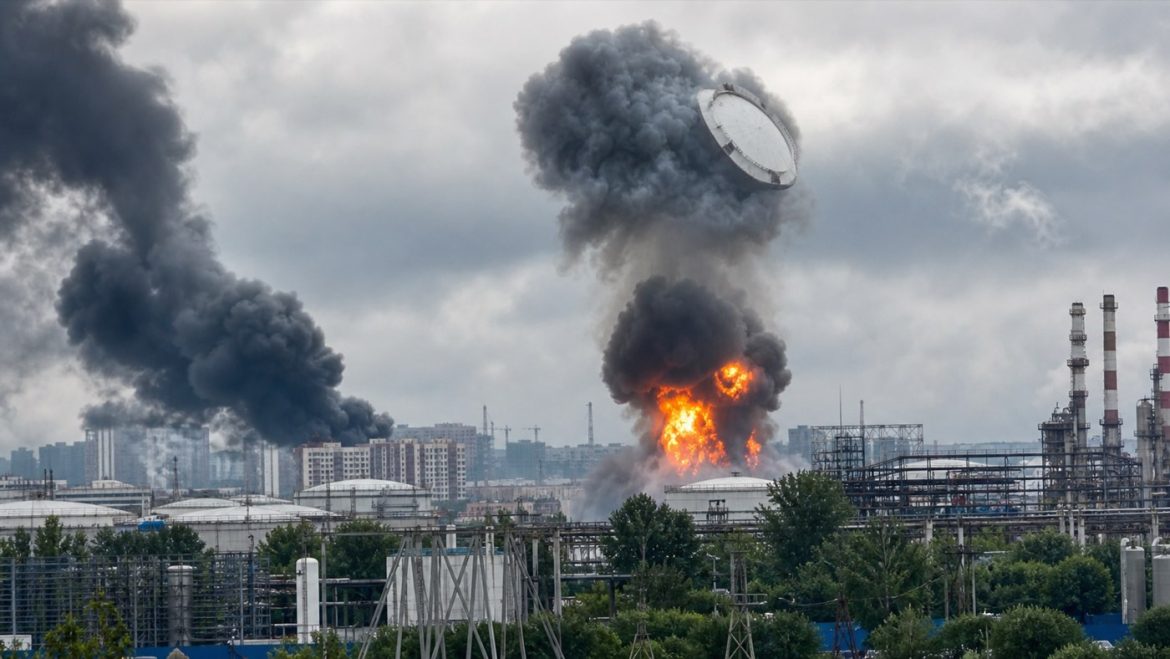
Ukraine’s sustained strikes on Russian refineries, fuel infrastructure and maritime logistics are no longer isolated operations, but part of a wider strategy to weaken the Kremlin’s war economy, disrupt energy exports and turn Russia’s own blockade tactics back against it.
The strikes by Ukraine’s Defence Forces on Russian oil refining over the past 12 months have been not only spectacular, but above all effective. They have produced a cumulative effect, damaging dozens of oil-processing units. The second quarter of this year was especially telling in terms of both intensity and results. The last days of June, when refineries were burning in Slavyansk-on-Kuban and Yaroslavl, were further confirmation.
This is causing a cascading effect: shortages in the production of mass-market oil products, restrictions on petrol and aviation kerosene exports, a fuel crisis on the domestic market, and, finally, hysteria and snot on the social networks of numerous specimens of the “deep people”. There is also calming babble from the high corridors of Russian power, saying there is no need to dramatise the situation, that there are sufficient reserves, and that these are merely isolated temporary difficulties.
The final touch was the statement by the tsar of the “Petrostate” on June 28 that Russia’s fuel shortage was supposedly not critical. Yet strategic reserves have begun to be used. It is worth looking more closely at what is what.
Deep strikes: more…
June 22 passed, by inertia, in discussion of the consequences of the Ukrainian drone attack on the Moscow refinery on June 19, which broke through the layered air defence of the Russian capital, and of the strike at a record distance of 2,000 kilometres against the Tyumen refinery on June 21. Yet June 22 is a symbolic date not only in the history of the Second World War, but also in the period of the Russian-Ukrainian war.
Four years ago, on that day, the first successful Ukrainian UAV attack on Russian oil refining took place. One of Russia’s newest refineries, the Novoshakhtinsk oil products plant in Rostov region, with a processing capacity of 7.5 million tonnes a year, was hit by a drone. Oil processing there stopped for only a few days at the time, but the strike was symbolic. Ukraine demonstrated an innovative approach: how a cheap drone can damage Russian oil-refining infrastructure that generates multibillion-dollar cash flows for the war budget.
It became the second successful UAV attack on refining infrastructure in world oil history. The first was in 2019, when Houthi drones attacked processing facilities in Saudi Arabia and disabled 50 per cent of the kingdom’s oil exports.
Today we are no longer observing isolated Ukrainian drone attacks on enemy refineries, as in 2023 or 2024, but massed and systematic raids by units of Ukraine’s Defence Forces on enemy oil-refining facilities almost every week, and sometimes more often.
The latest calculations show that, as of the end of June, 50 per cent of primary processing capacity, out of the total 6.6 million barrels per day of Russian refining capacity at the beginning of 2026, is not functioning. Most of it has been put out of operation by Ukrainian UAV strikes, although this figure also includes capacity downtime caused by continuing scheduled repairs at certain refineries. This is not yet a catastrophe for the “Petrostate”, but the trajectory towards it is becoming obvious.
Deep strikes: heavier…
The second quarter of this year was notable for records in range of use, mass and effectiveness of attacks. But not only that. The attacks by Ukraine’s Defence Forces on Russian refineries were marked not by drones alone. In particular, on May 31, 2026, the already mentioned Novoshakhtinsk oil products plant became the target of an attack by R-360 Neptune cruise missiles, modified to strike ground targets from the RK-360MC anti-ship missile system.
The strike by two missiles hit both primary-processing units, with a capacity of 5 million tonnes a year, that is, two thirds of the refinery’s capacity. It should also be noted that the Novoshakhtinsk plant was attacked by Storm Shadow cruise missiles on December 25, 2025, after which it was stopped for several months of repair. As soon as repair works approached completion, the refinery was again attacked with heavy means of destruction.
It is obvious that damage caused by a cruise missile warhead weighing several hundred kilograms is much more serious than damage from a drone warhead weighing several dozen kilograms. The repair period after a missile strike will be longer and more costly.
However, there should be no illusion that Russian oil refining is about to stop at any moment. It is worth recalling that the enemy attacked Ukraine’s Kremenchuk refinery for three years before it finally stopped in June 2025. Energy Minister Denys Shmyhal gave the statistics of hits on that refinery when speaking in the Verkhovna Rada in March: 260 drones and 60 missiles, both ballistic and cruise. Therefore, to finish off such leading Russian refineries as Ryazan, Nizhny Novgorod or Nizhnekamsk, which are close to Kremenchuk in capacity, much effort is still needed.
To drive Russian oil refining into a tailspin, the intensity of strikes and the seriousness of damage to processing capacity, especially secondary processing, must exceed the pace of repairs and restarts of restored units. At the end of June and beginning of July, a number of primary oil-processing units at various refineries are due to be put back into operation after repairs.
According to calculations, from the end of March to mid-June, 21 primary-processing units at 11 refineries were hit. Nineteen of them are now due to be restarted. The average repair period is six weeks, or one and a half months. But it needs to be increased to 12–16 weeks. If primary-processing units at Russian refineries do not operate for three or four months a year, the average plant will not only fail to fulfil its plan for supplying oil products to the market, but will also enter the zone of unprofitability, requiring financial assistance. It will turn from an asset into a burden.
Then not only will exports of diesel fuel stop — the most mass-produced type of oil product produced by Russian refineries and still sold abroad — but imports of it will also begin, as is already happening with petrol.
It is telling that the Russian government is expected in the coming days to decide on a ban on diesel fuel exports, in addition to earlier orders suspending exports of petrol and aviation kerosene. Incidentally, the draft decision on diesel fuel was ready back in May, but Deputy Prime Minister Alexander Novak then considered it untimely. As we can see, the time has come unexpectedly quickly, and not only because the tsar of the “Petrostate” has begun speaking about the fuel crisis.
To achieve multimonth downtime for both primary and secondary processing, heavier means of destruction are needed: cruise and ballistic missiles with a warhead of several hundred kilograms, and preferably a tonne. The example of the Novoshakhtinsk plant is indicative. All the more so because there are already tested “long Neptunes”, whose production should be scaled up first of all as a highly effective type of missile weapon created by professionals.
Of course, something else is also needed: to “thin out” Russian air defence, improve the navigation and target-guidance systems of UAVs and missiles, and increase their resistance to jamming. But this goes beyond the oil theme and deserves separate coverage.
Deep strikes: more diverse…
Refineries are not the only thing Ukraine’s Defence Forces are dealing with in the aggressor’s oil sector. No less important a priority is the destruction of oil-transport infrastructure: pumping stations, tank farms, export terminals and tankers.
With tanks everything is quite simple: they are large stationary targets with combustible contents. A heavy means of destruction is not needed to destroy a tank. But oil is transported through pipelines by powerful mainline pumping units at pumping stations. Without destroying the pumps, the transportation of oil to refineries and its loading onto tankers at terminals will continue.
In fact, strikes on a number of line production and dispatch stations in the Transneft system, which some considered key, did not lead to a stop in oil transportation, but only to certain restrictions. Why? Because the pumping units remained undamaged or suffered only minor damage.
It should be noted that a mainline pumping unit is a massive structure weighing 100–150 tonnes, depending on modification and capacity, and three or four such units are installed in the permanent structure of a mainline pumping station. The multiton cast casing of the pump reliably protects it from fragments.
To damage such structures effectively, more powerful means of destruction than UAVs are required: cruise and ballistic missiles. The same applies to maximising damage to the massive structures of oil-processing units and complexes at refineries, which weigh hundreds and thousands of tonnes. Success in applying the “Tuapse tactic” to Novorossiysk, Primorsk, Ust-Luga and key line production and dispatch stations is unlikely without heavy means of destruction.
If Putin has started talking about the use of strategic fuel reserves, it means that Rosrezerv tank farms must be burned out by drones of Ukraine’s Defence Forces. The beginning of systematic work in this direction was made in previous years, and now it is acquiring additional relevance.
War at sea
If the existing drone means of destruction are not capable of causing fatal damage to export terminals, and missile means are lacking, then it is obvious that another important link in the logistics chain of Russian oil must be addressed. This is the maritime link, which in fact plays the key role in the Kremlin obtaining the cash equivalent of sold raw material.
Ukraine’s Defence Forces have had certain success here. A number of tankers heading to Russian ports for loading have periodically been hit by unmanned surface vessels or UAVs. But this has not yet become a large-scale action. The successful implementation of systematic fire impact on the enemy’s land communications along the coast of the Sea of Azov — the Rostov-Mariupol-Melitopol-Dzhankoi road and rail routes — must be extended to the maritime spaces of the Sea of Azov, from the air by strike UAVs, and the Black Sea, by UAVs and unmanned surface vessels.
The strategic goal is not simply to hit every empty tanker, but a maritime blockade of Russia’s Black Sea ports. What the aggressor did to us in 2022 must return to them like a boomerang. The time has come.
Possible stages of parallel and sequential actions by Ukraine’s Defence Forces include:
- burning tanks in port zones to the ground with UAV attacks from the air;
- strikes on oil tankers, as well as product tankers and chemical tankers, heading for loading in Black Sea and Azov Sea ports;
- strikes on product tankers carrying petrol to Russian ports;
- strikes on dry cargo vessels and container ships carrying export cargoes from Russian ports.
Such a blockade must be synchronised with the burning out of the enemy’s forces and means in occupied Crimea.
Russia made the Black Sea a theatre of military action in 2022, hoping to cut Ukraine off from the sea. Ukraine’s Defence Forces not only prevented these plans, but also turned the Mediterranean, through which a substantial flow of Russian oil and LNG passes, into a theatre of military action. The striking of several sanctioned tankers that were supposed to carry raw materials from Russia in the Mediterranean Sea zone since last year needs to be scaled up. Special attention should be paid to LNG tankers carrying Yamal liquefied gas cargoes to Asia.
A beginning was made when Arctic Metagaz was attacked by a maritime strike drone in the central Mediterranean on March 3. Ukraine’s Defence Forces must not limit themselves exclusively to the maritime zones of the Azov, Black and Mediterranean seas. The aggressor must feel anxiety at any point in the world ocean.
Fuel doping for the aggressor
Having run into problems with petrol shortages on the fuel market, the Kremlin demanded additional supplies from allied Belarus, and also from Kazakhstan. As for Belarus, supplies began increasing at the start of this year, with a sharp jump in May. In January-May, petrol supplies from Belarusian refineries to Russia increased almost 13 times, while diesel fuel supplies increased approximately threefold. In May, almost four times more jet fuel was supplied than in May 2025. Yet it is obvious that this “doping” does not solve the problem of the market shortage.
Therefore, a corresponding request was also sent to Astana, although this is more than strange, since Kazakhstan is not a significant exporter of oil products and seasonally buys small volumes of petrol, Arctic diesel and jet fuel from Russia. Astana will therefore obviously limit itself to small volumes, with an eye to preserving in 2027 the volumes of imports of the above-mentioned oil products that it needs.
The appearance of tankers with fuel from unknown, for the time being, Asian countries is quite likely. However, this means that such vessels will automatically become lawful military targets for Ukraine’s Defence Forces as soon as they appear in Ukraine’s territorial sea, starting with the Sea of Azov. Incidentally, it is important that the more than year-and-a-half delay in adopting the law “On the Territorial Sea of Ukraine in the Sea of Azov and the Kerch Strait and the north-eastern part of the Black Sea” should be brought to an end.
Ukraine’s binary strategy
What we are observing now is the beginning of the end of the land empire of northern Eurasia, which pompously called itself an “energy superpower” during the cycle of rising oil prices in the 2000s. It would have remained the “Petrostate”, as the Russian Federation was called in the West, trading in oil and gas, had it not decided to use energy resources as a weapon, accompanying this with large-scale campaigns of corrupting political circles in Ukraine and Europe, propaganda frenzy and cognitive influence on citizens’ brains.
This was quite effective in the conditions of a hybrid-type war. But in the conditions of a prolonged and exhausting conventional war, the toolkit of “energy resources plus propaganda plus cognitive influence” has stopped working.
Ukraine is now applying a binary strategy: kinetic destruction plus a cognitive blow against the enemy. A vivid example is the strike on the Moscow refinery, accompanied by a verbal message to the Kremlin führer, and at the same time to the Washington narcissist and the “Euro-frightened”: peace in Europe is possible only in the event of the aggressor’s total defeat.
It is entirely realistic, and its “recipe” — the concentration of an asymmetric arsenal, “when non-force capabilities are brought into one bundle with military levers” — was described by Volodymyr Horbulin in his book How to Defeat Russia in the War of the Future? back in 2020.
The occupied Crimean peninsula is now a testing ground for Ukraine’s Defence Forces to practise the defuelling, degasification and de-electrification of a specific zone, or cell, of the theatre of military action, while simultaneously desacralising Crimea as a “suitcase without a handle”. The Moscow cell will not avoid the scenario of energy isolation. Forty days, of course, will not be enough.
The destruction of the aggressor’s energy infrastructure, not only oil-refining infrastructure, and the queues of the “deep people” at petrol stations for fuel, with emotional complaints, are not only a sectoral dysfunction of the “Petrostate”. They are also the collapse of the image of the “energy superpower” in the brains of its citizens. They see that “Putin, help!” does not work. The king is naked.
However, it is still far too early for victorious communiqués. Ukraine’s Defence Forces still have work to do in the enemy’s gas and electricity sectors: more, further and more painfully. So that, in the end, the regions of northern Eurasia understand: enough feeding Moscow and fuelling the war.

