
Moldovan investigators say a local company disguised dual-use equipment as waste-processing technology while allegedly supplying systems linked to Russian military aircraft.
Moldovan authorities have uncovered an alleged illegal export scheme involving dual-use aircraft-related components sent to Russia, in a case that points to the continuing difficulty of enforcing sanctions against Moscow’s military-industrial supply chains.
The investigation was announced by Moldova’s Security and Intelligence Service and the Prosecutor’s Office for Combating Organised Crime and Special Cases. According to the authorities, a Moldovan company is suspected of exporting goods worth more than 21 million lei, about €1 million, to Russian entities linked to the defence sector and subject to international sanctions.
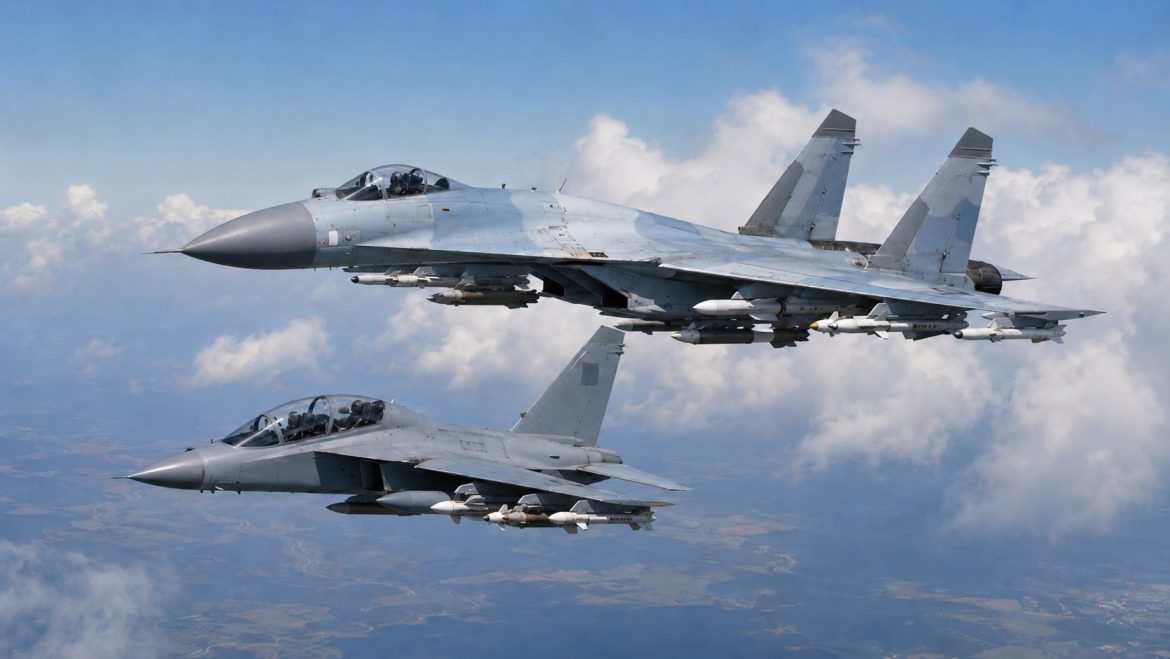
The goods under investigation were described as systems for controlling and measuring electrical signals from sensors. Moldovan investigators say such systems are used in engines for Yak-130 training and light combat aircraft, as well as Su-27 fighter aircraft. The alleged exports are said to have taken place after 2022, following Russia’s full-scale invasion of Ukraine and the expansion of Western restrictions on sensitive technology.
At the centre of the case is the classification of the equipment as dual-use. These are goods that can have civilian applications but may also be used for military purposes. The European Union has tightened export controls on such items in order to restrict Russia’s access to advanced technology, including products that may support its military-industrial complex.
According to investigators, the Moldovan company allegedly declared the goods to customs as equipment for waste processing. Prosecutors say this description was used to hide the real purpose of the products and mislead customs authorities. The company is also accused of exporting the goods without the permits required for dual-use items.
The alleged scheme went beyond incorrect customs declarations. Law enforcement agencies say representatives of the company created a firm in Russia in order to conceal the final recipient. The products were allegedly imported through that company and then passed on to an organisation connected to Russia’s military-industrial complex and already under international sanctions.
Investigators also allege that representatives of the Moldovan company coordinated directly with the Russian recipient on technical documentation, technical tasks and testing results. If confirmed, this would suggest an active technical relationship rather than a simple commercial breach.
On 24 June, officers from Moldova’s security service and prosecutors carried out six searches. They seized parts of control and measurement systems, computer equipment, mobile phones, technical documents and contracts. The material will now be examined as part of the criminal investigation.
The case is significant for Moldova, which has moved closer to the European Union since Russia’s invasion of Ukraine and formally opened accession negotiations with the bloc. Sanctions enforcement, export controls and customs oversight are now part of the country’s wider alignment with EU rules and security policy.
For the EU, the Moldovan investigation fits into a broader problem. Since 2022, Brussels and its partners have imposed import and export restrictions designed to reduce Russia’s access to advanced machinery, aviation goods, electronics and other sensitive products. However, enforcement has become more complex as Russian buyers have used intermediary firms, third-country routes and altered product descriptions to obtain restricted goods.
Aircraft maintenance is one of the areas where these controls matter. Russia does not only require weapons systems, missiles or drones. It also needs testing equipment, replacement parts, electronic systems and technical support to keep existing aircraft operational. For older Soviet-designed platforms such as the Su-27, and for aircraft such as the Yak-130, maintenance chains can be as important as new production.
The Moldovan allegations also show why customs descriptions are a central issue in sanctions enforcement. A product that is presented as industrial equipment may, depending on its specifications and end user, become relevant to military aviation. Investigators will now have to establish the technical nature of the seized components, the knowledge of those involved, and the actual destination of the goods.
No final judicial finding has been made. The company and individuals involved remain entitled to legal defence and the presumption of innocence. The investigation is continuing.
The outcome will be watched beyond Chisinau. For Moldova, it is a test of whether its institutions can identify and disrupt illicit procurement networks linked to Russia. For the EU, it is another example of the practical enforcement challenge behind sanctions policy: restrictions adopted in Brussels only have strategic effect if they are implemented at borders, in customs declarations and through company-level due diligence.

