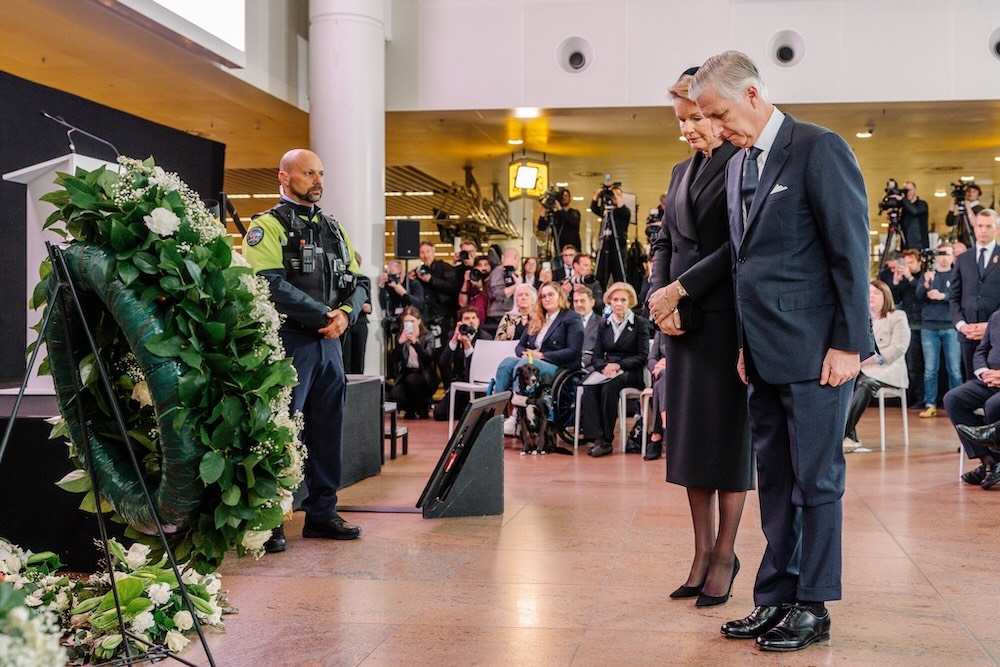
The victims of the 22 March 2016 terrorist attack at Brussels Airport were commemorated on Sunday in the central departures hall at Zaventem, in a ceremony attended by King Philippe, Queen Mathilde and Prime Minister Bart De Wever.
The event marked ten years since the bombing that formed part of the wider Brussels attacks, in which 35 people were killed. The commemoration opened with music and remarks from Brussels Airport chief executive Arnaud Feist, who said the attacks had left a profound mark but had also revealed exceptional courage. He paid tribute to the emergency services, security services, the federal police and airport staff, describing their response on the day of the bombing as an example of public service under extreme pressure.
Ten years ago, the unimaginable happened. A day we will always remember.
Our hearts go out to the victims of the 22 March 2016 attacks, to their families, friends and loved ones.Because remembrance matters. Because even in sorrow, our community stands united. Always together.… pic.twitter.com/yqtV19vBQt
— Brussels Airport (@BrusselsAirport) March 22, 2026
Feist also said the victims must never be reduced to figures in history books. They remained, he said, family members, friends and colleagues whose memory continued to live on in the hearts of those who knew them. His remarks set the tone for a ceremony that combined official remembrance with renewed testimony from survivors and bereaved relatives, many of whom continue to press for recognition and long-term support.
Among those present were Edmond and Marjan Pinczowski, who lost both of their children in the attacks. Speaking during the ceremony, Edmond Pinczowski focused on what he described as the continuing responsibility of the state towards victims and their families. He said many bereaved relatives felt abandoned and spoke of what he called a long and often lonely struggle that continued to this day.
Pinczowski said recognition and financial justice for victims were still lacking. He stressed that survivors and relatives were not asking for pity, but for responsibility. He called on the authorities and wider society to show not only strength in moments of crisis, but also consistency in the care and support they provide afterwards. His intervention added a sharper political and institutional note to the ceremony, underlining that, for many directly affected, the legacy of the attacks remains unresolved.
Listening to the speeches were several senior Belgian politicians, including Prime Minister De Wever and federal ministers Bernard Quintin, Theo Francken and Vincent Van Peteghem. Their presence reflected the official significance of the anniversary, but the strongest moments of the ceremony came from those speaking from personal experience.
King Philippe and Queen Mathilde laid a wreath at the memorial plaque to the victims in the departures hall. The names of those killed were then read aloud, followed by a minute’s silence. The ritual of naming the dead and observing silence has become central to annual commemorations of the Brussels attacks, offering a formal space for mourning while also reinforcing the continuing public memory of the event.
One of the most personal testimonies came from Béatrice de Lavalette, who was 17 at the time of the airport bombing and lost both legs in the explosion. She told those gathered that it would be untrue to say that life after the attack had been easy. She said she still woke every day with memories of the horror, and described her body as burned, bruised and mutilated. She also spoke of the invisible pain that continues long after the physical injuries.
De Lavalette recalled lying on the airport floor, bleeding, and telling herself that she would not die there. That refusal to give up, she said, had not only carried her through dark places. It had also allowed her to stand before the audience now as a Paralympic athlete, a friend, a daughter and a survivor. Her remarks reflected both the enduring trauma of the attack and the effort required to rebuild a life after catastrophic injury.
The Brussels Airport commemoration showed once again that anniversaries of terrorism are not only about remembrance, but also about the long aftermath. For survivors and families, the effects do not end when the ceremony is over. Physical injury, psychological trauma, grief and legal or financial disputes can continue for years, often outlasting the public attention that follows the original event.
Sunday’s ceremony therefore carried two messages at once. It honoured those who were killed and recognised the courage of those who responded on the day. But it also served as a reminder that many victims and families still believe their needs have not been fully met. A decade on, the attack remains not only a matter of national memory, but also an ongoing test of how institutions respond to those forced to live with its consequences.
At Zaventem, the official wreaths, speeches and silence marked the passage of ten years. The words of survivors and relatives made clear that, for many, the events of 22 March 2016 remain part of daily life.