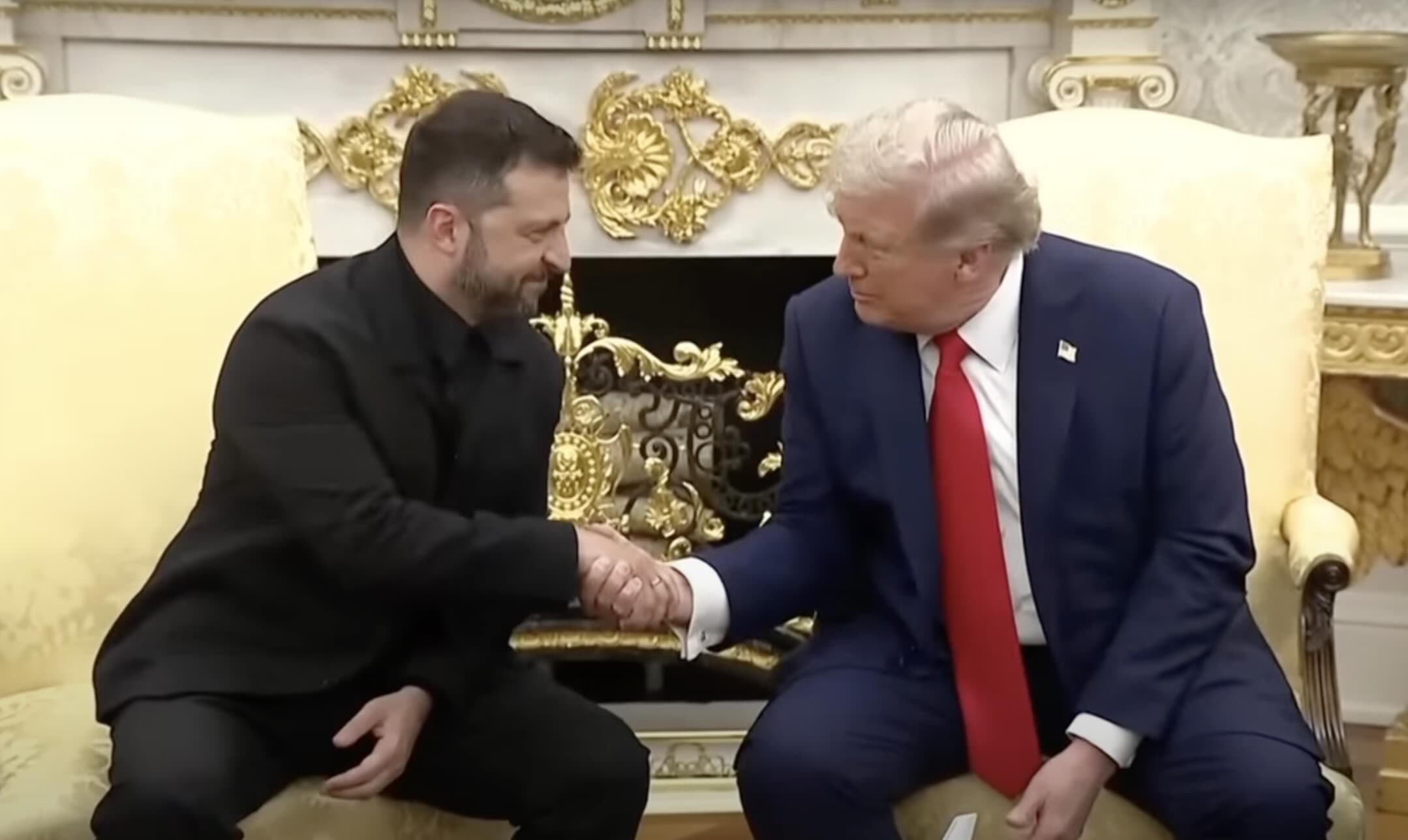
Donald Trump has claimed he is preparing the ground for a direct encounter between Vladimir Putin and Volodymyr Zelensky, raising the prospect of a dramatic three-way summit that could reshape the course of the war in Ukraine.
After hosting the Ukrainian president and several European leaders at the White House on Monday, Trump revealed he had spoken by telephone to the Russian leader and had begun “arrangements” for what he described as a “bilat” between Putin and Zelensky. The two leaders, he said, could then be joined by himself for a follow-up “trilat” – shorthand in diplomatic circles for a three-way meeting.
In a post on Truth Social, Trump wrote: “After that meeting takes place, we will have a Trilat, which would be the two Presidents, plus myself.” The announcement, characteristically made via social media, is already fuelling speculation that Mr Trump is attempting to cast himself as the indispensable broker of peace – a mantle he has long sought. But scepticism remains, not least because the details of both the potential summit and wider American commitments to Ukraine’s future security remain vague.
Zelensky cautious on timing
Speaking in Washington after his White House meeting, Zelensky welcomed Trump’s efforts but made clear that no date had yet been set for a potential Putin encounter. “There is no date, there is no location,” he said, underscoring the uncertainty surrounding the proposal.
Ukrainian officials have long insisted that any talks with Russia must be based on Kyiv’s terms, particularly the restoration of internationally recognised borders. For now, there is little sign that the Kremlin has shifted its stance.
Nevertheless, the fact that Trump is publicly pressing for talks at all marks a significant shift in tone, particularly given the backdrop of a devastating missile strike on the city of Dnipro only days earlier.
Security guarantees
Perhaps the most striking element of Monday’s discussions was Trump’s suggestion that the United States could play a role in guaranteeing Ukraine’s security once the war ends. Washington has until now resisted making any such commitments, wary of being drawn into a long-term military guarantee that could put it in direct confrontation with Moscow.
Trump, however, suggested the United States might work in tandem with European allies to construct some form of protection for Ukraine. “The guarantees could be made by European countries in co-ordination with the United States,” he told reporters, adding that America would “help” Europe deliver them.
That formulation leaves wide scope for interpretation. It is unclear whether he envisages a NATO-style collective defence pledge, a looser framework of bilateral defence agreements, or a continuation of the piecemeal support that Ukraine has received since Russia’s full-scale invasion began in 2022.
European diplomats reacted cautiously, noting that the language appeared deliberately imprecise. “It is one thing to say the US will help co-ordinate, but another to say the US will itself be part of a binding guarantee,” said one Brussels official. “The difference is immense.”
Europe in the spotlight
Mr Trump’s remarks appear calculated to push greater responsibility onto Europe, a long-standing theme of his foreign policy. He has frequently complained that the US shoulders a disproportionate share of the burden when it comes to European security.
By emphasising that Europe should take the lead in guaranteeing Ukraine’s safety, while America would merely “help”, Trump is both signalling continuity with that position and seeking to reassure a domestic audience wary of overseas commitments.
That stance will not sit easily with some European capitals, particularly in Eastern Europe, where fears of Russian aggression run deep. Governments in Warsaw and Tallinn are already pressing for ironclad security arrangements, ideally anchored in NATO. Anything less, they argue, risks emboldening the Kremlin.
A delicate balancing act
For Kyiv, the prospect of an American-brokered trilateral summit is a double-edged sword. On one hand, any serious negotiation that places Ukraine at the same table as Russia, under the aegis of Washington, represents a degree of recognition that Mr Putin has previously sought to deny. On the other, Ukrainian leaders fear being strong-armed into concessions that could leave the country permanently weakened.
Zelensky has consistently said Ukraine will not accept the partition of its territory. Yet the practicalities of achieving a just peace remain daunting, particularly with Russia continuing to occupy large swathes of eastern and southern Ukraine.
What comes next
Whether a Trump-orchestrated meeting between Putin and Zelensky materialises is still an open question. The Kremlin has so far made no public comment on Mr Trump’s claim, and officials close to Mr Putin have in the past dismissed similar suggestions.
For now, the announcement has had more impact in Washington than in Kyiv or Moscow. It has allowed Mr Trump to present himself as a man of action, contrasting his direct outreach to both sides with what he portrays as bureaucratic dithering in Brussels.
But the absence of concrete details – on timing, on format, and above all on the nature of any future security guarantees – means the gulf between words and deeds remains wide.
As one European diplomat dryly noted: “We have seen the photo opportunities before. The real test is whether the guns fall silent.”