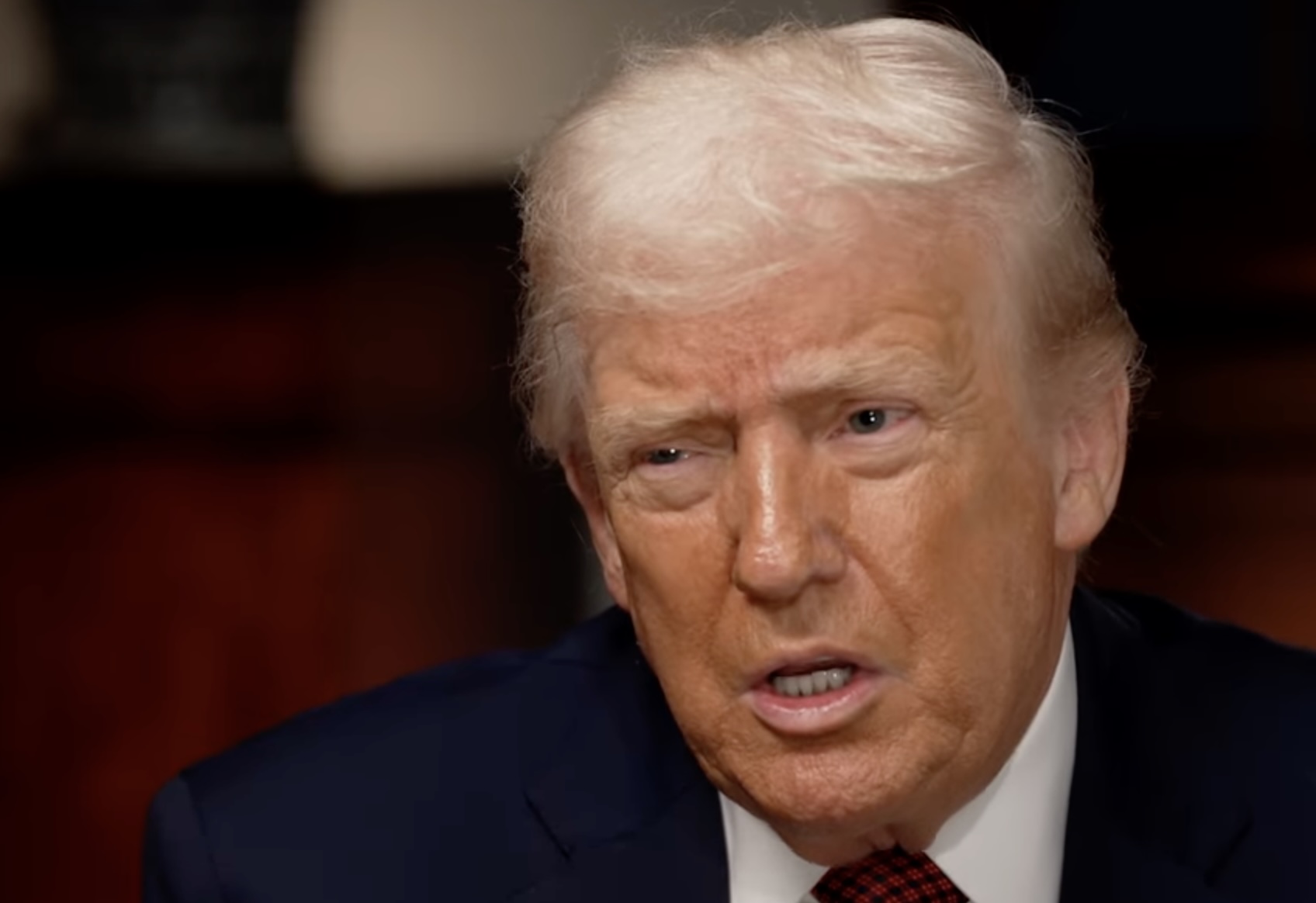
US President Donald Trump has used a new interview with Politico to restate his view that the war in Ukraine should be ended through a negotiated settlement that may involve Kyiv ceding territory to Russia, while sharply criticising Europe and questioning the quality of Ukrainian democracy.
In the interview, Mr Trump said Russia had the “upper hand” in the conflict and argued that “at some point, size will win,” a formulation that implies that Ukraine, as the smaller state, will eventually have to accept a deal on Moscow’s terms. This overlooks recent history, in which larger powers have failed to secure victory despite clear military and economic superiority – notably the United States in Vietnam, Iraq and Afghanistan. Mr Trump also suggested that a settlement acceptable to the Kremlin was already “on the table”, and expressed disappointment that President Volodymyr Zelenskyy had, in his telling, not yet fully engaged with new US proposals.
Mr Trump repeated his longstanding claim that the war would not have begun had he remained in office. At the same time, he insisted that the United States was not abandoning Ukraine, pointing to continued military and financial support, even as he urged Kyiv to contemplate concessions. The result is a message that combines public pressure on Ukraine with assurances to domestic and European audiences that Washington remains formally committed to its defence.
A central demand in the interview was that Ukraine should hold elections despite the ongoing full-scale invasion and martial law. Mr Trump questioned whether a country without current elections could be regarded as a democracy, directly challenging Mr Zelenskyy’s position that organising a nationwide vote under bombardment is neither constitutional nor practical. Ukrainian officials have repeatedly said that the constitution prohibits elections during martial law and that millions of displaced citizens could not be guaranteed a free and fair ballot.
The Politico conversation offered few operational details on how Mr Trump envisages an end to the war. He did not set out clear terms for a settlement, beyond indicating that Kyiv should be prepared to surrender at least some of the territories occupied by Russia and revisit its ambitions for NATO membership. Nor did he explain why, if Russia is destined to prevail because of its size, it has not done so in nearly four years of large-scale combat, or how Washington might realistically compel Vladimir Putin to accept any particular package of terms.
This lack of specificity contrasts with the domestic context in the United States, where polling shows a stable majority of Americans still favour supplying weapons to Ukraine and oppose forcing Kyiv to accept a deal that formalises Russian territorial gains. Recent surveys suggest that around two-thirds of US respondents back continued military aid, and that more than half regard territorial concessions as unacceptable as part of any peace agreement. This support places limits on how far any US administration can openly distance itself from Ukraine without incurring political costs at home.
Mr Trump’s comments on Europe were notably more direct. He described Europe as “decaying” and many of its leaders as “weak”, focusing in particular on migration and social policy. He argued that European governments “talk too much and do not deliver” on Ukraine, and suggested that the continent faces an existential crisis because of what he called “catastrophic” immigration decisions. These remarks align with the language of his administration’s new national security strategy, which casts the European Union’s political trajectory as a strategic problem for Washington.
In contrast to his criticism of Brussels, Berlin and Paris, Mr Trump again singled out Hungary’s prime minister, Viktor Orbán, and Argentina’s president, Javier Milei, for praise. Both leaders are associated with assertive nationalist agendas and a confrontational stance towards liberal institutions. His positive references to them have reinforced the perception among many European policymakers that the White House is increasingly aligned with far-right forces on the continent. A recent multi-country survey found that almost half of Europeans now view Mr Trump as an “enemy of Europe”, with particularly high levels of mistrust in France and Belgium.
For Kyiv, the immediate implications of the Politico interview are mixed. On the one hand, the US president is signalling that continued assistance is conditional and that Washington expects Ukraine to be more receptive to ceasefire or peace proposals involving difficult compromises. On the other, the administration has so far maintained sanctions on Russia and kept weapons flowing, while repeated attempts to secure a breakthrough with the Kremlin – including recent talks in Saudi Arabia – have not produced a durable agreement. Russian forces have continued offensive operations, and there is little public indication from Moscow that it is ready to accept a settlement restoring Ukrainian control over occupied areas.
Many diplomats and military analysts therefore continue to argue that any eventual cessation of hostilities will depend less on formulae developed in Washington and more on conditions on the ground and calculations in the Kremlin. In this reading, Mr Trump’s interview reflects an effort to demonstrate activity on the peace track, to pressure Kyiv, and to speak to parts of his domestic electorate, rather than a fully formed blueprint for ending the war. For Ukraine and its European partners, the message is that US rhetoric on elections and territorial concessions may fluctuate, but the core problem remains Russia’s unchanged war aims and the absence, so far, of a credible signal from Moscow that it is prepared to negotiate a settlement compatible with Ukraine’s sovereignty.