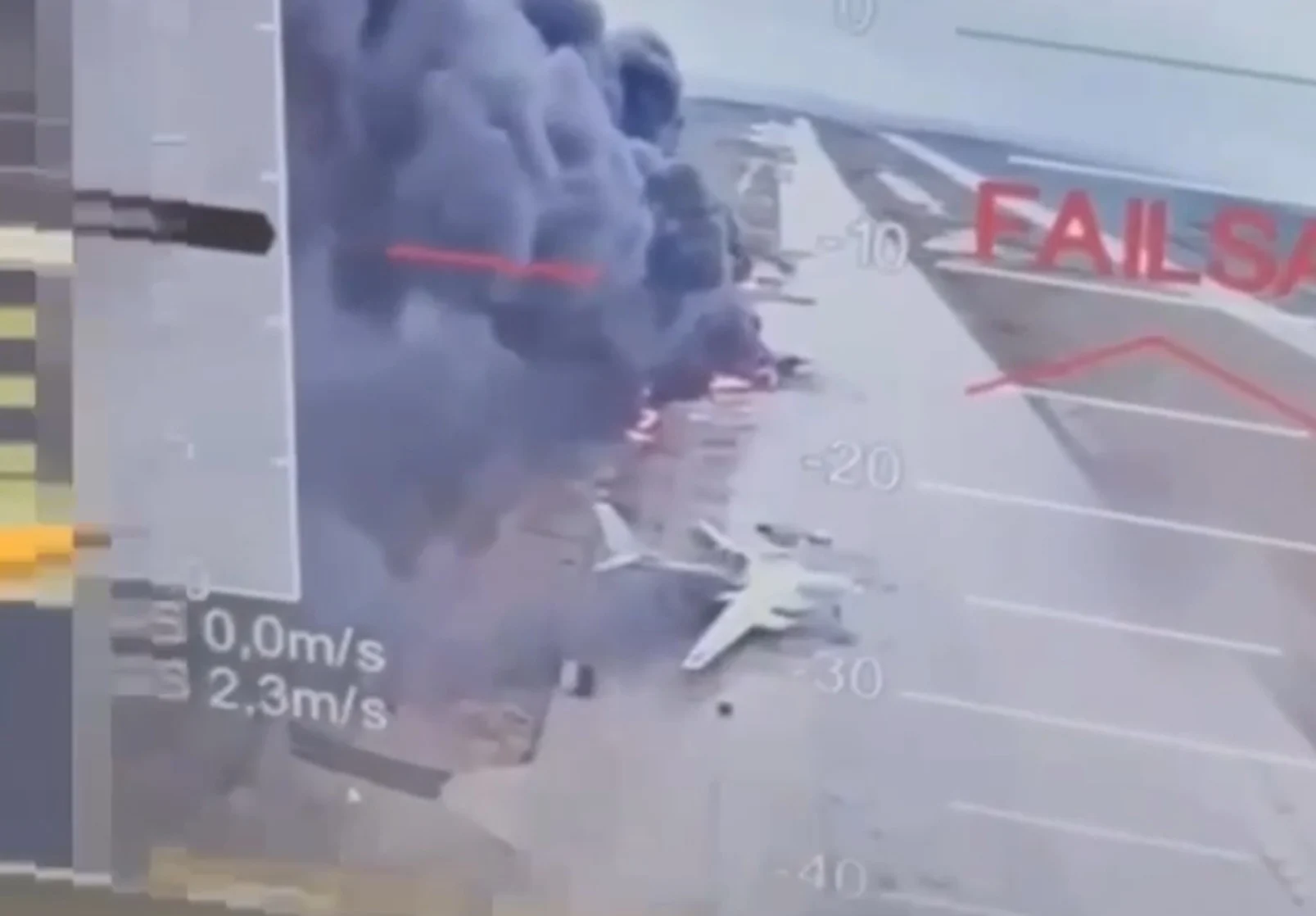
The Security Service of Ukraine (SBU) has reportedly launched a coordinated series of drone strikes on four Russian military airbases, damaging over 40 strategic aircraft, including long-range bombers regularly used in attacks against Ukrainian cities.
The large-scale operation, described by Ukrainian intelligence sources as unprecedented in scope, was confirmed by a senior source within the SBU.
The operation, reportedly codenamed Pavutyna (“Web”), targeted four airbases deep within Russian territory—Belaya, Dyagilevo, Olenya, and Ivanovo. These airfields are known to house key assets of Russia’s long-range aviation fleet, including Tupolev Tu-95 and Tu-22M3 bombers, as well as the A-50 airborne early warning and control aircraft.
Footage and audio shared with Ukrainian media show SBU chief Lieutenant General Vasyl Maliuk commenting on the aftermath of the strike at Belaya airbase. In the recording, Maliuk describes the burning remains of the airfield as evidence of the success of the mission. The SBU has not issued an official statement, but the source indicated that the agency’s special operations units are actively targeting aircraft used in ongoing missile and drone strikes against Ukrainian civilian infrastructure.
Preliminary assessments suggest that the Ukrainian strikes inflicted damage amounting to over $2 billion, with at least 40 aircraft confirmed hit. If verified, the scale of destruction would represent one of the most significant setbacks to Russia’s strategic air capabilities since the start of the full-scale invasion in February 2022.
The SBU reportedly employed drones launched from within Russian territory, with some Russian media outlets suggesting that the unmanned aerial vehicles (UAVs) were launched from lorries parked at fuel stations. These claims, if accurate, would indicate a significant expansion of Ukrainian operational reach and sophistication in conducting deep penetration strikes without conventional missile systems.
The targeted airbases are all situated well beyond the frontlines:
Belaya Airbase, located in Irkutsk Oblast, is home to Tu-95MS bombers.
Dyagilevo, in Ryazan Oblast, supports Tu-22M3 and Tu-95 units.
Olenya, on the Kola Peninsula, is used by strategic aviation, including bombers capable of carrying nuclear payloads.
Ivanovo, northeast of Moscow, hosts airborne early warning aircraft and transport planes.
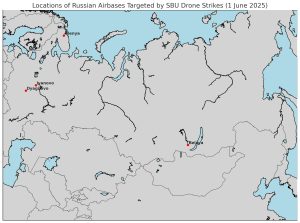
The exact number of drones used, as well as the nature of the payloads, has not been disclosed. The strikes were timed to occur during daylight hours on 1 June, leading to significant fires and secondary explosions, as reported by local observers and subsequently acknowledged by Russian online sources and military bloggers.
Russian official channels have yet to release a full account of the incident, although several pro-government Telegram channels have acknowledged that damage was inflicted and fires reported. There has been no official confirmation from the Russian Ministry of Defence regarding the scale of losses.
In recent months, Ukraine has increasingly relied on domestically produced UAVs and sabotage operations to conduct deep strikes within Russian territory. The pattern reflects a shift in Ukrainian doctrine, aiming to disrupt Russia’s strategic assets away from the frontlines, particularly those involved in launching missile attacks on civilian areas.
This latest operation also follows earlier reported attacks on oil refineries and military installations in Russia’s interior. Analysts note that the targeting of strategic bombers—some capable of carrying cruise missiles—may degrade Russia’s capacity to project air power over Ukraine in the medium term, particularly if key airframes and radar systems have been damaged beyond repair.
Ukrainian officials have repeatedly stated that their actions are aimed at reducing the frequency and effectiveness of Russian aerial bombardment campaigns, which continue to cause civilian casualties and infrastructure damage across Ukraine.
The use of covert drone deployments from Russian soil—if confirmed—would mark a notable development in Ukraine’s military capabilities. It would also suggest the presence of operational support networks within Russia itself, a claim Moscow has consistently denied.
Read also:
Attacks on Russian Oil Refineries Yield Unprecedented Success, Leaving Russia Without Gasoline