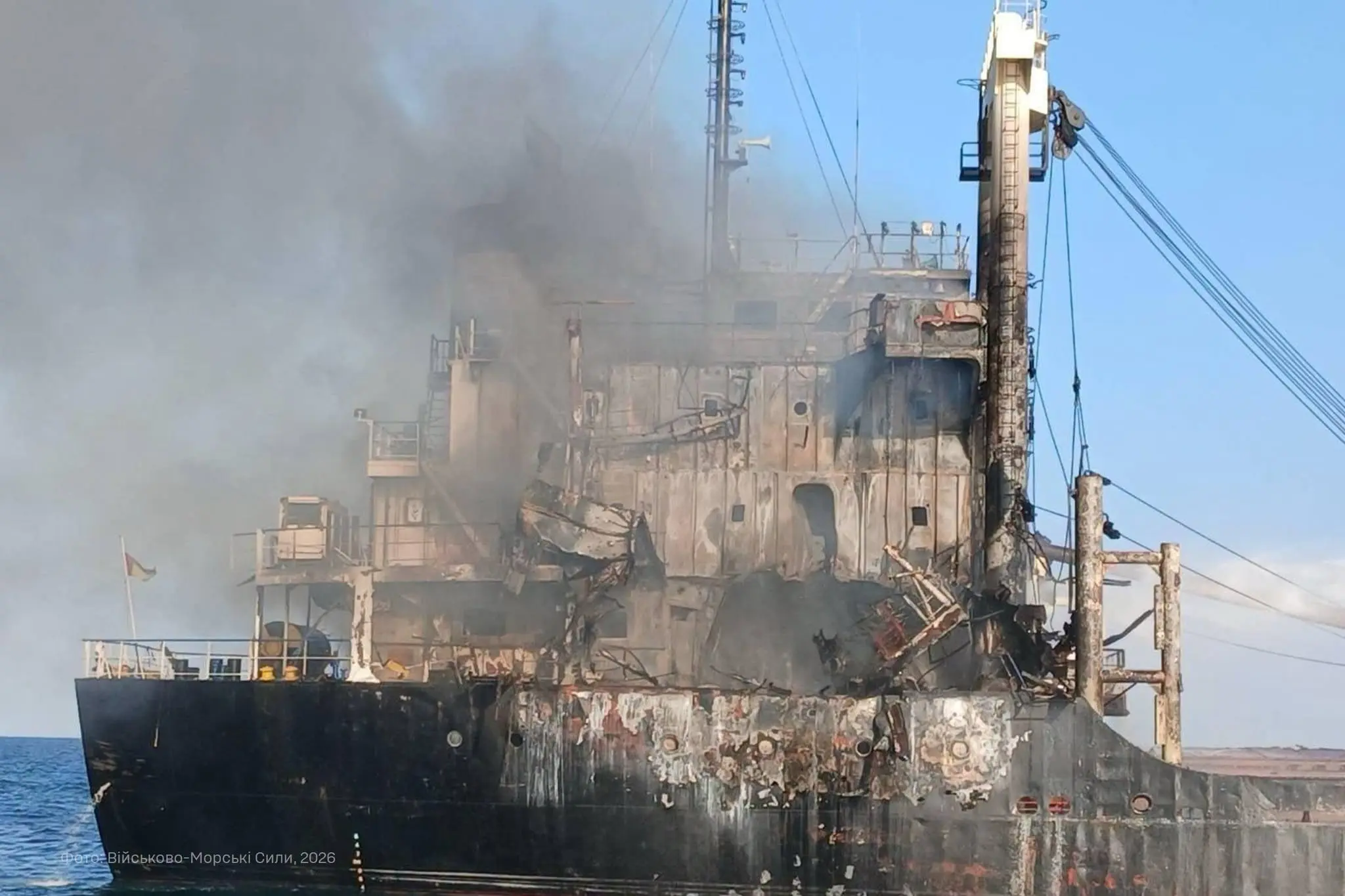
Eight people were rescued after the Guinea-Bissau-flagged Golden Leo was struck while leaving a Ukrainian port with a cargo of maize. The dead include a Ukrainian maritime pilot and crew members from Syria and India.
Ten people have been confirmed dead after a Russian missile strike hit a civilian merchant vessel carrying grain off the coast of Odesa, according to an updated statement from the Ukrainian Sea Ports Authority.
The search-and-rescue operation continued throughout the night after the Guinea-Bissau-flagged bulk carrier Golden Leo was struck on Sunday, 19 July. Firefighters brought the blaze aboard the vessel under control, while rescue teams searched the ship and the surrounding waters.
Eight people were rescued and taken ashore. Ten others died, including a Ukrainian maritime pilot employed by the Sea Ports Authority’s Delta-Pilot branch. The revised figures account for all 18 people who were reported to have been aboard the vessel.
The ship was carrying 17 crew members from Syria and India, as well as the Ukrainian pilot responsible for guiding it through the approaches to the port. It had completed loading maize at a Ukrainian port and was heading towards the Black Sea when it was attacked.
According to details released by Ukraine’s navy, Russian forces fired three Kh-59 or Kh-69 cruise missiles at the vessel as it was leaving the combat zone. The missiles struck the starboard side of the ship’s superstructure and caused a fire aboard.
The superstructure normally contains the bridge, crew accommodation and other facilities necessary for operating a merchant vessel. The location of the impact therefore increased the risk to the crew, although a complete assessment of the damage and the sequence of events has not yet been published.
Initial reports on Sunday said that five people had been killed and five remained missing. The death toll rose after rescuers continued their work overnight. By Monday morning, the authorities said all ten missing or initially confirmed victims had been found dead.
The Golden Leo is described in commercial vessel records as a cargo ship with International Maritime Organization number 9181833. Ukrainian officials said it was owned by a Turkish company but sailed under the flag of Guinea-Bissau.
Acting Ukrainian Foreign Minister Andrii Sybiha said the attack demonstrated that Russia was treating freedom of navigation as a military target. He said Ukraine was informing the governments of the crew members’ countries, the International Maritime Organization and other international partners about the strike.
Ukrainian authorities have described the attack as a war crime and a deliberate assault on an unarmed civilian vessel. A definitive legal assessment would depend on evidence concerning the ship’s status, cargo, location and whether it constituted a military objective at the time of the strike. The information released by Ukraine identifies the vessel as a commercial bulk carrier transporting agricultural produce.
Russia had not issued a detailed public response addressing the strike on the Golden Leo by the time the latest casualty figures were announced.
The attack came during a wider escalation of Russian strikes against Ukraine’s Black Sea ports and commercial shipping. On 17 July, attacks on port facilities in Mykolaiv and the Odesa region killed three people and damaged several foreign-flagged vessels. Russia’s defence ministry said its forces had struck port facilities in Odesa and Chornomorsk.
The repeated attacks have affected Ukraine’s ability to export agricultural products through its principal Black Sea terminals. The country’s ports in the Odesa region handle more than 90 per cent of Ukrainian grain and vegetable-oil exports, according to industry estimates.
Recent damage has reduced monthly grain-export capacity through the Black Sea ports from about six million tonnes to four million tonnes. Some terminals have suspended purchases, while shipowners and traders have cancelled bookings or withdrawn freight contracts because of the increased risks.
The attacks therefore affect not only Ukraine’s wartime economy but also seafarers, foreign shipping companies, insurers and countries importing Ukrainian agricultural products. Higher insurance and freight costs may further restrict the number of commercial vessels prepared to enter the region.
The International Maritime Organization’s position on the Black Sea is that the war presents a serious and immediate threat to merchant vessels and their crews. Its member states have repeatedly called for the protection of seafarers, freedom of navigation and commercial supply chains serving Ukrainian ports.
The deaths aboard the Golden Leo show the direct human consequences of attacks on Ukraine’s maritime export system. The victims were civilian mariners and a port pilot carrying out the routine but increasingly dangerous task of taking an agricultural cargo from a Ukrainian port into the Black Sea.