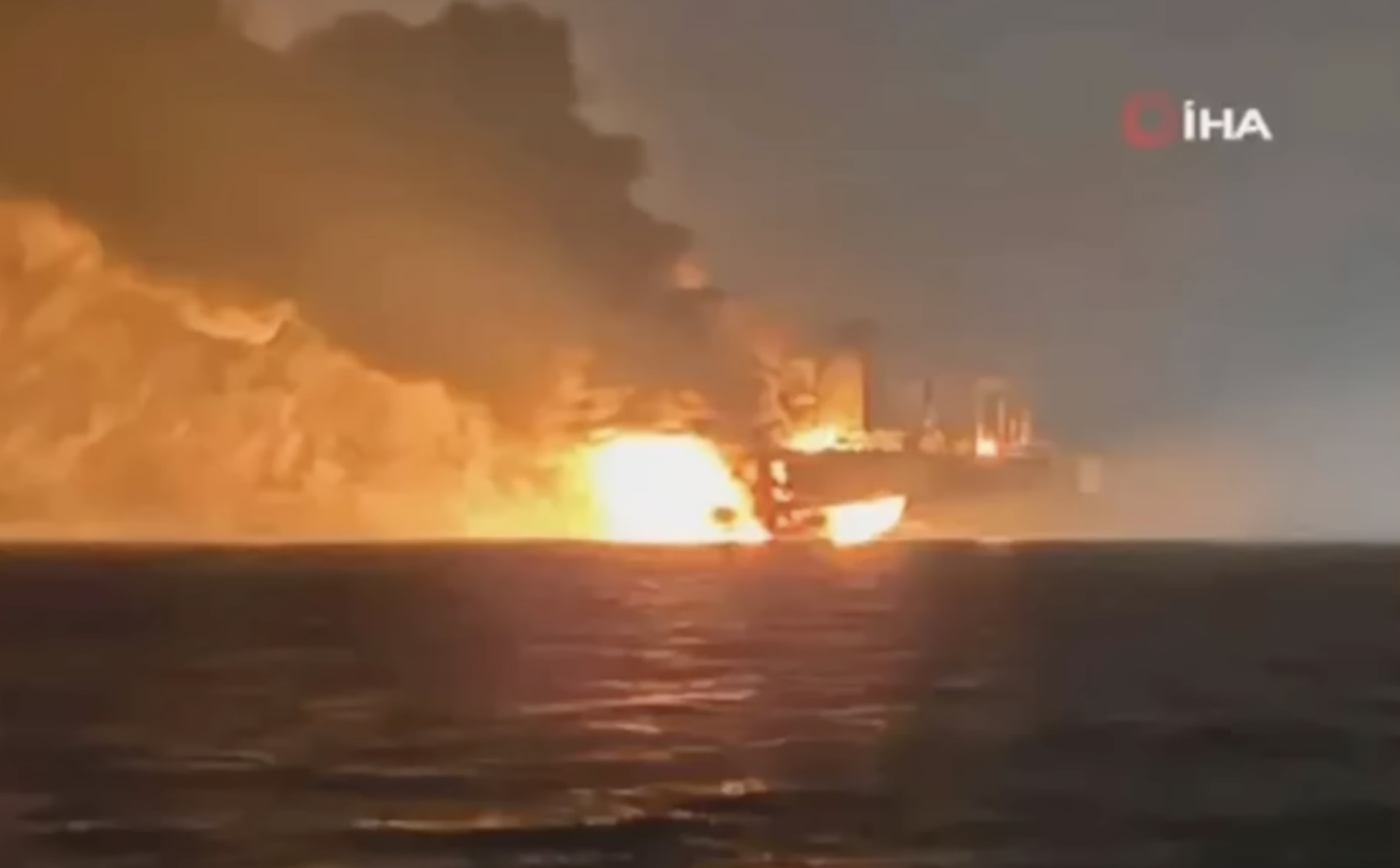
Two sanctioned oil tankers linked to Russia’s so-called “shadow fleet” have caught fire in the Black Sea after explosions off the Turkish coast, in what may mark a new phase in the contest over Moscow’s wartime oil revenues.
Turkey’s Directorate General of Maritime Affairs said the Gambian-flagged tanker Kairos suffered an explosion and fire on Friday about 28 nautical miles off Kocaeli province while sailing empty towards Russia’s Black Sea export hub of Novorossiysk. Within an hour a second tanker, the Virat, was reported “struck” roughly 35 nautical miles from the coast, also in the Black Sea. All 45 crew members from the two ships were safely evacuated, according to Turkish officials.
Video and photographs released by Turkish authorities showed thick plumes of smoke rising from the area where Kairos was burning. Ankara’s transport minister, Abdulkadir Uraloglu, said rescue teams on the scene believed there had been “external interference” and that both vessels were probably hit by an external impact, but he declined to specify whether this involved a naval mine, a drone or some other device. Turkish officials have said both ships were not carrying cargo at the time, reducing the risk of a major oil spill, but a full investigation is still under way.
OpenSanctions, a database that tracks entities involved in sanctions evasion, classifies both Kairos and Virat as part of Russia’s “shadow fleet” – a network of largely older tankers operating under flags of convenience and opaque ownership structures to move Russian crude and products outside the G7/EU price-cap regime. The United States, European Union, United Kingdom, Switzerland and Canada have all imposed measures on the two vessels this year, citing irregular and high-risk trading practices, including frequent switching of flags and patterns of disabling tracking systems while calling at Russian ports.
The incident comes against the backdrop of an increasingly open campaign by Ukraine to hit Russia’s oil export infrastructure around the Black Sea. Over recent weeks Ukrainian drones and missiles have struck facilities at Tuapse and Novorossiysk, two of Russia’s most important oil terminals. A major attack on 14 November temporarily halted exports through Novorossiysk, disrupting flows amounting to about 2.2 million barrels per day – roughly 2% of global supply – before operations were partially restored.
Ukrainian strike forces shutdown of oil exports from Novorossiysk
Ukraine has framed such operations as an effort to degrade the revenue streams that finance Russia’s war, repeatedly targeting refineries, depots and export terminals deep inside Russian territory. Maritime monitoring groups have noted that tankers associated with the shadow fleet were present during earlier attacks on Black Sea oil ports, and in at least one case a sanctioned vessel alongside a Russian terminal is believed to have been damaged.Upstream Online+1 Kyiv has not publicly claimed responsibility for the latest blasts at sea, and Turkish authorities have so far avoided attributing blame, but the near-simultaneous nature of the damage to Kairos and Virat is likely to fuel speculation that they were deliberately targeted.
If it is confirmed that the tankers were hit by naval drones or other precision weapons, the episode would represent a shift from strikes on static port facilities towards the systematic targeting of individual ships carrying, or preparing to carry, Russian oil. For shipowners, charterers and insurers already uneasy about ageing, minimally insured hulls operating close to war zones, the prospect that sanctioned tankers could be attacked en route to or from Russian ports would significantly alter the risk calculus.
Russia assembled its shadow fleet after the introduction of the Western oil price cap in late 2022, buying up or chartering hundreds of older tankers, many nearing or beyond the age at which mainstream operators retire them. These ships typically operate outside normal Western insurance markets, conduct ship-to-ship transfers in international waters and make extensive use of flags from smaller coastal states. Analysts and regulators have warned for months that such a fleet poses heightened safety and environmental risks, especially in confined seas such as the Black Sea and Baltic.
The European Union and its partners have recently moved to tighten the squeeze. In July Brussels adopted its 18th sanctions package on Russia, lowering the crude oil price cap from 60 dollars to 47.60 dollars a barrel and adding more than 100 vessels to a list of ships barred from EU ports and services on the grounds that they form part of the shadow fleet. Oil exports still account for around one-third of the Russian government’s revenues, making enforcement of the cap and action against sanctions-busting tankers a central element of Western strategy.
Events in the Black Sea now link that sanctions pressure to physical risk at sea. Novorossiysk and Tuapse handle substantial volumes of Russian and Kazakh crude; even temporary suspensions there have contributed to volatility in global prices in recent weeks. Should attacks on sanctioned tankers become a pattern rather than an isolated incident, traders may demand higher premiums or avoid Russian-linked cargoes altogether, with potential implications both for Moscow’s budget and for the structure of global oil flows.
For the moment, shipping through the Bosphorus and Dardanelles continues, and Turkish authorities say they are monitoring the situation closely to prevent further incidents. The cause of the explosions aboard Kairos and Virat has yet to be formally established. What is already clear is that the Black Sea has become one of the main fronts in the struggle over Russia’s wartime energy income – and that vessels in the sanctions-busting trade now sit squarely in the line of fire.
Risk in European Waters: The Shadow Fleet, Sanctions Evasion and Safety Gaps