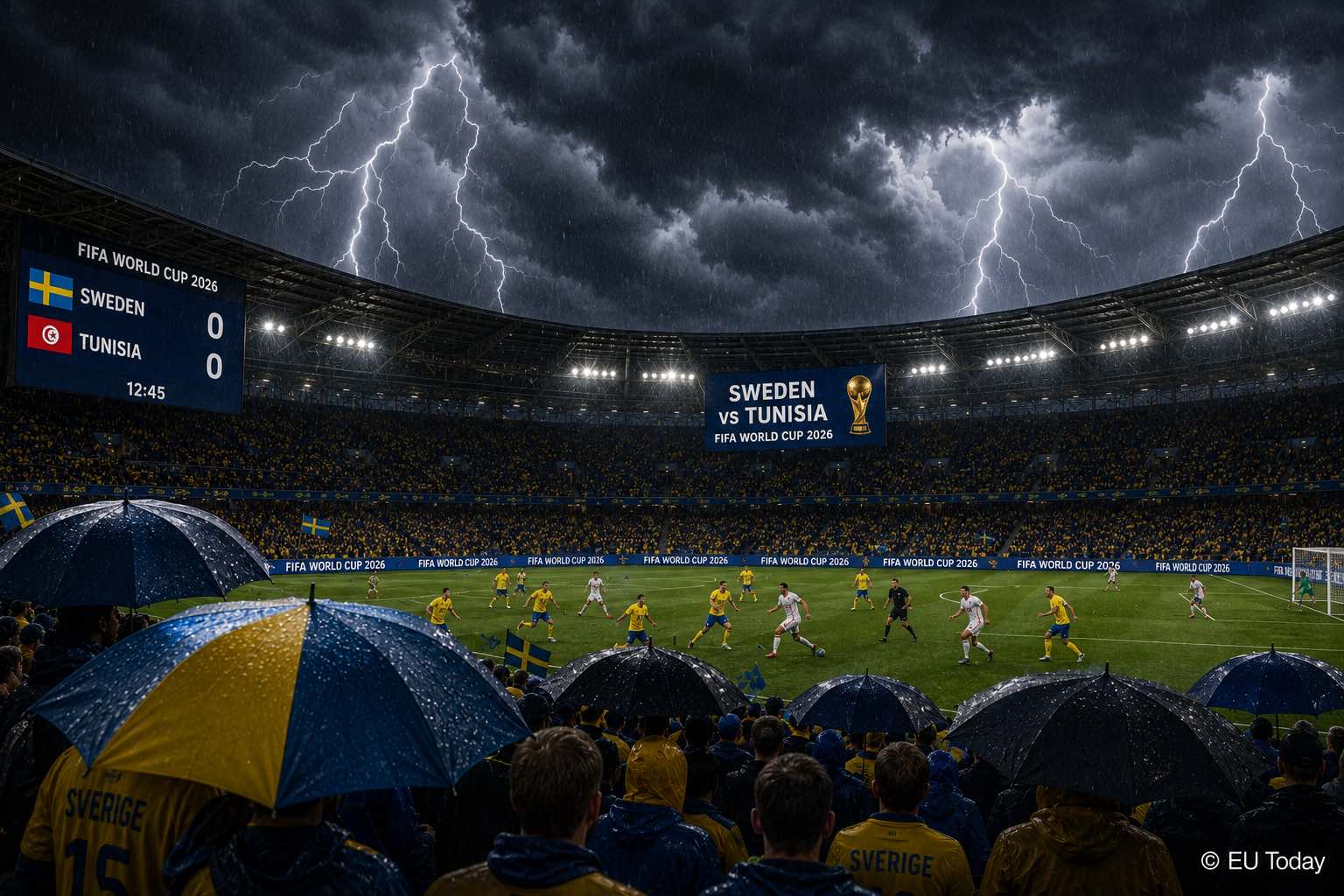
As millions of football supporters across Sweden prepare to celebrate their national team’s latest World Cup campaign – the team will kick off against the Netherlands on Saturday evening – an unwelcome opponent is threatening to steal the spotlight: the weather.
Heavy rain and thunderstorms are forecast across large parts of southern Sweden this weekend, potentially disrupting outdoor fan zones and public screenings established to capitalise on the country’s growing World Cup excitement. According to Swedish meteorologists, lightning strikes and intense downpours could force local authorities to cancel or suspend some of the largest public gatherings planned around Sweden’s match against the Netherlands.
The timing could hardly be worse. Sweden’s emphatic 5-1 victory over Tunisia in its opening fixture has generated a wave of national optimism, with thousands expected to congregate in parks, squares and stadium fan zones to follow the team’s progress. Yet organisers are now being forced to prepare contingency plans as severe weather warnings loom.
Officials in Stockholm have already indicated that public safety will take precedence over festivities. Authorities monitoring the giant-screen event at Stockholm Olympic Stadium have made clear that any risk posed by lightning could trigger restrictions or evacuation measures. Meteorologists have warned that outdoor viewing may become impractical in some areas if the forecast deteriorates further.
The contrast with much of the rest of Europe could scarcely be more striking.
While Swedish football supporters may be reaching for umbrellas and waterproof jackets, large parts of western and southern Europe are preparing for an intense early-summer heatwave. Temperatures exceeding 40°C are forecast in parts of France and Spain, while Germany faces a combination of heat and severe storms. Authorities across the continent have issued warnings concerning vulnerable populations, transport disruption and pressure on energy infrastructure.
Belgium, meanwhile, is expected to experience some of its hottest weather of the year. Forecasts suggest temperatures in Brussels could approach 35°C by Tuesday, creating uncomfortable conditions for commuters, tourists and office workers alike. Heat alerts have already been activated in anticipation of soaring temperatures and rising ozone levels.
For those inclined to dismiss such developments as mere coincidence, the juxtaposition presents an awkward challenge. Sweden is preparing for thunderstorms while Brussels, Paris and Madrid swelter. No doubt climate change deniers will have their explanations. Perhaps, somewhere on the internet, there are already claims that the weather is being manipulated by a shadowy “New World Order”, secret satellites or some other grand conspiracy.
The reality is considerably less theatrical.
Climate scientists have long argued that global warming does not simply mean that every place becomes uniformly hotter. Rather, it contributes to greater instability and more extreme weather patterns. Heatwaves, intense rainfall, droughts and storms can all occur simultaneously across different regions. Indeed, Europe’s recent weather history increasingly appears characterised by volatility rather than predictability.
Football’s World Cup itself has become increasingly vulnerable to such extremes. Organisers across North America have already faced disruptions from storms, lightning and extreme temperatures during the tournament’s opening stages, underlining the growing challenge that weather presents to major sporting events.
For Sweden’s supporters, however, the immediate concern remains simpler. Whether gathered beneath grey skies in Stockholm or sheltering from thunderstorms in Malmö, fans will hope the weather proves a temporary inconvenience rather than a decisive factor in what promises to be one of the country’s most memorable football summers.
Elsewhere in Europe, a different challenge awaits. As temperatures climb towards uncomfortable and potentially dangerous levels, public health officials are urging people to take sensible precautions. Staying hydrated, avoiding prolonged exposure to direct sunlight and checking on elderly relatives or neighbours may sound mundane compared with the drama of a World Cup campaign, but they could prove considerably more important over the coming days.
The lesson from Europe’s contrasting weather patterns is straightforward enough. Whether facing storms in Sweden or heatwaves in Brussels, preparation matters.
And if you are heading outdoors next week, wherever you happen to be in Europe, don’t forget to take a bottle of water with you!
___________________________________________________________________________________________________________________
Click here for more News & Current Affairs at EU Today
Click here to check out EU TODAY’S SPORTS PAGE!
___________________________________________________________________________________________________________________