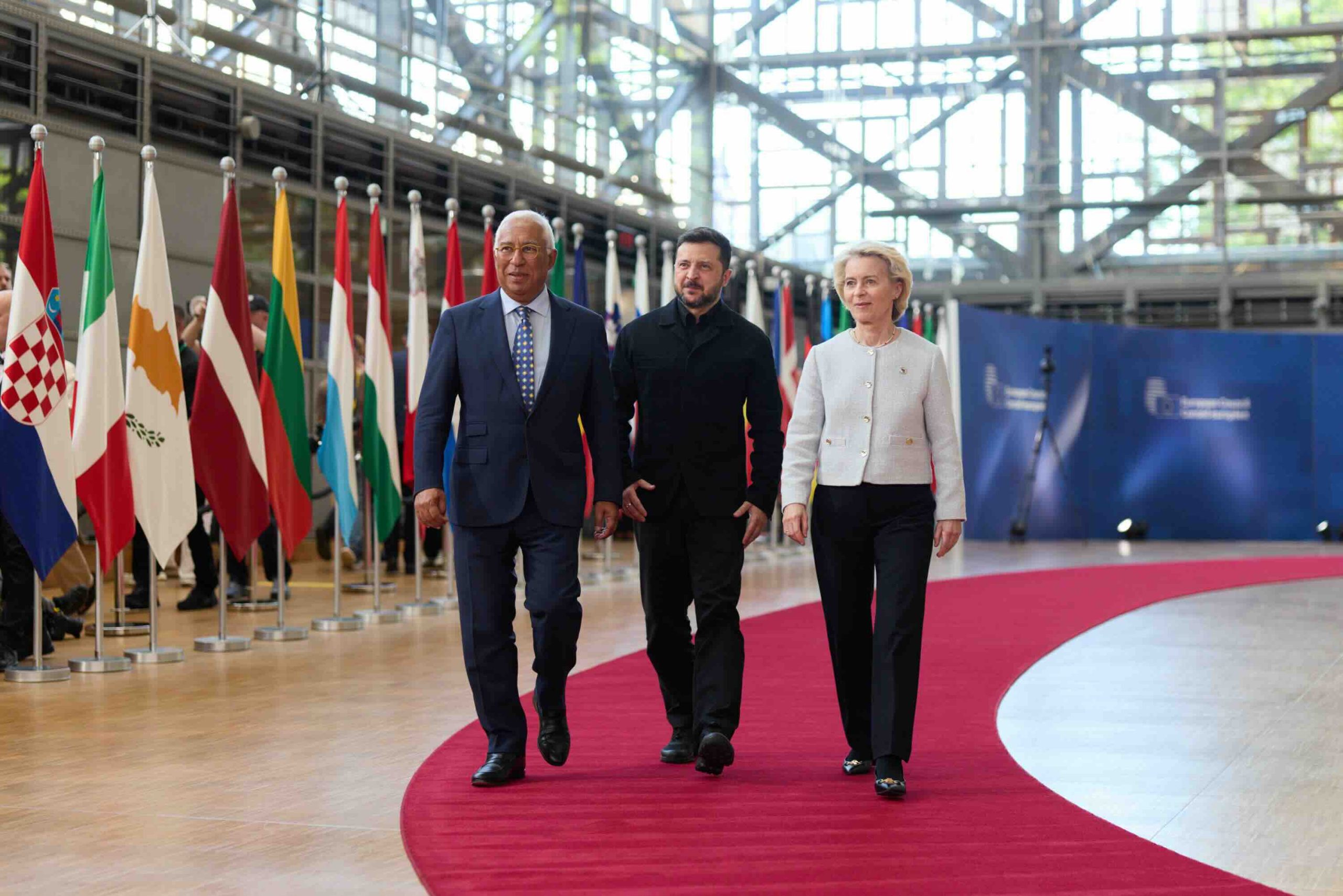
President Volodymyr Zelenskyy has urged European Union leaders to treat Ukraine’s accession to the bloc as part of Europe’s future security settlement, after Hungary blocked language that would have pointed towards an accelerated path to membership.
Speaking to EU leaders in Brussels on 18 June, Zelenskyy argued that Ukraine’s defence against Russia had become central to Europe’s own security. He called for Kyiv’s accession process to be accelerated, saying that Ukraine had paid more than any other European country for its right to be free, independent and European.
The intervention came at a summit where EU leaders reaffirmed political, financial, military and diplomatic support for Ukraine, but stopped short of endorsing the accelerated-accession language sought by Kyiv. In the final European Council conclusions, leaders welcomed the opening of the “fundamentals” cluster in Ukraine’s accession talks on 15 June and said they looked forward to the opening of other clusters “in line with the merit-based approach”.
That wording matters. It reflects support for continuing the accession process, but not for bypassing the normal conditions attached to EU enlargement. Hungary said it had secured the removal of a reference to accelerating Ukraine’s accession from the summit statement. According to reporting on the summit negotiations, Hungarian Prime Minister Péter Magyar said the removal had not been easy.
The dispute illustrates the central tension in Ukraine’s EU bid. Kyiv now presents membership not only as a political or economic objective, but as a security guarantee. For Ukraine, accession is part of the same strategic argument as air defence, long-term military aid, sanctions on Russia and reconstruction finance. For several EU capitals, however, enlargement remains a legal and institutional process that cannot be separated from rule-of-law, market, budget and governance requirements.
The Council conclusions attempted to hold both positions together. Leaders said Ukraine’s long-term security and ability to defend itself must be guaranteed, that no settlement could be decided without Ukraine, and that Europe had a key role to play in any future peace arrangement. They also linked support for Ukraine to continued reform efforts, including rule-of-law commitments.
The summit followed the opening of the first cluster of accession negotiations between the EU and Ukraine on 15 June. The “fundamentals” cluster covers rule of law, democratic institutions, public administration reform, economic criteria and fundamental rights. In enlargement negotiations, it is regarded as the foundation of the process and normally remains open until the late stages of accession talks.
For Kyiv, the political argument is that Ukraine’s wartime role has already altered Europe’s security order. Zelenskyy told leaders that the future of Europe was being shaped by Ukraine’s defence. He also pressed for practical assistance ahead of another winter, including air defence missiles, fuel, energy equipment and financial support for the armed forces.
The Council conclusions reflected those concerns. EU leaders called for accelerated production and delivery of priority military equipment, including air defence systems, ammunition, drones and missiles. They also said they expected the first disbursement from a €90 billion loan for Ukraine’s 2026 and 2027 needs before the end of June, while urging member states to help close the remaining gap in Ukraine’s finances.
The accession argument is therefore no longer isolated from the wider war effort. Ukraine is seeking to convert its military role and political alignment with Europe into a firmer institutional guarantee. EU leaders, meanwhile, are trying to preserve unity between governments that see Ukraine’s membership as a strategic necessity and those concerned about the consequences of rapid enlargement.
Those consequences are substantial. Ukraine’s accession would affect the EU budget, agricultural policy, cohesion funding, voting weights and the future shape of the single market. It would also raise questions over how the EU absorbs a large country still at war, with major reconstruction needs and a long border with Russia and Belarus.
Hungary’s intervention shows that even after the formal opening of negotiations, unanimity remains a major constraint. Enlargement decisions require agreement among member states at key stages. One government can slow or block progress, even when most capitals support the broader strategic direction.
The language adopted in Brussels therefore gives Ukraine a path forward, but not the political shortcut Zelenskyy requested. The EU has accepted that Ukraine’s future is tied to Europe’s security. It has not accepted that this alone is enough to suspend the normal accession logic.
That distinction will shape the next phase of the debate. If the war continues, Ukraine will press the case that membership is part of deterrence. If peace talks advance, Kyiv may argue that accession is essential to prevent any settlement from leaving Ukraine in a grey zone between Russia and the EU. In either case, the question for Brussels will be whether enlargement can remain a merit-based process while also becoming an instrument of European security policy.