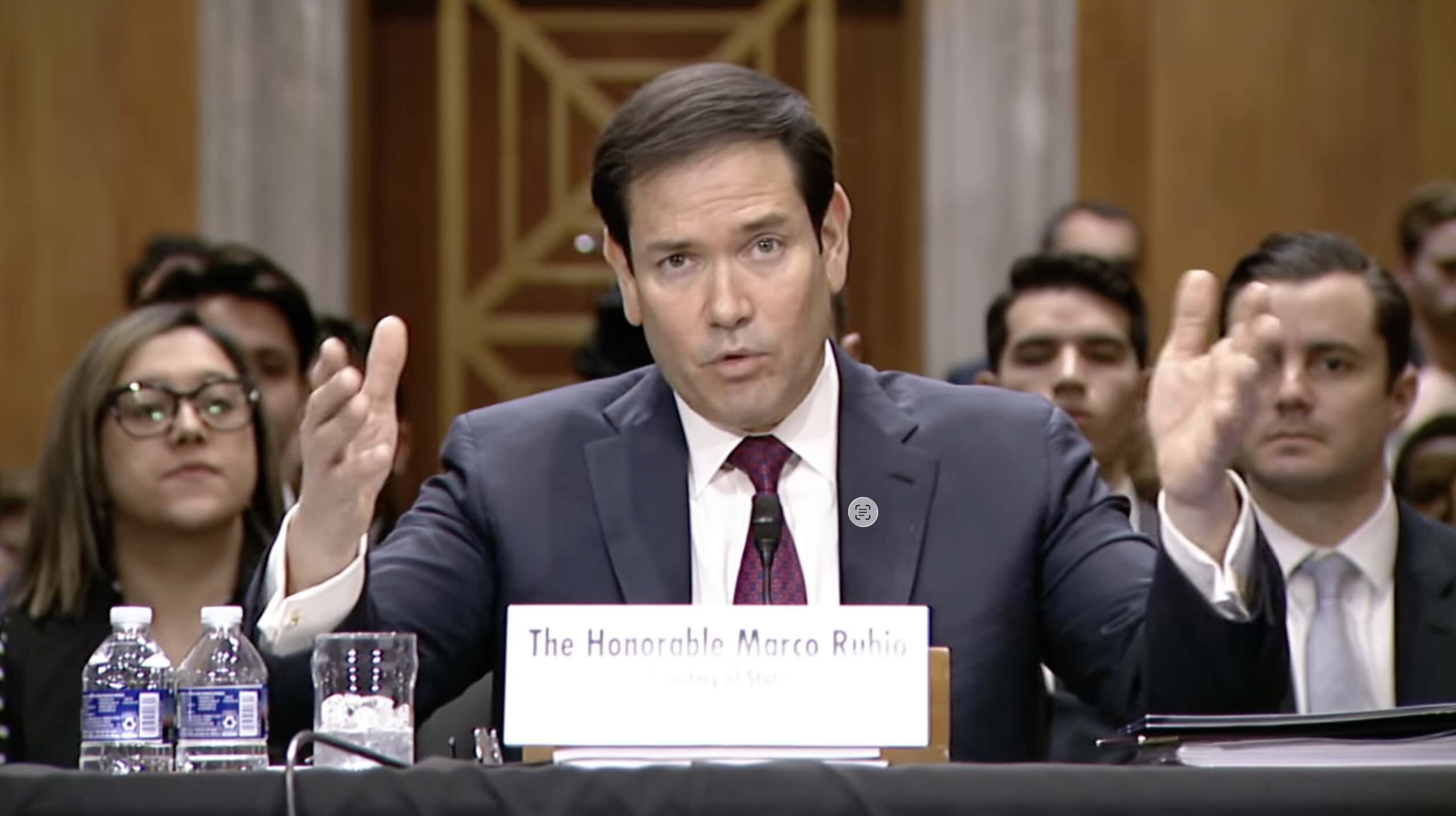
WASHINGTON — US Secretary of State Marco Rubio has told Congress that President Donald Trump’s senior emissary Steve Witkoff and the president’s son-in-law Jared Kushner will not attend the next round of talks aimed at ending Russia’s war in Ukraine, although the United States may still send other representatives.
Mr Rubio made the remarks during a Senate Foreign Relations Committee hearing on 28 January, as attention in Washington shifts to follow-up discussions expected this week after a weekend of contacts in Abu Dhabi that included a rare face-to-face engagement between Russian and Ukrainian officials.
According to Reuters, a US official briefed reporters after the Abu Dhabi meeting that further discussions were expected on Sunday, 1 February, again in Abu Dhabi. Ukrainian and Russian statements after the weekend talks signalled a willingness to continue dialogue.
Mr Rubio said the negotiations have narrowed to what he described as a central and “very difficult” issue: the territorial question in Donetsk, part of the Donbas region in eastern Ukraine. Russia controls most of Donbas, and President Vladimir Putin has repeatedly demanded that Ukraine surrender the remaining areas of Donetsk still held by Ukrainian forces as part of any settlement.
Donbas Withdrawal Emerges as Reported Condition in US–Ukraine Talks on Guarantee
In testimony, Mr Rubio framed the dispute as a gap still to be bridged, telling senators that progress has been made in reducing the number of unresolved issues, but that the remaining problem is politically and militarily sensitive for both sides.
Mr Witkoff has also publicly argued that the talks are effectively down to “one last issue”, speaking at the World Economic Forum in Davos on 22 January, shortly before travelling to Moscow.
The decision not to send Mr Witkoff and Mr Kushner to the next session suggests the coming round is likely to concentrate on working-level discussions, rather than political trade-offs that require direct access to the president.
The talks have unfolded alongside reports of US proposals intended to create space for compromise in eastern Ukraine. In December, President Volodymyr Zelenskyy said Washington had floated the idea of establishing a “free economic zone” in Ukraine-controlled parts of the Donbas, with Ukrainian troops withdrawing and Russian forces staying out. He said key questions remained unresolved, including governance and enforcement.
Recent reporting has linked the “free economic zone” concept to a broader discussion about security guarantees. Mr Rubio told senators that, in principle, the United States regarded security guarantees as broadly settled, but said they would only take effect after the war ends and would ultimately depend on Russia’s stance. The Financial Times has reported that Washington has indicated US security guarantees would be contingent on Ukraine signing on to a peace deal.
Separately, European governments have continued discussions about post-ceasefire security arrangements. On 6 January, France issued a statement on behalf of the so-called “Coalition of the Willing” following talks in Paris involving Ukraine and the United States, setting out work on “robust security guarantees” for Ukraine. In the UK, ministers have described planning for a multinational force intended to support deterrence, training and the regeneration of Ukrainian forces, while broader European conversations continue about how any presence would be structured and mandated.
Russia has consistently opposed Western military deployments in Ukraine, and the question of enforcement and guarantees remains a likely point of dispute in any negotiation track, particularly if territorial arrangements are discussed alongside security commitments.