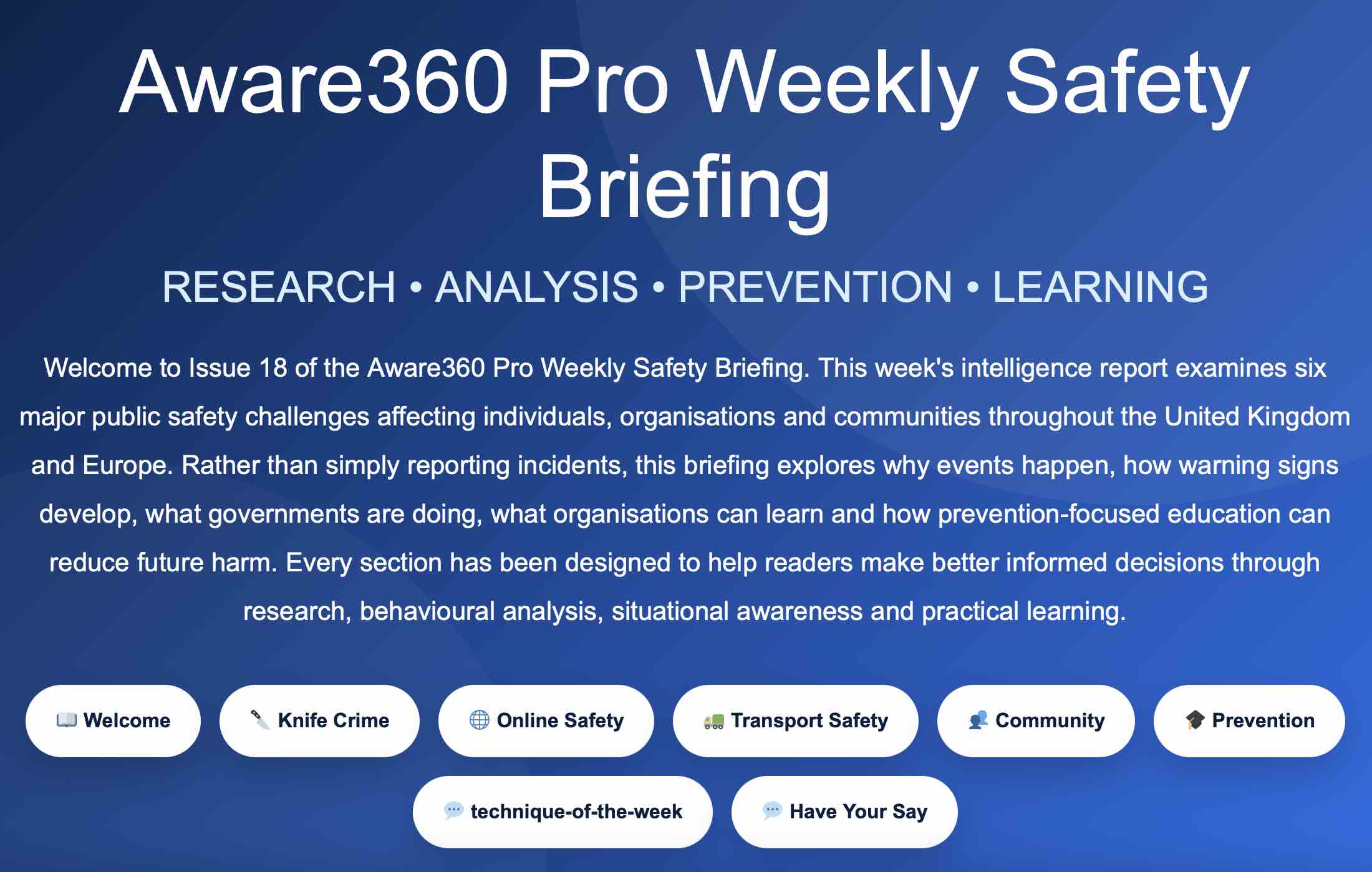
Public safety reports are often dominated by statistics, political declarations and the inevitable catalogue of recent incidents. The latest edition of Aware360 Pro’s Weekly Safety Briefing takes a very different approach.
Rather than concentrating on what has already gone wrong, the publication asks a more challenging question: what warning signs were visible before things went wrong, and what could have been done to prevent harm in the first place?
The result is a wide-ranging examination of several of the most pressing public safety risks facing the United Kingdom and Europe, from knife crime and online child exploitation to transport-related violence and broader community resilience. While the themes are diverse, a common thread runs through the report: the belief that prevention, awareness and behavioural understanding remain underused tools in reducing harm.
The most prominent risk highlighted is knife crime and youth violence. Although official figures suggest offences involving knives have fallen in England and Wales, the report argues that numerical improvements should not encourage complacency. The underlying drivers remain deeply entrenched. Fear, social exclusion, peer influence, criminal exploitation and exposure to violence continue to shape the decisions of vulnerable young people.
What distinguishes the briefing from many public discussions of knife crime is its focus on behaviour rather than criminality alone. The report suggests that carrying a weapon is often the final stage in a longer process of exposure, normalisation and escalation. By the time a young person is found carrying a knife, numerous opportunities for intervention may already have been missed.
The advice offered is correspondingly preventative. Schools, employers, youth organisations and community groups are encouraged to identify vulnerability earlier, understand behavioural warning signs and create trusted environments where concerns can be disclosed before they develop into crises. The report repeatedly argues that knife crime cannot be treated solely as a policing issue but must also be understood as a safeguarding challenge.
The second major area of concern is online safety. Here the briefing identifies a landscape that has become increasingly complex. Children and young people are exposed to risks ranging from grooming and sextortion to fraud, manipulation and AI-generated deception. The report warns that many parents and professionals continue to underestimate the sophistication of modern online exploitation.
Particularly striking is the report’s observation that online harm frequently develops invisibly. A child may appear physically safe at home while simultaneously being manipulated through gaming platforms, social media applications or private messaging services. The danger, according to the briefing, lies less in the technology itself than in the behaviours occurring within digital environments: secrecy, coercion, isolation and emotional control.
The recommendations are practical and aimed at organisations as much as families. Clear communication policies, staff training, safeguarding procedures and accessible reporting mechanisms are all emphasised. The report also argues that digital literacy should evolve beyond simple internet safety messages and instead teach children how manipulation operates in practice.
A third category of risk concerns transport safety. Although public transport remains one of the safest ways to travel, the briefing highlights continuing concerns surrounding anti-social behaviour, harassment, violence against women and girls, aggression towards transport staff and road safety more generally.
The report makes an important observation that transport risk is often overlooked by employers despite affecting millions of workers every day. Travel-related threats, particularly for lone workers or employees travelling at night, can easily fall between traditional workplace safety responsibilities and broader public safety concerns.
The advice provided focuses on anticipation rather than reaction. Organisations are encouraged to assess travel risks, train staff in conflict avoidance, promote reporting mechanisms and treat near misses as valuable intelligence rather than isolated inconveniences. The report suggests that many incidents can be prevented through earlier recognition of escalating behaviour and clearer procedures for responding safely.
Beyond these specific risks, the publication devotes considerable attention to community awareness. In an era where public institutions face increasing pressures on resources, the report argues that communities themselves remain one of the most valuable sources of intelligence available to authorities.
Its message is neither alarmist nor vigilante in tone. Rather, it emphasises observation and reporting. Suspicious behaviour, signs of exploitation, safeguarding concerns and environmental warning indicators often attract attention long before they become matters for formal investigation. The challenge is persuading people to trust their instincts and report concerns without fear of embarrassment or overreaction.
Perhaps the most interesting argument made throughout the briefing concerns education itself. The publication repeatedly questions whether conventional training methods remain fit for purpose. Policies, posters and online compliance courses are described as useful but insufficient. Under pressure, people rarely recall lengthy procedures; they respond according to habits, experience and instinct.
For this reason, the report advocates scenario-based learning, behavioural awareness training and practical exercises that simulate real-world decision-making. This philosophy underpins much of the publication’s advice. Whether addressing knife crime, online exploitation or transport safety, the proposed solution is remarkably consistent: teach people how risk develops, allow them to practise responses and build confidence before they encounter genuine danger.
There is, of course, a commercial dimension to this argument. Aware360 Pro positions its own interactive learning platform as a potential solution throughout the document. Yet the broader point remains persuasive. Across sectors ranging from aviation to healthcare, experiential learning has increasingly replaced passive instruction as organisations seek to improve decision-making under pressure.
The briefing’s greatest strength lies in its insistence that risk rarely emerges without warning. Most serious incidents, it argues, are preceded by behavioural indicators, environmental signals or patterns of vulnerability that become visible long before an emergency occurs. The challenge is not merely identifying these signs but ensuring that individuals, organisations and communities know how to respond.
Taken as a whole, the report offers a thoughtful assessment of contemporary public safety challenges. Its emphasis on prevention may strike some readers as optimistic in an age of complex social pressures and rapidly evolving threats. Yet its central message remains difficult to dispute. Effective public safety is not simply about responding quickly when something goes wrong. It is about recognising danger early enough that it never happens at all.
__________________________________________________________________________________________________________________
Click here for more News & Current Affairs at EU Today
Click here to check out EU TODAY’S SPORTS PAGE!
___________________________________________________________________________________________________________________