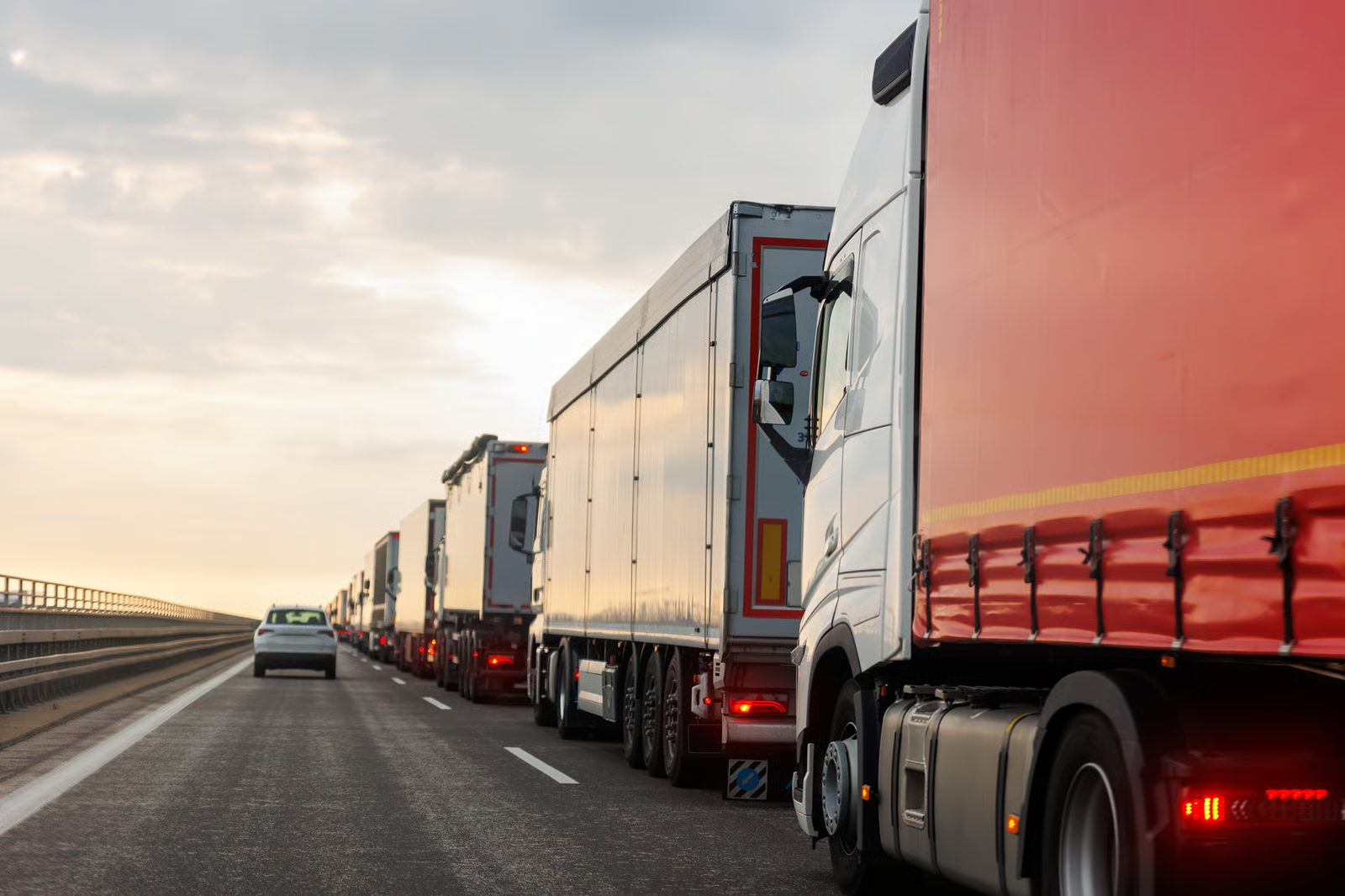
A provisional Eurovignette agreement gives hauliers and national authorities clearer rules for linking road charges to truck emissions. The technical changes will shape fleet investment, freight pricing and the commercial value of lower-emission vehicles.
European Union negotiators have reached a provisional agreement clarifying how road tolls and user charges should vary according to the carbon emissions of heavy-duty vehicles.
The agreement between the Council and European Parliament amends the Eurovignette directive as expanded CO2 standards for trucks and other heavy vehicles begin applying from 1 July 2026.
The measure is technically narrow, but commercially important. Road charges are part of the operating cost of every truck moving goods across tolled European networks. Changes in vehicle classification can affect fleet purchasing, route economics and the prices charged to customers.
A legal mismatch needed to be repaired
The Eurovignette framework allows member states to vary tolls according to environmental performance. New CO2 standards have created additional vehicle groups, emissions trajectories and reference values that were not fully aligned with the directive’s existing terminology.
Without clarification, the same truck could face inconsistent treatment across national systems or uncertainty over when a new emissions class should begin affecting charges.
The agreement updates definitions for zero-emission and low-emission heavy-duty vehicles, vehicle groups, reduction trajectories and reference emissions. The objective is not to create one identical toll throughout Europe, but to make national charging systems apply common categories more consistently.
Lower emissions gain a clearer commercial value
Member states will be able to apply reduced user charges or infrastructure charges to low-emission vehicles alongside incentives already supporting zero-emission trucks.
For fleet operators, this can change the total-cost calculation. An electric or low-emission truck may carry a higher purchase price, but lower tolls over several years can narrow the difference, especially for vehicles covering long distances on tolled motorways.
The effect will vary by country because the directive does not require every member state to use the same road-charging structure. Hauliers operating internationally will still face a patchwork of toll levels, exemptions and infrastructure conditions.
Clarity nevertheless matters for investment. A fleet manager is more likely to pay for a cleaner vehicle when the expected charging advantage is defined and durable.
Freight customers will ultimately see the cost
Road tolls do not remain with the transport company. They are incorporated into rates paid by manufacturers, retailers and agricultural businesses and can eventually reach consumer prices.
Hauliers already face volatile fuel costs, driver shortages, wage pressure, insurance and the expense of complying with different national systems. CO2-based tolling adds another variable, particularly for older fleets that fall into less favourable classes.
Large logistics groups may be able to renew vehicles quickly and optimise routes around charging systems. Smaller operators often retain trucks for longer and have less access to finance. A transition intended to reward cleaner transport could therefore accelerate consolidation unless financing and charging infrastructure improve.
Vocational vehicles receive specific treatment
The agreement clarifies how vehicles such as refuse trucks and construction vehicles should be allocated to CO2 classes.
These vehicles have operating patterns that differ from long-haul freight. They may spend more time idling, lifting, compacting or working at low speed, making direct comparison with motorway tractors difficult.
Clear classification should reduce disputes between operators and toll authorities. It also shows why emissions-based charging cannot rely on a single measure applied to every heavy vehicle regardless of function.
Trailer incentives were dropped
Negotiators decided not to retain a system that would vary charges according to the environmental performance of trailers.
More efficient trailers can reduce fuel consumption through lower weight, improved aerodynamics or better design. In principle, a toll incentive could reward those gains.
In practice, the co-legislators concluded that trailer-based variation would increase administrative complexity, complicate electronic toll services and interfere with existing concession contracts. The Commission has been asked to examine the remaining obstacles.
The decision illustrates the limits of regulatory precision. A system can recognise more environmental detail, but each additional classification increases data, enforcement and billing requirements.
Infrastructure remains the harder constraint
Toll incentives cannot create charging stations or grid connections. Zero-emission trucks require high-capacity infrastructure at depots, logistics hubs and motorway rest areas, often with power demands far beyond those of passenger cars.
Operators will hesitate to replace diesel fleets if they cannot recharge reliably across borders. Governments may then offer lower tolls for vehicles that remain impractical on many routes.
The problem sits inside Europe’s wider effort to make cross-border transport cleaner and more coherent. EU Today has also examined Brussels’ push to remove practical barriers to international passenger rail, where infrastructure and fragmented national systems similarly determine whether environmental policy produces a usable alternative.
The Eurovignette changes should therefore be read alongside infrastructure policy, vehicle standards and industrial support. Price signals work only when companies have a realistic alternative to the technology being penalised.
Provisional agreement is not final application
The deal must still be endorsed and formally adopted by the Council and Parliament after legal-linguistic review. The new heavy-vehicle CO2 standards begin influencing classification from July, but the amending agreement is not itself final law yet.
That distinction matters for operators planning immediate costs. National toll authorities will continue applying existing rules while preparing for the clarified framework.
The measure is unlikely to attract the attention given to headline vehicle bans or fuel taxes. Yet it may have a more immediate effect on thousands of commercial decisions. By attaching a clearer price to emissions, the EU is turning climate policy into a recurring cost visible each time a heavy vehicle uses a tolled road.