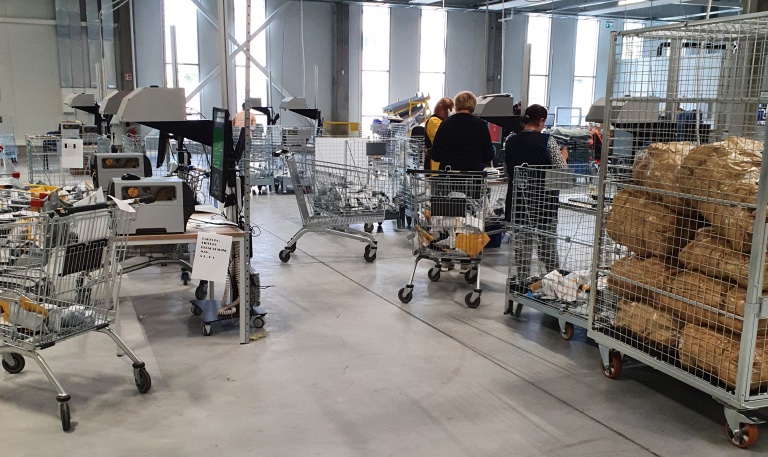
A new €3 customs charge on low-value imports has begun applying across the EU, confronting Shein, Temu and AliExpress with higher costs while testing whether customs authorities can police an immense flow of small parcels.
The European Union’s new €3 customs charge on low-value e-commerce imports took effect on 1st July, ending a duty-free advantage that helped Chinese online marketplaces build a mass market around inexpensive goods shipped directly to European consumers.
The provisional charge applies to categories of goods contained in consignments worth less than €150. The measure taking effect across the bloc is expected to fall most heavily on direct shipments associated with platforms such as Shein, Temu and AliExpress, although it covers qualifying imports regardless of the seller’s nationality.
For shoppers, the immediate question is price. For Brussels, the larger question is enforcement. Billions of low-value items enter the Union each year, often through high-volume hubs where customs authorities have limited time to check valuation, product safety, origin and compliance.
The €3 charge is therefore more than a revenue measure. It is the first live test of whether the EU can turn its promised customs overhaul into workable controls at parcel scale.
The end of a commercial advantage
The previous exemption for consignments below €150 reduced the cost of sending individual orders directly from factories and fulfilment centres outside the EU. It also favoured a business model based on enormous product ranges, rapid advertising and frequent low-value purchases.
European retailers argued that the system created unequal treatment. Businesses importing goods in bulk already faced customs formalities, warehousing costs and EU compliance duties, while direct-to-consumer sellers could often deliver inexpensive parcels without customs duty.
The new charge narrows that gap, but it is not a simple flat fee on every box. It is levied by tariff category represented in a parcel, which means one consignment containing different types of goods can attract the charge more than once. It is also separate from the handling fee being developed under the wider customs reform.
EU Today explained in March how the broader customs overhaul shifts responsibility towards online platforms. Under that framework, marketplaces and sellers will increasingly be treated as importers, required to provide accurate data and meet customs obligations instead of leaving the final consumer to resolve problems at delivery.
Customs capacity is the real test
The scale of the trade is formidable. An answer published by the European Parliament set out the July timetable and linked the measure to continuing enforcement action involving major online platforms. Separate EU figures have shown that billions of low-value parcels are entering the market annually, creating a screening problem no national customs service can solve through physical inspection alone.
Effective enforcement will require reliable advance data, automated risk assessment and co-operation between customs, market-surveillance authorities and digital regulators. Authorities need to identify not only unpaid duties but unsafe toys, non-compliant electronics, counterfeit goods, cosmetics containing restricted substances and shipments split or misdeclared to reduce charges.
That is why the fee’s effect cannot be judged solely by the revenue it raises. If collection is inconsistent, large platforms may adapt faster than customs agencies. Sellers can move stock into EU warehouses, consolidate consignments or restructure product classifications. Smaller traders may face proportionately higher compliance costs.
Consumers may not see a uniform price rise
Shein, Temu and AliExpress have several choices. They can absorb some of the charge, pass it to buyers, alter minimum order values or route more inventory through European warehouses. Their scale gives them room to experiment, and fierce competition may prevent a simple euro-for-euro increase in checkout prices.
The measure could nevertheless change consumer behaviour at the margin. A €3 charge is substantial on a €5 item and negligible on a €100 order. It may discourage very small purchases and increase consolidated ordering, while making EU-held stock more attractive.
The logistics sector will also notice. Direct e-commerce has supported large air-cargo volumes and specialised sorting operations. If platforms move more goods by sea into EU warehouses, air freight could lose some traffic even if overall sales remain high.
A trade measure without the label
Brussels presents the change as customs modernisation and fair competition, not a China-specific tariff. Legally, that distinction is important. Politically, however, the target is obvious: a commercial model dominated by Chinese marketplaces and built around huge volumes of low-cost direct imports.
The charge arrives as the EU is using more trade-defence instruments against Chinese subsidies and economic dependencies. Unlike an anti-subsidy duty on a defined product, the parcel measure reaches across consumer categories and into millions of ordinary transactions.
Its success will depend on whether it changes compliance rather than merely adding another small cost. If platforms provide better data, reduce unsafe shipments and place more responsibility inside the EU, Brussels will argue the policy is working. If trade is simply rerouted while national customs systems remain overwhelmed, the fee will have exposed the limits of enforcement.
The €3 charge is modest. The administrative experiment behind it is not.
Main Image: https://mailroomsolutions.com/parcel-sorting-solutions/
__________________________________________________________________________________________________________________
Click here for more News & Current Affairs at EU Today
Click here to check out EU TODAY’S SPORTS PAGE!
___________________________________________________________________________________________________________________