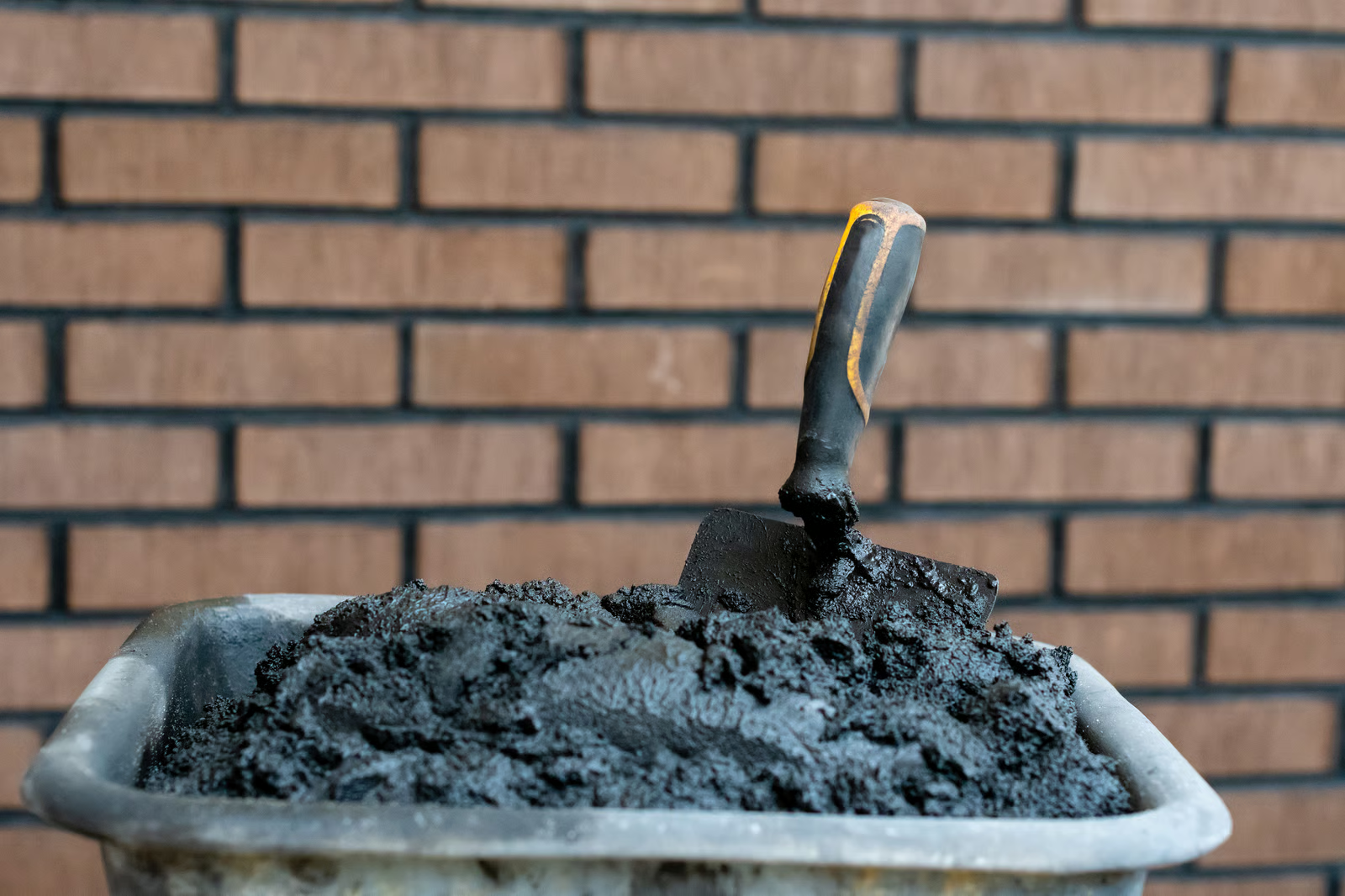
The Commission’s allegations concern ordinary building inputs, but the case sits directly inside Europe’s debate over construction costs, infrastructure spending and cartel deterrence.
The European Commission has accused construction-chemicals companies and trade associations active in France, Germany and Spain of coordinating price increases for products used in cement, concrete and mortar. Reuters reported that the Commission sent statements of objections after dawn raids in 2023 and that the companies could face fines of up to 10 per cent of global annual turnover if infringements are established.
A summary of the Commission’s position reported by EU Law Live said the suspected coordination concerned chemical additives for cement and chemical admixtures for concrete and mortar. The alleged conduct took place between 2021 and 2022, when raw-material prices were rising after the pandemic and Russia’s invasion of Ukraine.
The case is at an early procedural stage. A statement of objections is not a finding of guilt. It sets out the Commission’s preliminary concerns and gives the companies and associations a chance to reply. That distinction matters, especially in competition cases that can take years and may be contested vigorously.
EU Today recently covered Dow’s EUR1.1 billion damages claim linked to an ethylene cartel. The construction-chemicals case is different, but it belongs to the same enforcement universe: alleged coordination in industrial inputs can create financial exposure long after the period of conduct.
The economic importance comes from the products involved. Cement, concrete and mortar are basic materials for housing, roads, bridges, utilities and public infrastructure. Chemical additives and admixtures can affect performance, durability, workability and production efficiency. If prices for those inputs are coordinated illegally, the effects can move through builders, public authorities and households.
The Commission’s theory appears to focus on coordinated future price increases in the context of national trade-association communications. That is a sensitive area. Trade associations can legitimately collect data, represent members and explain market conditions. But they can also become vehicles for signalling prices, aligning behaviour or reducing uncertainty among competitors. EU competition law draws a hard line when coordination restricts competition.
The national-market structure increases the case’s significance. The alleged conduct concerns France, Germany and Spain, three large construction markets with major infrastructure and housing needs. The Commission reportedly identified different sets of companies and trade associations across the three countries, including names such as Cemex, Chryso, Mapei, Master Builders Solutions, MC Bauchemie, Sika and national trade bodies.
The timing also matters. Between 2021 and 2022, many suppliers faced genuine cost pressure. Energy, transport, raw materials and labour were all volatile. Competition law does not prevent companies from raising prices to reflect higher costs. It does prevent competitors from coordinating those increases or using associations to align market conduct. That is why the factual evidence will be decisive.
For companies, the financial risk is not limited to Commission fines. If a cartel finding is eventually adopted, follow-on damages claims can emerge from customers, public purchasers or contractors who argue that they overpaid. Construction supply chains are document-heavy, which can make damages litigation both complex and substantial.
For governments, the case lands at an awkward moment. Europe needs housing, transport upgrades, energy infrastructure and climate adaptation. Public budgets are already under pressure. Any suspicion that construction inputs were inflated through coordination will attract political attention, even before a final legal decision.
The Commission also has a deterrence interest. Cartels formed during periods of crisis can be especially damaging because firms may justify coordination as a response to shared disruption. Brussels will want to show that inflationary pressure is not an excuse for competitors to align prices.
The companies will now have the opportunity to examine the file, respond and request an oral hearing. The outcome is uncertain. But the message from Brussels is already clear: even low-profile inputs can become high-stakes competition cases when they feed into essential sectors such as construction.
The case will also be watched by public purchasers. Governments and municipalities are among the largest buyers of infrastructure and construction services, even when they do not buy chemical additives directly. If upstream costs are distorted, the bill may appear later in road projects, schools, hospitals, housing schemes and climate-resilience works. That is why cartel enforcement in basic materials has a wider public-finance dimension. It is not only about competitors behaving badly. It is about whether inflated input costs quietly reduce how much infrastructure Europe can build.