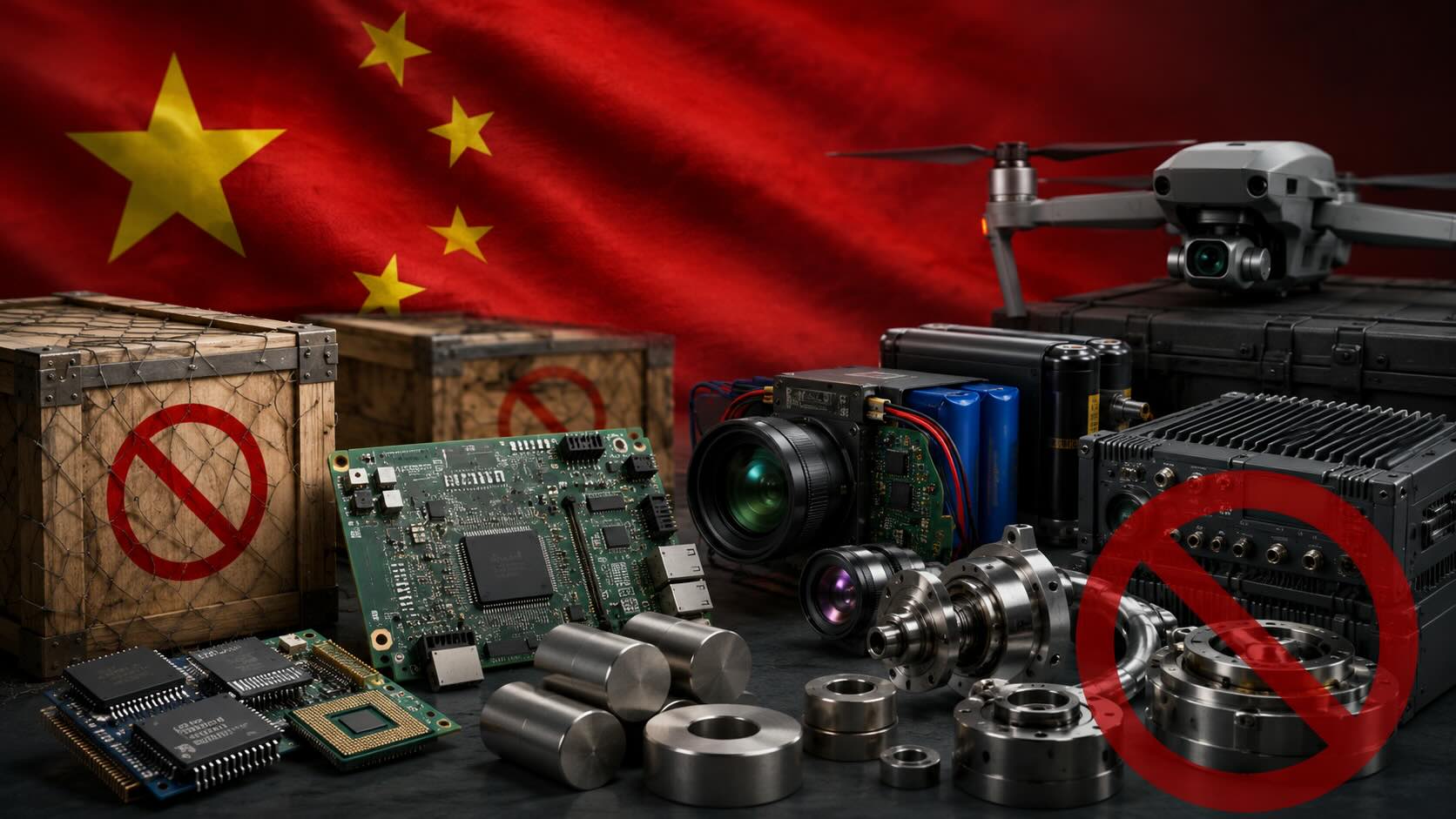
Beijing’s decision turns a sanctions dispute into a supply-chain test for European defence and technology companies, exposing how control of dual-use inputs can be used as an instrument of foreign policy.
China has placed 14 European organisations on an export-control list, restricting their access to Chinese dual-use goods and technology after the European Union included Chinese actors in its latest sanctions against Russia.
The measure, announced by China’s Ministry of Commerce on 24 July, is more consequential than a diplomatic protest. It directs Chinese exporters to stop supplying listed organisations with controlled dual-use items and requires special authorisation for transactions that might otherwise reach them indirectly.
Germany’s Rheinmetall is the best-known name affected. The group is one of Europe’s largest defence manufacturers and a central participant in the expansion of ammunition, armoured-vehicle and air-defence production prompted by Russia’s full-scale invasion of Ukraine.
The Ministry of Commerce decision presents the restrictions as a response to the EU’s 21st sanctions package. Beijing argues that the European measures damage Chinese companies’ legitimate rights and interests. The EU, by contrast, says its listings target entities assisting Russia’s military-industrial capacity or helping it evade restrictions.
That difference is not semantic. Brussels treats access to European markets and finance as leverage against support for Russia’s war. Beijing is now using its position in manufacturing supply chains to impose a direct operational cost on identifiable European businesses.
What the restriction does
China’s dual-use regime covers goods, software and technology with both civilian and military applications. Depending on the product, that can include specialist electronics, machine tools, sensors, communications equipment, advanced materials, chemicals and associated technical data.
The significance of listing does not depend on every affected company buying controlled products directly from China. Modern industrial supply chains run through distributors, subcontractors and component makers. A prohibition on direct exports, combined with controls on indirect supply, can force companies to document end users more rigorously and find alternative inputs.
The immediate impact will therefore vary. A large group such as Rheinmetall can redesign procurement and qualify new suppliers, but doing so takes time. A smaller technology business may have fewer substitutes and less bargaining power. Even when an equivalent component exists elsewhere, testing and certification can delay its use in a defence system.
The European Commission and national authorities will need to determine whether the restrictions disrupt current programmes or mainly create future compliance risk. Companies should disclose material exposure without revealing sensitive inventories or defence-production details.
EU Today has already examined Brussels’ creation of a rare-earth crisis team in response to Chinese controls. The new action advances that dispute: China is no longer applying leverage only by product category but by naming European end users.
The 14 listed organisations
The Chinese notice’s annex is the authoritative list and should be consulted for exact legal names and subsidiaries. Its inclusion of Rheinmetall gives the decision particular political weight, but the collective treatment matters just as much. Beijing is signalling that businesses associated with European security policy may be exposed even when they are not themselves responsible for EU sanctions decisions.
That creates three layers of risk.
First, there is the direct loss of controlled Chinese inputs. Second, suppliers may become excessively cautious and suspend lawful trade rather than incur compliance risk. Third, investors and customers may price in uncertainty about delivery schedules.
The indirect effect may exceed the value of the prohibited goods. Defence production depends upon assured delivery, configuration control and long-term maintenance. An inexpensive electronic component can become strategically important when replacing it requires a design change across a certified system.
Defence Matters has documented how European and Ukrainian drone production remains exposed to Chinese components. Drones are only the most visible example. The underlying problem extends to magnets, batteries, optical equipment, semiconductors and industrial machinery.
Europe’s policy dilemma
The EU cannot credibly respond by promising complete separation from China. European manufacturers continue to rely on Chinese production, while Chinese companies depend on European customers, equipment and technology. The practical objective is resilience: identifying inputs for which interruption would stop production and developing alternatives before a crisis.
That requires more than stockpiling. Reserves can bridge a temporary interruption, but they do not solve a structural embargo. European policy must support processing capacity, component production, recycling, supplier qualification and common purchasing where scale is necessary.
Brussels must also distinguish economic-security policy from indiscriminate protectionism. Subsidising every domestic substitute would be expensive and inefficient. Priority should go to bottlenecks whose loss would compromise defence readiness, critical infrastructure or essential industrial output.
There is also a legal question. European companies may challenge particular Chinese restrictions through administrative channels, while the EU can consider action under its trade-defence instruments or at the World Trade Organization. Such routes are slow, however, and they cannot replace immediate supply-chain mitigation.
Retaliation carries its own dangers. If Brussels answers every Chinese control with a symmetrical restriction, both sides could accelerate a cycle in which commercial dependence becomes a catalogue of targets. Yet failing to respond may encourage the view that European sanctions policy can be weakened by pressure on individual firms.
The most credible response combines support for affected companies, rigorous enforcement of EU sanctions and a clear offer of dialogue on transparent export-control standards.
China’s decision is therefore a test of Europe’s industrial policy as much as its diplomacy. The EU has chosen to use economic restrictions in defence of Ukraine; it must now demonstrate that its own defence industry can absorb the counter-pressure. Strategic autonomy will be measured not by declarations, but by whether named European manufacturers can continue delivering when a major supplier state closes the gate.