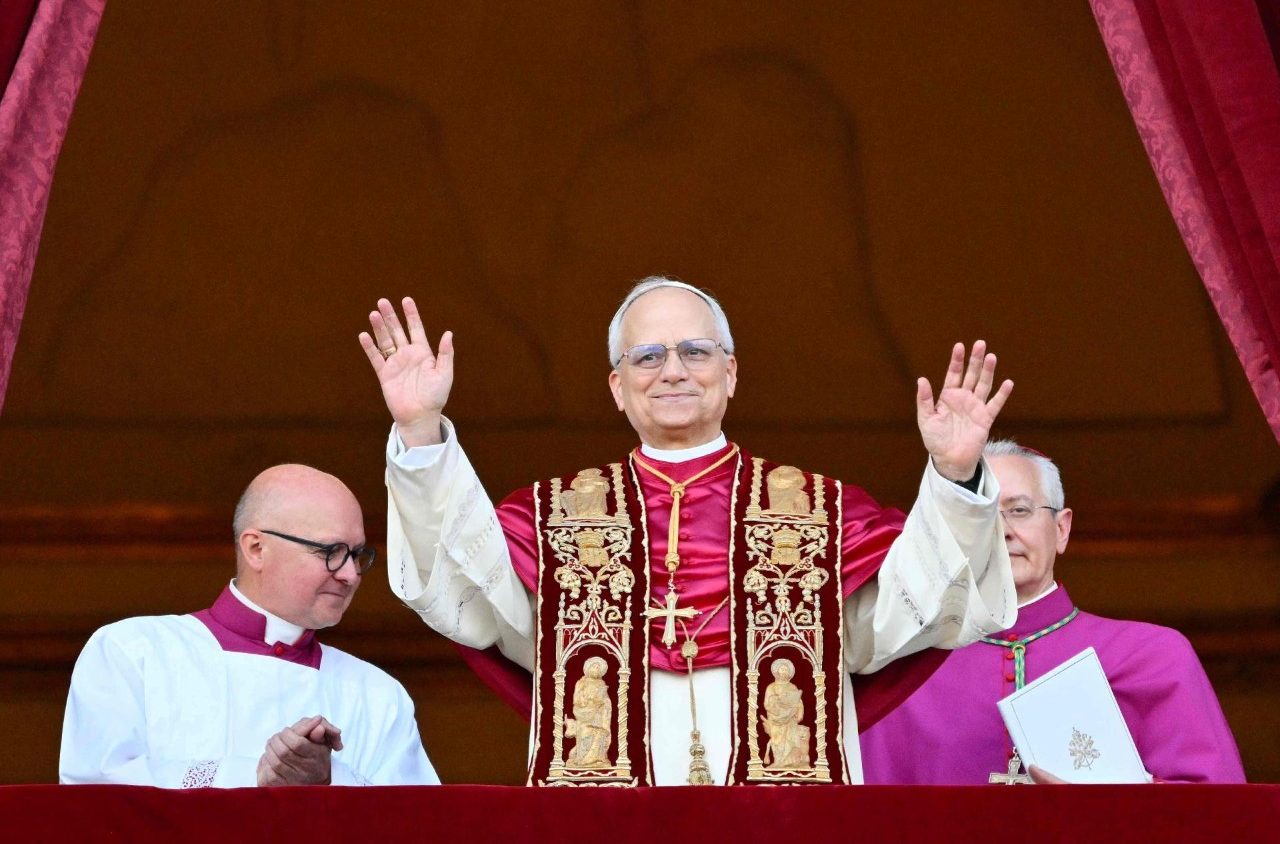
Vatican City, 8 May 2025 — Cardinal Robert Francis Prevost, a 69-year-old American prelate born in Chicago, has been elected as the 267th pope of the Roman Catholic Church.
Appearing before tens of thousands gathered on St Peter’s Square shortly after 19:00, he introduced himself to the world as Pope Leo XIV, the first pontiff in history from the United States.
The white smoke rose from the Sistine Chapel chimney at 18:03, signalling that the conclave of 133 cardinal electors had reached the required two-thirds majority. The announcement “Habemus Papam” was delivered from the central loggia of St Peter’s Basilica by Cardinal Dominique Mamberti, ushering in a new papacy after the death of Pope Francis last month.
Moments later, the new pope stepped out onto the balcony to offer his first apostolic blessing and addressed the assembled crowd with the words: “Peace be with you all”. The phrase was met with loud cheers and applause from a crowd estimated at over 40,000.
Prevost’s election marks the third consecutive conclave in which a new pope has been chosen on the second day of voting. Pope Benedict XVI was elected in 2005 after four ballots, and Francis in 2013 after five. Pope Leo XIV was elected following a similar timetable, although Vatican sources have yet to confirm the exact number of ballots cast.
A Transcontinental Ecclesiastical Career
Robert Francis Prevost was born in 1955 in Chicago and was ordained a priest of the Augustinian order in 1982. He served for over a decade in Peru, eventually becoming bishop of Chiclayo in 2014. In 2023, Pope Francis appointed him Prefect of the Dicastery for Bishops — one of the most influential roles in the Roman Curia.
Known for his administrative acumen and Latin American experience, Prevost had long been considered a quiet but serious candidate in papal succession discussions. His election appears to reflect both the globalisation of the Catholic Church and a desire among the College of Cardinals to choose a leader with direct pastoral experience in the Global South.
Pope Leo XIV is the first American and only the second pontiff from the Americas. His background in religious orders, combined with his service in the Roman Curia and pastoral work abroad, is expected to shape his approach to Church governance.
Reaction from the United States and Beyond
The news quickly prompted reactions from religious and political leaders. US President Donald Trump offered his congratulations via Truth Social, calling Prevost’s election a “great honour” for the United States and expressing his desire to meet with Pope Leo XIV soon. “It will be a very meaningful moment,” Trump wrote.
Other messages of congratulation have begun arriving from Catholic leaders across the Americas, Europe, and Africa, where Prevost is known for his missionary work and theological education initiatives. It is expected that official recognition from governments and major religious institutions will continue in the coming days.
A Papacy of Symbolism and Challenge
The choice of the name Leo evokes the memory of Pope Leo XIII (r. 1878–1903), remembered for his efforts to engage with modern social issues through the encyclical Rerum Novarum and for navigating the Church’s relationship with secular authority in an industrialising world. Observers suggest that the new pontiff may be signalling a desire to confront contemporary global challenges — including inequality, migration, and declining church attendance — through a framework rooted in Catholic social teaching.
The Church now enters a transitional period as the new pope prepares to appoint his team within the Roman Curia, manage relations with 1.3 billion Catholics worldwide, and address internal reform efforts left incomplete under Francis. Issues such as clerical abuse, financial transparency, and curial restructuring remain unresolved.
Pope Leo XIV’s installation Mass is expected to take place in the coming days. In accordance with tradition, it will be held in St Peter’s Basilica and attended by heads of state, religious dignitaries, and representatives of other faiths.
As the bells of St Peter’s continue to ring and flags are raised across Vatican City, the Church stands at the beginning of a new chapter. The pontificate of Pope Leo XIV, the first American to wear the white cassock, opens amidst high expectations and profound uncertainty — a moment of both historical significance and institutional test.
What profile Pope Leo XIV will shape for himself — and how he will navigate a deeply divided world — will become clearer in the months ahead.