Following the recognition by the United States of the Moroccan sovereignty over the Sahara, a position supported by several European countries including Germany and the Visgrad group (Poland, Czechia, Slovenia) Spain has now added its unambiguous support to the Moroccan plan.
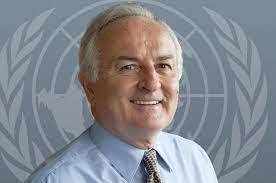
EU Today asked Bernard Miyet (pictured), former UN Under-Secretary General for Peacekeeping Operations of this fundamental European movement for his take on the current situation
“It is worth recalling,” he told us, “that as early as the year 2000 Mr. James Baker, the Special Envoy of the Secretary General of the United Nations, put forward the idea of a ‘third way’ of being aware of the impasse in which the referendum process took place.
“It took several years before a movement took shape behind the Moroccan government’s proposal for an autonomy plan in 2007, qualified as a credible and serious basis within the Security Council, although categorically rejected by the Polisario Front and Algeria.
“The recent evolution of the position of Spain, the former colonial power, may be likely to influence other European countries given the geopolitical importance of Morocco, which is a privileged partner of the European Union.
“The Kingdom of Morocco constitutes a pole of stability in the western Mediterranean in the face of the security and migratory challenges that may arise and the Europeans wish to preserve this situation. From this point of view, the tensions or difficulties encountered between or within the Maghreb countries are a source of concern, as is obviously the destabilisation of the Sahel where the jihadist groups that threaten Europe and West Africa are prospering and proliferating
“In this context, the autonomy solution could become more attractive for certain countries which are still attached to a referendum process which has been bogged down for so long.”
The fact of France’s traditional support for Morocco within the Security Council, in this context, could be a major factor in moulding a common European position. M. Miyet told us “Within the European Union, France has constantly preached the need to take into account the risks and challenges coming from both its eastern and southern flanks in order to guarantee peace and security.
“The invasion of Ukraine is an electric shock that reminds Europe of the need to strengthen ties within NATO. But it also confirms the need to have operational capabilities capable of promoting genuine European defense in order to ward off external threats. This crisis has demonstrated how much the dependence of certain European states on their natural gas and energy suppliers makes them vulnerable. Beyond the issues of the Nordstream2 project, the unilateral closure by Algeria of the gas pipeline which crosses Morocco and provides 14% of the energy needs of Spain and Portugal is also a source of questioning. Europeans must therefore be attentive to what is.”
Follow EU Today on Social media: