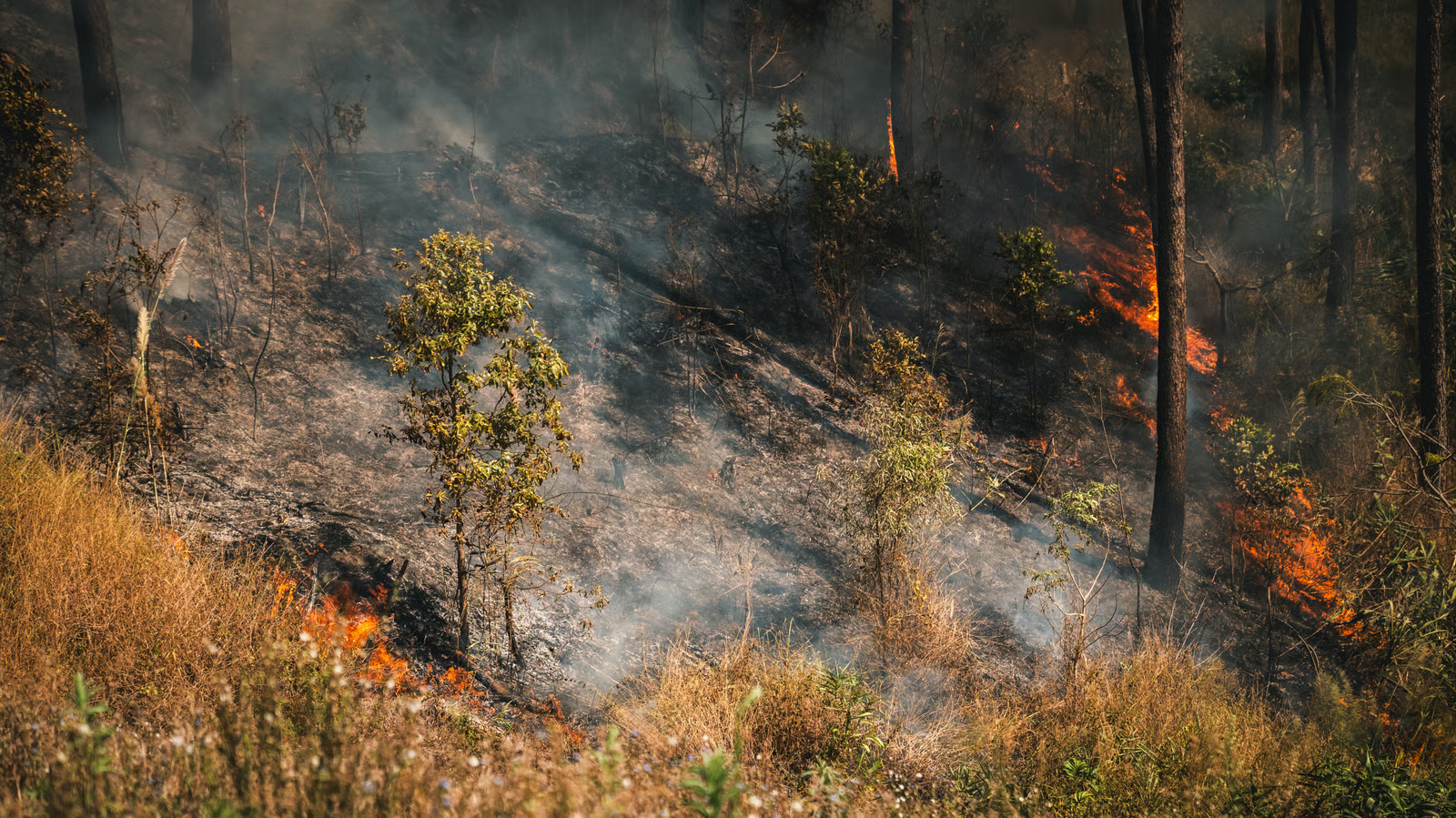
The crisis has moved beyond coastal evacuation into urban disruption and a cross-border test of Europe’s limited aircraft, crews and emergency coordination.
Wildfires moving inland towards Bordeaux have forced further evacuations and the closure of the city’s airport, while Spain has declared a national wildfire emergency and sought European firefighting support.
The escalation changes the nature of the crisis. Fires that initially threatened coastal communities and tourist areas are now affecting a major transport hub and testing whether France, Spain and the European Union can sustain simultaneous large operations.
French authorities have deployed armed-forces personnel in support roles, while national and European aircraft are being allocated across the affected region. Spain’s emergency declaration strengthens central coordination and enables national resources to be directed where regional capacity is overwhelmed.
Figures for evacuations, burned area and aircraft change rapidly. They should be attributed to the responsible authorities and updated before publication rather than treated as final totals.
Bordeaux becomes an operational problem
Closing an airport protects passengers and gives emergency services room to operate, but it also removes transport capacity that may be useful for evacuation, logistics and personnel rotation.
Smoke reduces visibility and can contaminate runways or aircraft systems. Fire near approach paths can make safe operations impossible even when terminals are not directly threatened. Authorities must also preserve airspace for firefighting aircraft, which operate at low altitude and require separation from commercial traffic.
The economic consequences extend beyond cancelled flights. Hotels, road networks, freight movements and regional tourism are affected as evacuees and visitors change plans simultaneously.
EU Today’s previous analysis of the Cap Ferret evacuation and Europe’s wildfire-capacity problem identified the danger of multiple countries needing the same scarce aircraft. The movement towards Bordeaux makes that concern immediate.
Spain’s national emergency
Spain’s autonomous communities normally lead wildfire response, supported by national ministries and military emergency units. A national declaration provides a framework for managing an event whose scale crosses regional boundaries.
It does not mean local command disappears. Effective response depends on combining municipal knowledge, regional firefighting services, national assets and European assistance without creating competing chains of command.
The priority is life safety: evacuation routes, warnings, protection of hospitals and care homes, and support for people unable to leave independently. Authorities should communicate in several languages in tourist areas and provide accessible shelter information.
Evacuation numbers demonstrate scale but not success by themselves. Plans must account for return, property security, animal care and the medical needs of displaced residents.
The European mechanism
The Commission’s 2026 wildfire overview says the rescEU and European Civil Protection Pool capacity includes 22 aircraft, five helicopters and 777 firefighters from participating countries.
Those numbers are meaningful but not unlimited. Aircraft require crews, maintenance, fuel and suitable bases. Weather can ground them. A plane committed to France cannot simultaneously assist Spain, Portugal or Greece.
The Emergency Response Coordination Centre matches national requests with available offers and strategic reserves. It should prioritise according to threat to life and expected operational effect, not political visibility.
European solidarity also depends on national services retaining enough capacity at home. A country facing extreme fire weather may hesitate to release aircraft even before a major blaze begins.
Military support
Armed forces can supply helicopters, transport, engineering equipment, medical support and personnel. Their command discipline and logistics are valuable during a prolonged emergency.
Military deployment is not a substitute for professional wildfire services. Soldiers require task-specific training and should not be placed on active fire lines without appropriate equipment. Their strongest contribution may be transport, route clearance, communications and relief of exhausted civilian crews.
The deployment also raises endurance questions. If fires continue for weeks, governments need rotation plans and reserves for other emergencies.
Prevention and land management
Extreme heat, drought and wind can make fires uncontrollable, but damage is shaped by land use, building standards and preparedness.
Fuel breaks, vegetation management and prescribed burning reduce risk when conducted under safe conditions. Communities need defensible space around buildings, reliable water supplies and evacuation routes capable of carrying seasonal populations.
Prevention often receives less political attention than aircraft purchases because its success is an event that does not happen. Funding should be evaluated across the entire cycle: prevention, preparedness, response and recovery.
Planning rules also matter. Rebuilding in the same exposed locations without stronger standards reproduces vulnerability. Insurance pricing can encourage adaptation but must not leave lower-income residents without protection.
Public information
Fast-moving fires generate rumours about road closures, arson and evacuation orders. Authorities should publish geolocated alerts, time-stamped maps and clear sources.
Social-media videos can help identify fire movement but can also show old or unrelated scenes. News organisations should verify location and date before use.
Air-quality guidance is essential beyond the immediate fire zone. Smoke affects people with respiratory and cardiovascular conditions and can travel far from visible flames.
The capacity test
France and Spain are two of Europe’s largest states and both possess substantial firefighting resources. Their simultaneous need demonstrates why national capacity alone cannot cover every extreme season.
The EU should review whether its reserve is large enough for correlated climate emergencies, when several countries experience the same heat and wind pattern. More aircraft may be necessary, but so are common maintenance, crew training and pre-positioning.
Once the immediate danger recedes, an independent operational review should examine warning times, evacuation, airport closure, resource requests and cross-border deployment.
The closure of Bordeaux airport is a visible sign of escalation. The deeper issue is whether European systems can continue protecting people when several large emergencies compete for the same specialised assets. This season is no longer testing one fire service. It is testing the architecture of European civil protection.