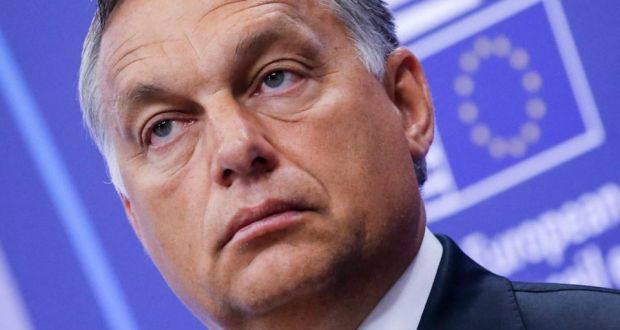
Thursday’s announcement by Foreign Minister Péter Szijjártó that Budapest could host possible peace talks between Russia and Ukraine – potentially including U.S. President Donald Trump – is merely the latest act in Viktor Orbán’s theatre of opportunism.
It is a performance that may or may not find an audience in Washington – in Moscow it certainly will – but it should provoke serious concern in Brussels, Kyiv, and beyond.
Szijjártó’s remarks, broadcast on Facebook, came as speculation swirled that the White House was considering Hungary as a venue for a trilateral meeting between Trump, Vladimir Putin, and Volodymyr Zelensky. On the surface, it is an offer wrapped in diplomatic courtesy – an EU member state extending hospitality for the cause of peace.
But beneath it lies the awkward reality that Budapest has long functioned as Moscow’s most reliable friend inside the European Union. To accept Orbán’s offer would be to risk giving Russia a propaganda coup while undermining Europe’s own cohesion.
Hungary’s strategic positioning
Orbán has for years carved out a role as the EU’s chief dissenter. Whether on sanctions against Moscow, aid for Kyiv, or support for EU migration policy, Budapest has routinely obstructed consensus. Hungary’s warm ties with the Kremlin are not hidden but openly celebrated. Orbán has courted Russian energy, maintained a friendly line with Moscow even after the invasion of Ukraine, and presented himself domestically as a lone defender of Hungarian interests against Western diktat.
Against this backdrop, a peace summit in Budapest would inevitably be seen as legitimising Hungary’s equivocal stance. Far from projecting neutrality, it would suggest that one of Putin’s most reliable interlocutors within the EU had been rewarded with a central role in ending the war. For Ukraine, that would be a bitter pill to swallow. For the EU, it would be a dangerous precedent.
Trump, Putin and Zelensky: the symbolism of location
The question of venue for high-level summits is never trivial. In Dayton in 1995, the neutral terrain of a U.S. Air Force base provided the stage for a Balkan settlement. In Helsinki, in 2018, Trump and Putin sought to present themselves as equals on neutral ground. To gather in Budapest, however, would send a very different signal: that Hungary – a state at odds with its own EU partners, often accused of democratic backsliding, and openly sympathetic to Moscow – had been chosen as the arbiter of peace in Europe’s most brutal conflict since 1945.
Trump may see tactical value in such symbolism. Orbán is one of the few European leaders who openly supported his previous election campaigns and who continues to align himself with Trump’s brand of nationalism. For Putin, the image of a summit in a friendly EU capital would serve as proof that his isolation is cracking. But for Zelensky, whose country relies on Western unity for survival, the optics would be dire.
Brussels’ leadership vacuum
The dilemma is compounded by the European Union’s own lack of direction. In principle, Brussels ought to be setting the tone for European involvement in any peace process. In practice, the EU is poorly led, saddled with a Commission under Ursula von der Leyen that has been more concerned with lofty rhetoric than hard power.
Von der Leyen presents herself as a wartime leader, yet her influence outside Brussels is negligible. Few beyond the Berlaymont could identify her as a pivotal figure in transatlantic diplomacy, and even within the Union she inspires little confidence. Her Commission has failed to command credibility in Kyiv, Washington or Moscow. The absence of a coherent European strategy has left a vacuum into which Orbán has eagerly stepped.
This leadership deficit is not new, but it has rarely been more stark. The EU proclaims itself a geopolitical actor, yet when it comes to peace talks about a war on its own continent, the possible venues discussed are Washington, Anchorage, and Budapest. Brussels, with all its institutional machinery, is nowhere to be seen. Von der Leyen may issue stern statements and promise that Europe stands firm, but the fact that Hungary – a member state openly undermining EU unity – can plausibly insert itself into such a conversation is proof of how irrelevant the Commission has become.
Risks for Ukraine
For Zelensky, engaging in talks hosted by Hungary would carry significant political risk. Kyiv has consistently accused Budapest of undermining sanctions and obstructing aid packages. Accepting Hungary as a mediator could be perceived domestically as a capitulation, while internationally it would dilute Ukraine’s appeal for European unity. Far from securing guarantees, it would risk entrenching divisions within the West.
Moreover, any deal struck in Budapest would be vulnerable to charges of bias. Russia would celebrate the choice of venue as a symbolic concession. Hungary would parade its role as validation of Orbán’s obstructive diplomacy. The EU would be left looking divided, as indeed it is, with its most wayward member basking in undeserved legitimacy.
Europe’s choice: unity or appeasement
The debate over Hungary’s role reveals deeper questions about Europe’s resolve. Does the EU wish to present a united front, in which Brussels and credible neutral states coordinate a peace process? Or will it allow Orbán to hijack the agenda, offering his capital as a stage for leaders who care little about the Union’s collective strength?
Accepting Hungary’s offer would be unwise. It would undermine the EU’s position, embolden Orbán, and give Putin an unnecessary advantage. A genuine peace process requires venues that embody neutrality and credibility, not capitals whose leaders have spent years cosying up to the Kremlin.
Péter Szijjártó may present Budapest as a convenient host for history-making talks, but the reality is less flattering. Hungary has no claim to neutrality, no record of constructive mediation, and no credibility as a guarantor of European security. Its offer is not an act of magnanimity but of self-interest, designed to elevate Orbán’s standing while embarrassing Brussels. The fact that the proposal is even being discussed reflects the EU’s wider malaise – a Union adrift, led by a Commission president whose influence scarcely registers outside Brussels.
If Europe wishes to matter in the search for peace, it must look elsewhere. To indulge Orbán’s ploy would be to concede not just the stage to Moscow’s ally, but the future of Europe’s credibility along with it.
__________________________________________________________________________________________________________________________
READ ALSO: VON DER LEYEN’S OVAL OFFICE VISIT LAYS BARE EUROPE’S POWER VACUUM

The scene was emblematic of von der Leyen’s broader predicament.
She presides over an institution that styles itself as the executive of a continent but is, in practice, an unelected bureaucracy whose pronouncements echo loudly only within the EU’s own bubble. When she appears abroad, there is a whiff of theatre without substance, ceremony without consequence.
__________________________________________________________________________________________________________________________